Failed Experiments · Chemistry
Smell-O-Vision: The Movie That Hissed Perfume at Its Audience and Left Them Sniffing
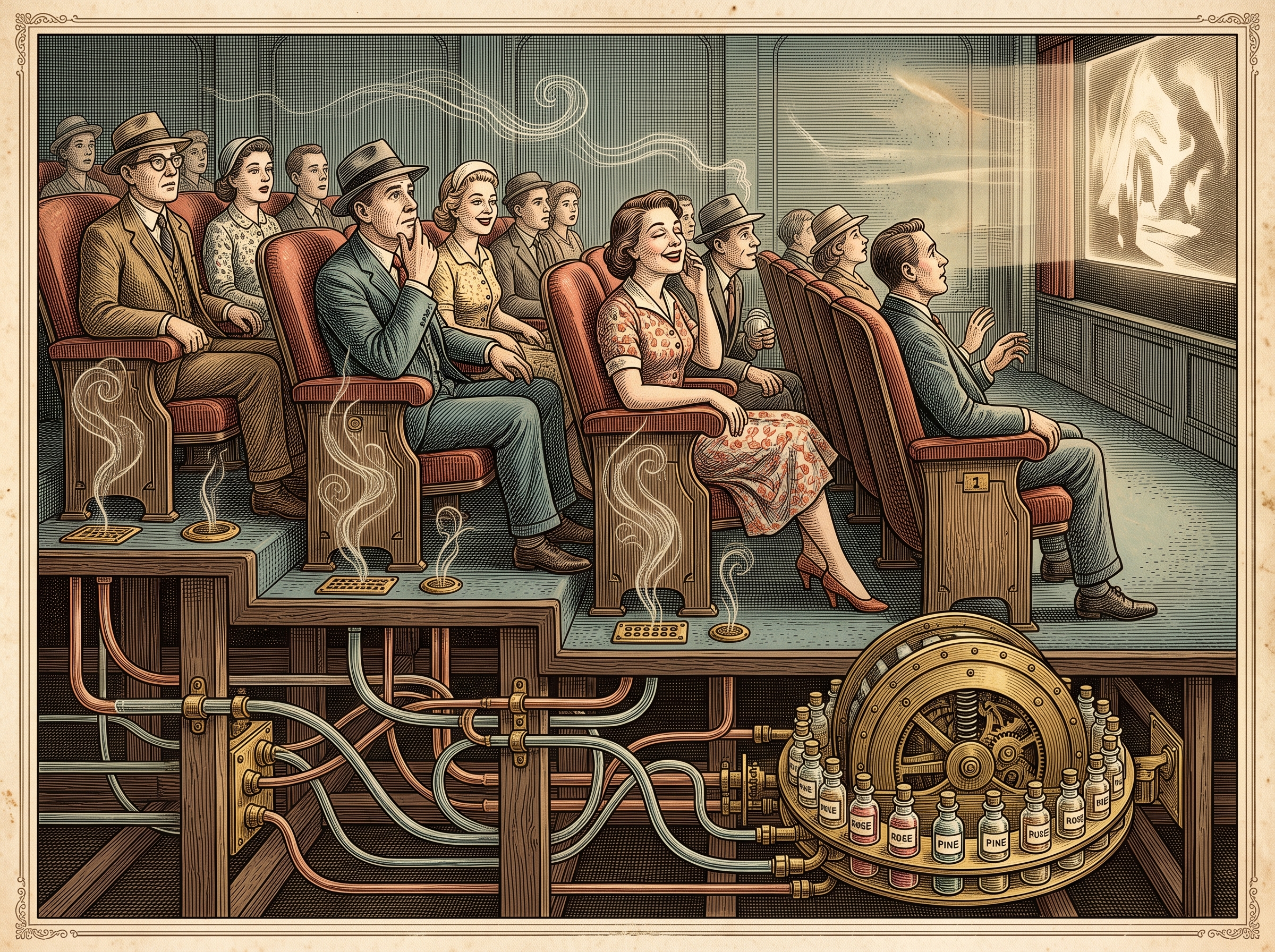
On January 6, 1960, at the Cinestage Theatre in Chicago, a murder mystery began and the seats started to hiss. Hidden tubes under every chair were pushing out puffs of perfume, coffee, and pipe tobacco, timed to match the film. In the balcony, the smells arrived a few seconds after the action they belonged to. Elsewhere, they were so faint that people leaned forward and sniffed loudly, trying to catch a whiff of the plot.
By the Curiosities Desk · · 5 min read · Filed under Chemistry · Today’s round
What happened?
The idea was older than the film. Swiss inventor Hans Laube had shown a system he called “Scentovision” at the 1939 New York World’s Fair, with pipes running to individual seats so a projectionist could control when and how much of each smell arrived. He couldn’t sell it to the studios, and in 1946 he went back to Europe.
Showman producer Mike Todd met Laube at the fair and remembered him. Todd considered using the system for Around the World in Eighty Days (1956) but passed. After Todd died in 1958, his son, Mike Todd Jr., signed Laube up, renamed the process “Smell-O-Vision,” and built a whole movie around it.
That movie was Scent of Mystery, directed by Jack Cardiff and shot across Spain in 1959. Denholm Elliott played an English tourist trying to stop a plot to kill an American heiress; Peter Lorre played his cab driver; Elizabeth Taylor, Todd Jr.'s stepmother, made an uncredited cameo. The smells weren’t just decoration. They carried clues. The killer was identified by the smell of his pipe tobacco, and the heroine by her perfume. When wine casks rolled down a hill and smashed, a grape aroma was cued. One critic wrote that the hero’s coffee smelled like coffee, but when the villain sipped his cup, the audience smelled brandy.
The hardware was clever. Laube’s “smell brain” held perfume containers on a belt wound around a motorized reel. Markers on the film cued the reel, needles pierced each container, and fans blew the scent through tubing to vents under each seat. Todd estimated the setup cost $25 to $30 per seat, at a time when a movie ticket cost under a dollar.
Then a rival got there first. In December 1959, about a month before Todd’s premiere, a public-relations man named Charles Weiss opened Behind the Great Wall in New York with a competing process called AromaRama, which blew smells through the theater’s air conditioning. Variety dubbed the race “the battle of the smellies.” New York Times critic Bosley Crowther called AromaRama a “stunt,” and the press arrived at Scent of Mystery already expecting the worst.
The Chicago reviews confirmed it. Variety’s Hy Hollinger reported the distracting hiss, the late-arriving smells upstairs, and the loud sniffing. An Associated Press critic liked the “easily recognized” smells, like perfume, mint, wood shavings, and roses, but found others, like pipe smoke, shoe polish, and horses, “well nigh nauseating.” Director Cardiff later recalled that samples Laube sent during filming all smelled “exactly the same as the others – like a very cheap eau de cologne.”
The engineers fixed most of the problems within a few showings. Todd Jr. later said his press agent thought of reversing the pump to suck each smell back out before the next one arrived, and that it “worked perfectly, but by that time the ship had sailed.” The film earned about $300,000 in U.S. and Canadian rentals. It was later cut down, stripped of its smells, and re-released as Holiday in Spain.
Why was it strange?
Movies had learned to add sound and color by putting more information on the film strip. Light and sound travel fast enough to reach every seat at essentially the same moment. Smell does not work that way, because a smell is not a signal. It’s a physical cloud of molecules that has to travel to your nose and then be cleared away again.
That made Smell-O-Vision a strange kind of experiment: a chemistry problem dressed as show business. Every scene change asked the theater to remove one cloud of molecules from the air and deliver a new one to hundreds of noses on time. Without the reverse pump, the old smells simply drifted into the new ones. Laube’s daughter later claimed the producers cut corners on his design and dropped the “neutralizer” he meant to send between scents. That’s her account, not something the record confirms, but it points to the same weak spot.
Another experiment that taught more by not working: The 12-Foot Weed Thomas Edison Bred to Make Car Tires.
What did scientists learn?
Smell is a chemical sense. Odor molecules have to be volatile, meaning they evaporate easily into the air, and then they bind to receptors in the nose. Humans have roughly 400 types of working smell receptors, and a single scent usually triggers a combination of them. That’s one reason a mixture of leftover smells comes across as a muddle rather than two clear notes.
Timing is the other problem. Odor molecules spread by drifting and diffusing, which is slow compared with sound. They also cling to fabric, carpets, and skin. And noses adapt: after a few breaths of the same smell, your brain turns down the volume, a process called olfactory adaptation. So a scent that arrives late, lingers, or blends into the next one fights human biology on three fronts at once.
Later attempts quietly solved the problem by making the delivery personal. John Waters’s Polyester (1981) handed out scratch-and-sniff cards with numbered spots, so each viewer released one smell, right under their own nose, on cue.
Another ambitious failure: The Chemist Who Failed to Make Diamonds — and Got the World’s Favorite Fake One Named After Him.
How does it affect us today?
Scent never went away. It shrank. Theme-park rides and “4D” cinemas now release short, targeted bursts of smell, like orange blossoms or pine, alongside moving seats and wind, often in smaller rooms where airflow is easier to control. Researchers keep trying to build devices that release smells on demand for screens and virtual reality, and they keep running into the same questions Laube faced: how to deliver a smell fast, and how to make it go away.
In 2015, film producer Tammy Burnstock and scent artist Saskia Wilson-Brown revived Scent of Mystery with newly blended smells. No formulas survived, only a list with entries like “happy odor of baking bread” and “the faint smell of a yellow rose,” so Wilson-Brown recreated them by hand.
A close cousin: Polywater: The New Form of Water That Almost Ate the World.
Fun fact
Scent of Mystery was shown with a cartoon called Old Whiff, about a bloodhound who had lost his sense of smell. Comedian Henny Youngman is credited with the best review of the main feature: “I didn’t understand the picture. I had a cold.”
Sources
- Hollinger, Hy. “Film Review: Scent of Mystery.” Variety, January 1960.
- American Film Institute. “Scent of Mystery (1960).” AFI Catalog of Feature Films.
- Gross, Daniel A. “The Third Sense.” Distillations, Science History Institute, 2017.
- Frumkes, Roy. “An Interview with Mike Todd Jr.” in70mm.com, 1995.
- Burnstock, Tammy. “Jack Cardiff about ‘Scent of Mystery.’” in70mm.com (1986 interview).