Failed Experiments · Chemistry
The 12-Foot Weed Thomas Edison Bred to Make Car Tires
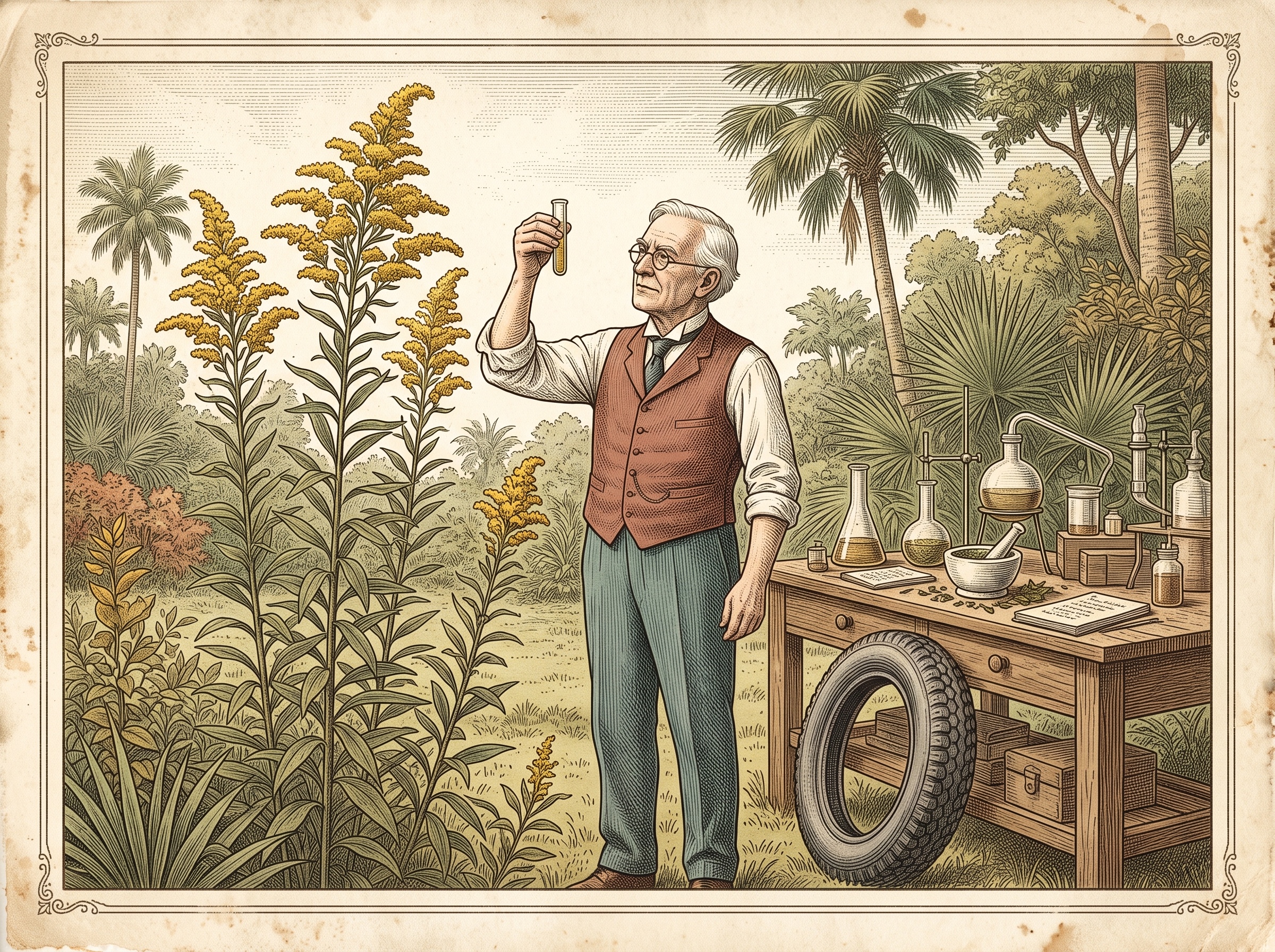
In 1929, the most famous inventor in America was spending his winters in Florida doing something that looked a lot like gardening. Thomas Edison, the man behind the phonograph and the practical light bulb, had rows of his wife's citrus trees cleared to make room for a roadside weed. His plan was to grow goldenrod taller than a person, grind it up, and pull car tires out of it.
By the Curiosities Desk · · 5 min read · Filed under Chemistry · Today’s round
What happened?
The worry started during World War I. Every tire on every American car depended on natural rubber, and nearly all of it came from plantations in Southeast Asia controlled by British and Dutch colonial interests. Edison and his two famous friends, carmaker Henry Ford and tire maker Harvey Firestone, kept coming back to the same uneasy question: what happens to American roads if a war cuts off that supply?
In 1927, the three men decided to find out whether the United States could grow its own. Each put in $25,000 to create the Edison Botanic Research Corporation, and in 1928 a laboratory went up beside Edison’s winter home in Fort Myers, Florida. Edison, then in his eighties, threw himself into it with the same trial-and-error stubbornness he had once spent on light-bulb filaments.
The search was enormous. Collectors gathered trees, vines, shrubs, and weeds across the country, especially in the South. According to the estate’s horticulture staff, even Union Pacific Railroad section chiefs were asked to clip plants along their rights-of-way and mail them in. Each sample was dried, ground, and chemically tested for latex, the milky fluid that rubber is made from. By the end of 1929, Time magazine reported that Edison had examined 16,000 American plants and found traces of rubber in 1,200 of them. The final tally passed 17,000.
The winner was not an exotic tree. It was goldenrod (genus Solidago), the yellow-flowered weed that lines ditches and empty lots across North America. One species in particular, Solidago leavenworthii, held more rubber than the rest. Edison shipped tons of goldenrod stalks south, reportedly planted hundreds of test plots on the estate, and began cross-breeding and fertilizing the plants for size and yield. The results were impressive for a weed: plants that grew as tall as 12 feet and held up to about 12 percent rubber, roughly double the yield of the wild plant. A variety was named Solidago edisoniana in his honor.
Rubber, though, is not just a yield. It has to perform. Shortly before Edison died on October 18, 1931, he was handed a small piece of rubber made from his goldenrod. Popular accounts say Ford later had a set of Model T tires made from it, though that story is better described as a well-loved tradition than a documented test. After Edison’s death, his family kept the lab running until the mid-1930s, when the project passed to the U.S. Department of Agriculture. Government scientists kept studying goldenrod for years, but it never reached a tire factory.
Why was it strange?
Edison was right about almost everything except the plant. The crisis he feared arrived exactly as predicted. When Japanese forces swept across Southeast Asia in early 1942, a later USDA report noted, the United States lost “practically its entire source of rubber imports almost overnight.” The nation had stockpiled roughly a single year’s worth of rubber.
And yet, at the moment Edison’s research should have paid off, goldenrod was nowhere in the rescue plan. The government’s emergency farm effort bet on guayule, a desert shrub that had already been used for rubber for decades. The real answer, though, came from chemists building synthetic rubber out of petroleum in giant new factories. Edison found the best rubber weed in America, and the country ended up not needing a weed at all.
The same thread — Thomas Edison — continues in The Talking Doll Edison Built With a Phonograph in Its Chest — and Pulled From Stores Within Weeks.
What did scientists learn?
Natural rubber is a polymer, a molecule built from thousands of small repeating units linked into long chains. Long chains are what make rubber stretchy, tough, and springy. Many plants make some rubber, but not all plant rubber is created equal.
Goldenrod stores its rubber in scattered spots inside its leaves rather than in a flowing latex you can tap like a rubber tree. Getting it out means harvesting and processing the whole plant. What comes out is soft and tacky, and it arrives mixed with natural resins that have to be removed before the rubber will harden. In practice, that meant more work and more cost for a weaker material than plantation rubber.
The project also showed the limits of brute-force testing. Edison’s method, try everything and keep what works, was brilliant at narrowing 17,000 candidates down to one. It could not change the underlying chemistry of that one.
Elsewhere in chemistry: The Hot Stove Accident That Invented Modern Rubber.
How does it affect us today?
The fear that started it all never went away. Natural rubber is still essential for products like heavy-duty and aircraft tires, and most of it still comes from a narrow band of tropical countries. Researchers are still looking for a homegrown backup, and the plant they keep returning to is the one Edison’s government successors chose: guayule.
In a neat bit of continuity, the tire company bearing Harvey Firestone’s name ran IndyCar race tires containing guayule rubber at the 2022 Music City Grand Prix in Nashville, made with shrubs from a Bridgestone research farm in Eloy, Arizona. The Fort Myers laboratory, meanwhile, was named a National Historic Chemical Landmark by the American Chemical Society in 2014. Its equipment is still in place, along with a 12-foot goldenrod stalk.
Another experiment that taught more by not working: Smell-O-Vision: The Movie That Hissed Perfume at Its Audience and Left Them Sniffing.
Fun fact
Goldenrod often takes the blame for late-summer hay fever, but it is largely innocent. Its pollen is heavy and sticky and is carried by insects. The usual culprit is ragweed, which blooms at the same time and throws its light pollen into the wind.
Sources
- Edison Botanic Research Laboratory — Edison and Ford Winter Estates (founding in 1927, 17,000+ plant samples, transfer to USDA)
- “Science: Goldenrod Rubber” — Time, December 16, 1929 (contemporary report: 16,000 plants examined, 1,200 with traces of rubber)
- In Search of Thomas Edison’s Botanical Treasures — New York Botanical Garden (herbarium specimens, Solidago edisoniana, USDA continuation)
- The Emergency Rubber Project: A Report on Our Wartime Guayule Rubber Program — U.S. Department of Agriculture, Forest Service, 1946 (primary source on the 1942 rubber crisis)
- Goldenrod rubber — CAMEO materials database, Museum of Fine Arts, Boston (properties of goldenrod rubber)