Failed Experiments · Engineering
The Talking Doll Edison Built With a Phonograph in Its Chest — and Pulled From Stores Within Weeks
In April 1890, a Boston toy dealer named Horace Partridge & Co. sent Thomas Edison's company a polite but worried letter: "We are having quite a number of your dolls returned to us and should think something was wrong." Something was. Inside each porcelain-headed doll sat a tiny phonograph, and the dolls were coming back with loose works, no voice at all, or — in one case from Salem — a voice that faded over about an hour until no one could make out a word it said.
By the Curiosities Desk · · 5 min read · Filed under Engineering · Today’s round
What happened?
Edison invented the phonograph in 1877, and the idea of a doll that could talk followed close behind. By the fall of 1888 his laboratory in West Orange, New Jersey, had a working prototype that played a small, ring-shaped record made of solid tin. That November the New York Evening Sun reported that the dolls had been “perfected” and that only mass production remained.
Mass production turned out to be the hard part. The Edison Phonograph Toy Manufacturing Company, a separate firm headed by William W. Jacques, ordered doll bodies and bisque heads from German factories in Thuringia, while workers at the Edison Phonograph Works assembled the talking mechanisms. Partway through development the records switched from tin to wax; historians still aren’t sure why.
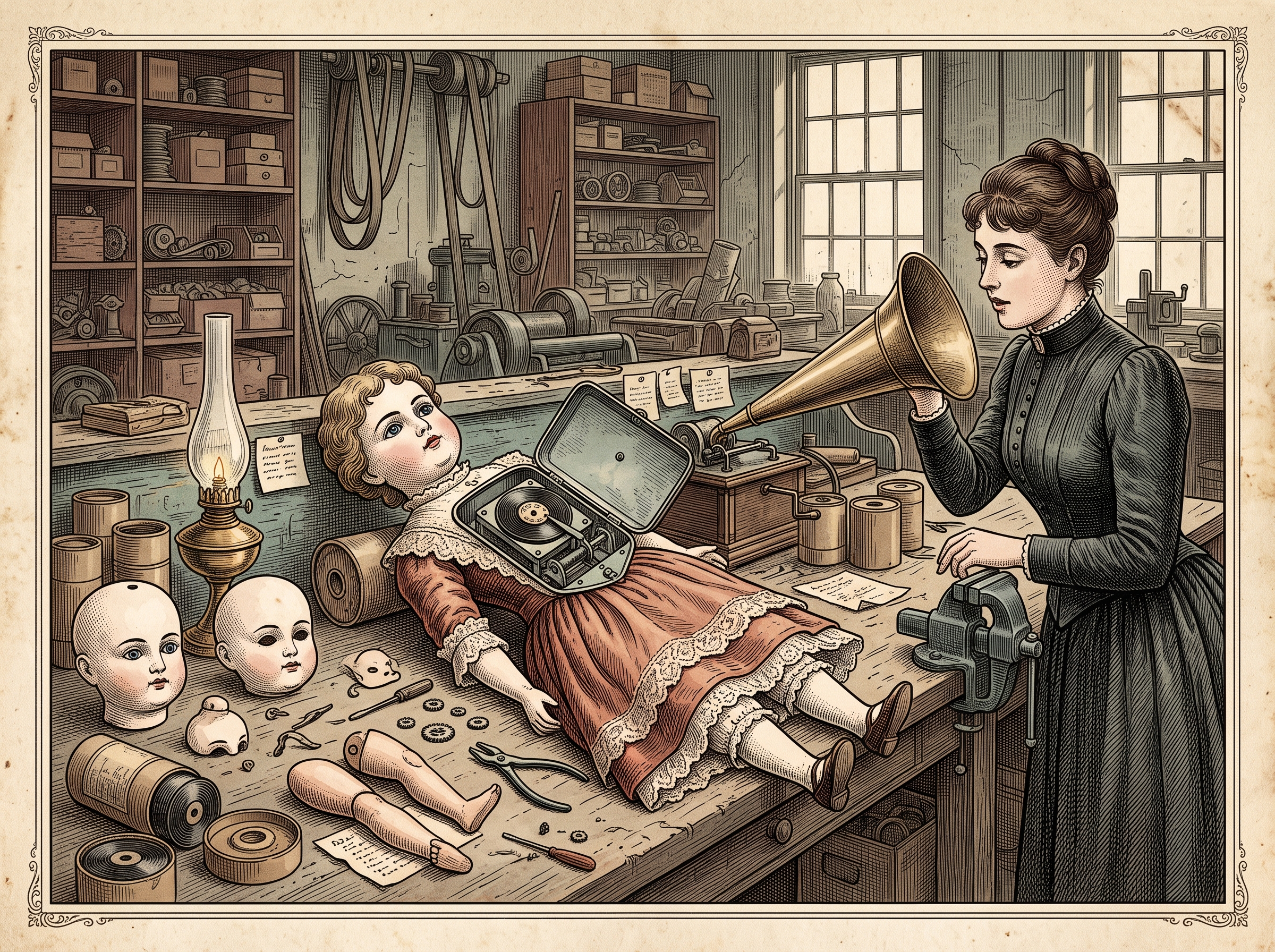
The finished doll stood 22 inches tall and weighed about four pounds. It had a porcelain head, jointed wooden limbs, and a tin torso that held the phonograph. A child turned a crank on the doll’s back, and a steel needle traced the groove of a wax ring, playing a single nursery rhyme — “Twinkle, Twinkle, Little Star,” “Jack and Jill,” “Little Jack Horner,” and others — for about 20 seconds.
There was no way yet to copy a recording, so every doll needed its own original. According to the Smithsonian, perhaps as many as 18 young women sat in factory cubicles reciting rhymes into recording machines, one doll at a time.
The dolls began leaving West Orange in early April 1890. They cost $10 undressed and $20 dressed, which Smithsonian magazine calculated as roughly $237 and $574 in 2015 dollars. Reviews were cool. One newspaper described the recorded voices as a “flat, uninflected whine,” and the Washington Post ran the headline “Dolls That Talk: They Would Be More Entertaining if You Could Understand What They Say.”
Then the returns began. Customers complained that the crank was easy to lose, the needle easily knocked out of place, and the wax records prone to breaking. Production, which had started in February, halted in early May 1890 — the dolls had been on sale for only a few weeks.
The paper trail shows how badly the numbers went. A year later, in May 1891, Edison’s secretary Alfred O. Tate reported that the toy company had accepted 10,060 finished dolls from the Edison works and still had about 7,500 sitting in storage, plus some 253 cases of unassembled German heads, arms, and legs. That means no more than about 2,560 ever left the building, and the Smithsonian estimates fewer than 500 reached actual customers. By the fall of 1890 the toy company was more than $50,000 in debt and couldn’t get a loan to build a better version.
Why was it strange?
This was not a failure of the big idea. The phonograph worked; the doll talked. The trouble was everything around it: a delicate recording mechanism packed inside a toy meant to be hugged, dropped, and dragged across floors. Edison could make a machine that captured a human voice, but he hadn’t yet made one that could survive a child.
It also flipped the usual order of invention. Recorded sound was barely a decade old, and one of the very first attempts to sell it to ordinary families wasn’t music or speeches — it was a nursery rhyme coming out of a doll’s chest. Historian Paul Israel, director of the Thomas A. Edison Papers, has suggested that Edison simply didn’t understand consumer markets very well. Smithsonian magazine reports that Edison himself came to call the dolls his “little monsters.”
The same thread — Thomas Edison — continues in The 12-Foot Weed Thomas Edison Bred to Make Car Tires.
What did scientists learn?
The first lessons were about engineering for real-world use. Wax was soft enough to record on but fragile enough to crack in shipping. A needle that could read a groove only fractions of a millimeter wide was also easy to knock loose. Reliability, durability, and cost mattered as much as whether a device technically worked — a lesson Edison’s phonograph business would keep relearning as it moved toward mass-produced, copyable cylinders in later years.
The second lesson came more than a century later, and it was about preservation. Surviving doll records were too fragile, or too warped, to play with a needle without risking damage. In 2011, physicist Carl Haber and engineer Earl Cornell at Lawrence Berkeley National Laboratory used a 3D optical scanning method — developed with the Library of Congress — to map the surface of an 1888 tin doll record that had been bent out of round. Software then turned the microscopic hills and valleys of the groove into sound. They recovered an unidentified woman reciting “Twinkle, twinkle, little star,” missing only the first syllable. By April 2015, eight doll recordings, including six wax ones lent by private collectors and the Smithsonian, had been digitized the same way.
Another experiment that taught more by not working: The Railway That Ran on Suction — and the Rats Blamed for Eating It.
How does it affect us today?
That no-contact scanning approach, known as IRENE, is now one of the tools archivists use to rescue sound from broken, warped, or too-precious-to-play recordings. The doll records helped prove it could pull voices back from objects nobody dared touch.
The doll also left a more personal legacy. Historian Patrick Feaster of Indiana University notes that the women Edison hired were the first people known to be employed specifically to perform for the phonograph — arguably the world’s first professional recording artists. Every voice actor, audiobook narrator, and the recorded voice in a train station or a car’s GPS traces their job back to those cubicles in West Orange.
And the doll itself survives as a museum lesson. One, donated in 1937, is displayed at the Smithsonian’s National Museum of American History, where curator Peter Liebhold has called it a failure “by one of the deities of invention.”
Another ambitious failure: The Windows That Took the Blame for a Plane Crash They Didn’t Cause.
Fun fact
The only known talking doll record from 1888 wasn’t found in a doll at all. National Park Service curators cataloged it in 1967 after finding it in the desk of Edison’s longtime secretary, William H. Meadowcroft, with a paper tag still tied to it. The voice on it went unheard for more than 120 years.
Sources
- Talking Doll FAQ: Industrial Production — Thomas Edison National Historical Park, National Park Service (production records from Charles Batchelor’s journal and A. O. Tate’s 1891 inventory)
- Early Talking Doll Recording Discovered — Thomas Edison National Historical Park, National Park Service (2011 optical recovery of the 1888 tin record)
- Hear Edison Talking Doll Sound Recordings — Thomas Edison National Historical Park, National Park Service
- Dawson, V. (2015). The Epic Failure of Thomas Edison’s Talking Doll. Smithsonian Magazine