Failed Experiments · Engineering
The Windows That Took the Blame for a Plane Crash They Didn't Cause
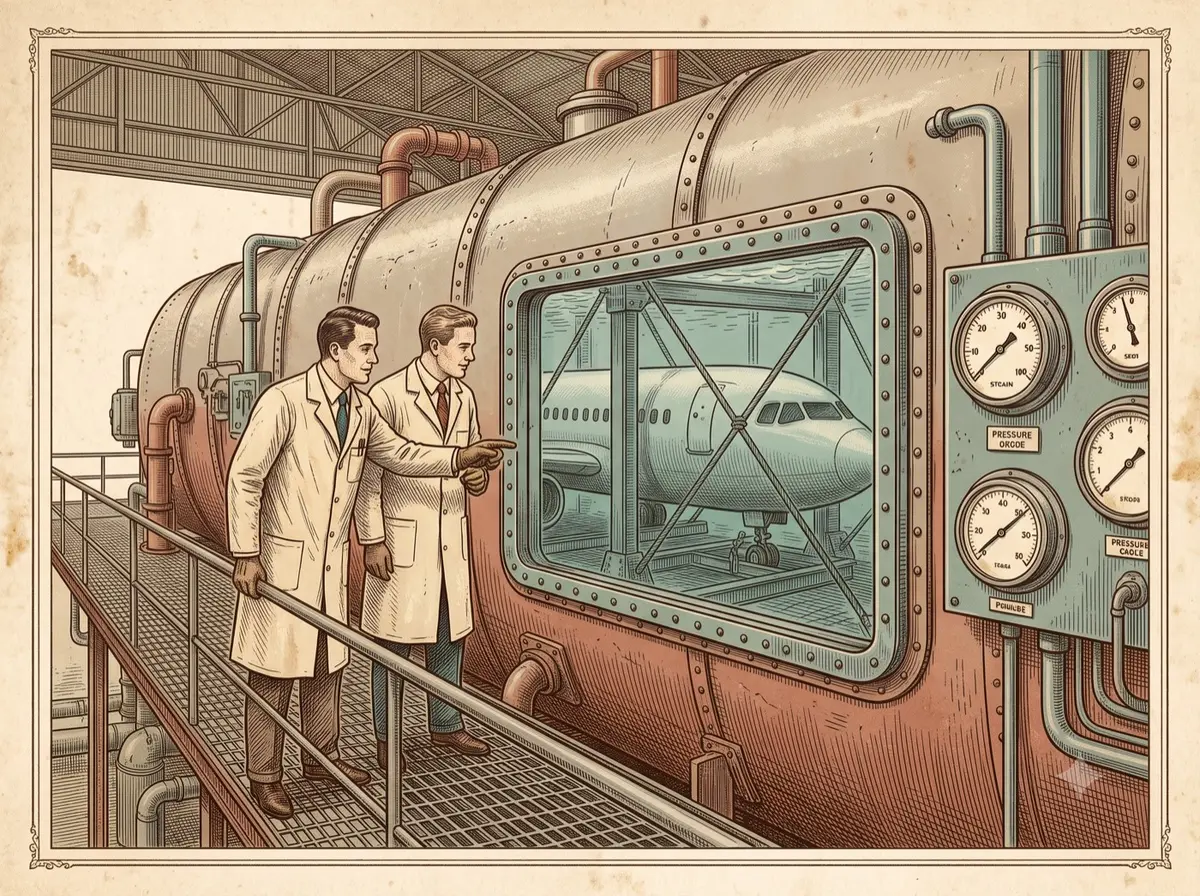
In June 1954, a team of British engineers built a steel tank the length of a bus, sealed a complete airliner fuselage inside it, and filled it with water. Then they did something that would have alarmed any passenger who'd ever flown in the plane: they pressurized it, drained it, and pressurized it again, over and over, trying to make it fail on purpose. After 3,057 cycles, it did — splitting open with a crack that finally told investigators what had been killing people at 30,000 feet.
By the Curiosities Desk · · 6 min read · Filed under Engineering · Today’s round
What happened: The Windows That Took the Blame for a Plane Crash They Didn't Cause
The plane was the de Havilland Comet, the world’s first commercial jet airliner. When it entered service with BOAC in May 1952, flying London to Johannesburg, it was faster, quieter, and higher-flying than anything else in the sky — cruising above the weather at 40,000 feet while propeller airliners droned along below. Newspapers and rivals alike treated it as the future of air travel arriving early.
Then, within two years, three Comets broke apart in mid-air. The first fatal structural failure, BOAC Flight 783, came down in a storm over India in May 1953, and was initially blamed on turbulence and pilot handling rather than the airframe itself. The pattern became impossible to ignore on January 10, 1954, when BOAC Flight 781 — the very first production Comet, registered G-ALYP — disintegrated over the Mediterranean off the Italian island of Elba, twenty minutes after leaving Rome. All 35 people aboard were killed, and there was no distress call, no witness, and no obvious cause. The fleet was grounded, inspected, modified, and cautiously returned to service. Ten weeks later, on April 8, 1954, a second Comet, chartered by South African Airways, broke up in the same way near Naples, killing 21. The entire Comet fleet was grounded again, this time for good.
The British government convened the Cohen Committee, led by Lord Cohen, with the technical investigation run by Sir Arnold Hall of the Royal Aircraft Establishment (RAE) at Farnborough. The Royal Navy spent months trawling the Mediterranean seabed for wreckage from G-ALYP, eventually recovering most of the airframe for reconstruction on land. In parallel, Hall’s engineers took a sister aircraft, G-ALYU, and submerged its entire fuselage in a purpose-built water tank at Farnborough, repeatedly pressurizing and depressurizing it to simulate the stress of climbing to cruising altitude and back down, flight after flight after flight. On June 24, 1954, after 3,057 simulated pressurization cycles, the test fuselage burst open. When investigators compared the failure point to the reconstructed wreckage of G-ALYP, they matched: both cracks began at a rivet hole in the corner of a cutout in the roof of the fuselage, just above the cockpit, where an antenna for the plane’s automatic direction finder, or ADF, poked through the skin.
Why it was strange: The Windows That Took the Blame for a Plane Crash They Didn't Cause
Two brand-new, state-of-the-art aircraft — showcases of British engineering — had simply come apart in clear conditions, for no reason anyone could see from the ground or hear over the radio. That alone unsettled a traveling public just getting used to jet flight. But the stranger twist came afterward, in how the story got told. For decades, popular accounts of the Comet disasters — and they still circulate today — blamed the shape of the passenger windows, claiming their square corners concentrated stress until the fuselage cracked. It’s a tidy story: square windows bad, round windows good, lesson learned. The Cohen Inquiry’s own report doesn’t say that. The fatal cracks began at the ADF antenna cutout above the cockpit, not at any passenger window, and de Havilland’s later switch to oval passenger windows was, according to metallurgist Paul Withey’s 2019 re-examination of the case, driven more by manufacturing convenience than by the accident findings. The real culprit was a broader, less photogenic problem: any sharp-cornered opening in a pressurized metal skin, whether it holds a window, a hatch, or an antenna, concentrates stress at that corner far more than engineers of the time had accounted for.
The same thread — Aviation History — continues in The Wooden Flying Boat That Flew Once, for 26 Seconds — and Was Kept Ready to Fly for 29 More Years.
What scientists learned: The Windows That Took the Blame for a Plane Crash They Didn't Cause
The core discovery was metal fatigue in a pressurized aircraft skin — a failure mode barely understood in 1954. Every time the Comet climbed to altitude, its fuselage was pumped up like a balloon to keep the cabin breathable; every time it descended, the pressure released. That cycle, repeated thousands of times over a plane’s working life, could crack aluminum alloy at a stress concentration point long before any inspector would see a problem, and once a crack started, cabin pressure did the rest, tearing the skin open explosively. De Havilland’s original ground tests had pressurized fuselage sections to enormous margins of safety, but no one had yet grasped that repeated cycling, not peak pressure, was the real hazard. The Farnborough water tank test proved it by reproducing the failure under controlled conditions — a rare case where engineers deliberately, methodically destroyed an airplane to understand why other airplanes were being destroyed by accident.
Another experiment that taught more by not working: The Railway That Ran on Suction — and the Rats Blamed for Eating It.
How it reaches us today: The Windows That Took the Blame for a Plane Crash They Didn't Cause
The Comet disasters became the founding case study of modern aircraft fatigue testing. Every commercial jet built since has had its fuselage cycled through simulated pressurization thousands of times before it ever carries a paying passenger, and manufacturers now design around “fail-safe” and “damage-tolerant” principles: structures built so that a single crack won’t bring down the whole airplane before routine inspection catches it. The techniques developed to recover and reconstruct G-ALYP’s wreckage from the seabed also shaped how aviation accidents are investigated to this day. De Havilland rebuilt the Comet with a thicker, stronger fuselage; the redesigned Comet 4 flew BOAC’s first scheduled transatlantic jet service in 1958, and a later military version, the Hawker Siddeley Nimrod, remained in RAF service until 2011 — nearly six decades after the Comet’s rocky start.
Another ambitious failure: The Talking Doll Edison Built With a Phonograph in Its Chest — and Pulled From Stores Within Weeks.
Fun fact: The Windows That Took the Blame for a Plane Crash They Didn't Cause
Part of the actual wreckage that solved the mystery — the fractured ADF antenna cutout from G-ALYP — is preserved and on public display at the Science Museum in London, a small jagged piece of metal that rewrote how every airliner since has been built and tested.
Sources: The Windows That Took the Blame for a Plane Crash They Didn't Cause
- “de Havilland Comet,” Wikipedia (cross-referenced with the Cohen Inquiry findings and cited academic sources) — https://en.wikipedia.org/wiki/De_Havilland_Comet
- Royal Air Force Museum, “Comet Failure,” archive exhibition on the Comet — https://www.rafmuseum.org.uk/research/archive-exhibitions/comet-the-worlds-first-jet-airliner/comet-failure/
- Federal Aviation Administration, “De Havilland DH-106 Comet 1,” Lessons Learned from Transport Airplane Accidents — https://www.faa.gov/lessons_learned/transport_airplane/accidents/G-ALYV
- T. Swift and P. Withey (analysis discussed in), “A review of the De Havilland Comet I G-ALYP fuselage failure based on the Court of Enquiry Report (1955)” — https://www.researchgate.net/publication/344122909
- AerosSurance, “Common Comet Misconceptions and Collaborative Contribution to Safety” — https://aerossurance.com/safety-management/comet-misconceptions/
This story touches on a real aviation disaster in which 56 people lost their lives across two crashes. Their deaths led directly to safety standards that have made flying dramatically safer for everyone since.
Related stories: The Windows That Took the Blame for a Plane Crash They Didn't Cause
- Galloping Gertie: The Bridge That Taught Engineers to Fear the Wind — A bridge that twisted itself apart in a moderate wind
- The Unit Mix-Up That Doomed a Mars Probe — Pounds and newtons, and a $150 million probe lost at Mars
- The Kingfisher That Redesigned the Bullet Train — A kingfisher’s beak fixed the bullet train’s sonic boom