Impossible Inventions · Engineering
The Wooden Flying Boat That Flew Once, for 26 Seconds — and Was Kept Ready to Fly for 29 More Years
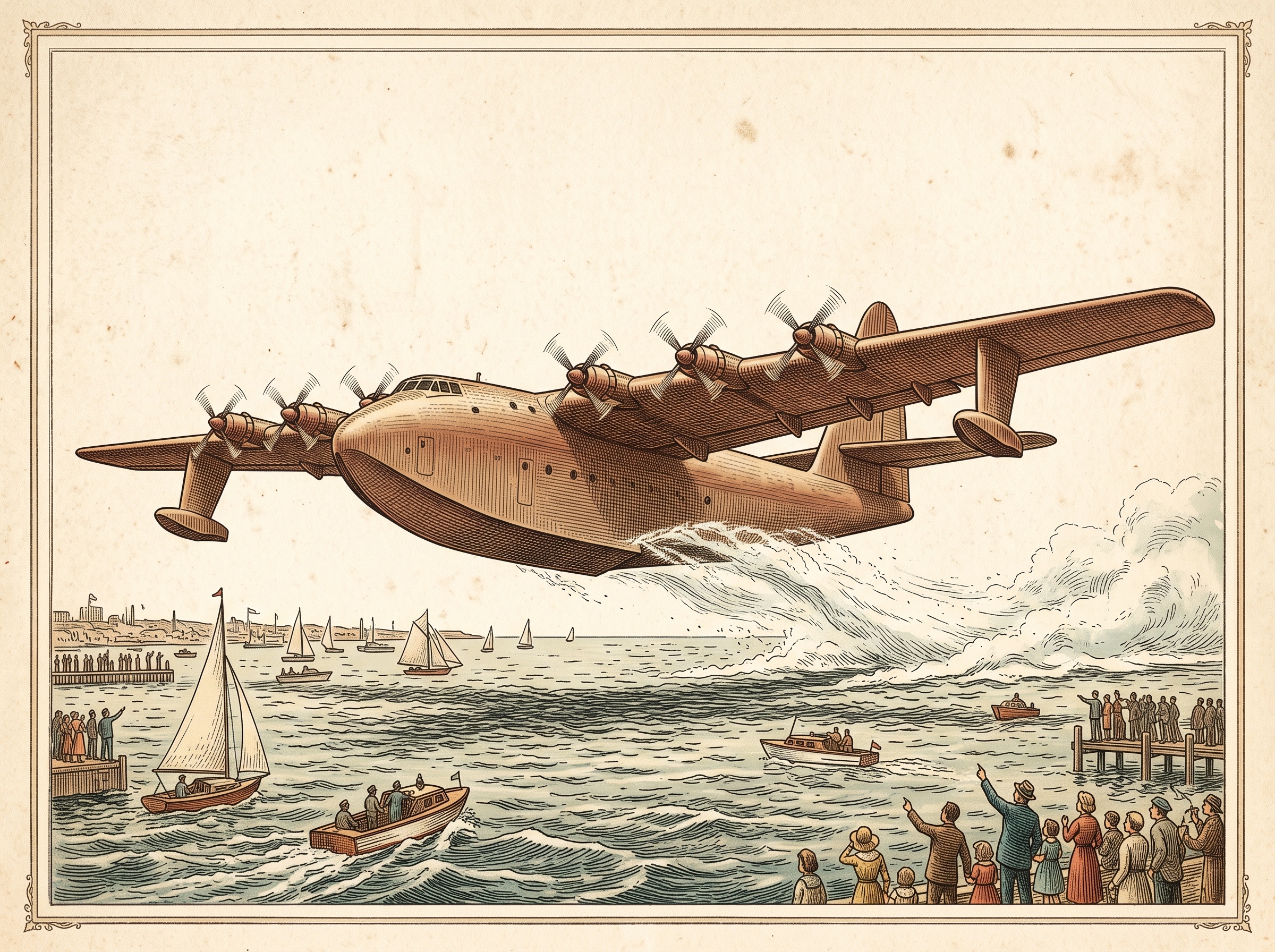
On November 2, 1947, most of the reporters aboard Howard Hughes' giant wooden flying boat had already given up and gone ashore to file their stories. The plane had spent the afternoon taxiing around Long Beach Harbor, and it didn't look like it was going anywhere. Then, on the next run, the largest airplane anyone had ever built rose out of the water, flew about a mile at roughly 70 feet up — and settled gently back down. It never left the water again.
By the Curiosities Desk · · 5 read · Filed under Engineering · Today’s round
What happened?
The story starts in 1942, when German U-boats were sinking Allied cargo ships in the Atlantic faster than they could be replaced. Henry J. Kaiser, the industrialist famous for mass-producing Liberty ships, had a bold answer: if ships were getting torpedoed, why not fly the cargo over the submarines instead? He needed an aviation partner, and he found one in Howard Hughes — the Texas-born film producer, record-setting pilot, and owner of Hughes Aircraft.
The government contract came with a striking catch. The plane couldn’t be built from strategic wartime materials like aluminum, which were needed for bombers and fighters. So Hughes’ team turned to wood — specifically “Duramold,” a process in which thin layers of veneer were bonded together with resin into a strong, moldable laminate (an early cousin of today’s composite materials). The finished design, first called the HK-1 for Hughes and Kaiser, was meant to carry 750 fully equipped soldiers or two 30-ton Sherman tanks across an ocean.
The numbers were enormous. The wingspan stretched about 320 feet — longer than a football field. Eight 28-cylinder engines, each turning a propeller more than 17 feet across, hung from the wings. The parts were so big that a house-moving company hauled them through the streets to Long Beach in sections.
It was also slow. Hughes was a famous perfectionist, and the project dragged on. Kaiser withdrew in 1944, and Hughes carried on alone under a new name: the H-4 Hercules. By the time the plane was finished, World War II had been over for two years. The press had given it a nickname Hughes despised — the “Spruce Goose” — and critics called it the “Flying Lumberyard.”
In August 1947, Hughes was called before a U.S. Senate committee investigating whether government money had been wasted on aircraft that never arrived. He defended the project fiercely, telling the senators that he had “put the sweat of my life into this thing” and that if it failed, he would “probably leave this country and never come back.”
Then he went back to California to prove the plane could fly. On November 2, with Hughes at the controls, a hydraulics engineer named Dave Grant as copilot, and 36 people aboard in total — crew, mechanics, journalists, and industry guests — the H-4 made a series of taxi runs. Four reporters left after the first two. On the final run, the giant lifted off the water and stayed airborne for about 26 seconds, covering roughly a mile at about 70 feet before Hughes set it down. (Sources disagree on its exact speed and height; most cite 70 feet.)
According to one widely retold account, a radio reporter still aboard asked Hughes whether he had expected that. Hughes reportedly replied, “I like to make surprises.”
Why was it strange?
Here’s the twist hidden in that short hop: it proved less than it seemed to.
At 70 feet, the H-4 was flying far inside a zone engineers call “ground effect.” Any aircraft flying within about one wingspan of the ground or water gets extra help: the surface below interferes with the swirling air currents that normally drag at the wingtips, so the wing produces more lift with less drag. With a 320-foot wingspan, a 70-foot altitude is practically skimming. The flight showed the plane could lift off — but it never tested whether the Hercules could climb out of that cushion, carry a real load, or cross an ocean. Its range, ceiling, and cargo capacity were never verified.
And then there’s the name. The “Spruce Goose” contained almost no spruce. It was built almost entirely of laminated birch. Hughes disliked the nickname partly because, as Boeing’s history of the aircraft puts it, he felt it insulted the people who built it.
Strangest of all is what came next. Hughes didn’t scrap the plane. He kept it in a climate-controlled hangar, maintained in flying condition by a dedicated crew sworn to secrecy, for nearly three decades. The crew was reportedly about 300 people at first, shrinking to around 50 by 1962. It was disbanded only after Hughes died in 1976. A plane that flew for 26 seconds was kept ready to fly again for 29 years.
The same thread — World War II — continues in The Rocket-Powered Wheel That Chased Britain’s Admirals Into Barbed Wire.
What did scientists learn?
The H-4 was a real engineering experiment, even if it never got a second flight. Its wooden construction showed that laminated wood composites could be shaped into enormous, strong structures — an idea that echoes in today’s carbon-fiber and fiberglass aircraft parts, which also bond thin layers together with resin.
It also pushed control systems forward. No pilot could move control surfaces that large with muscle alone, so the Hercules used hydraulically powered controls — a system in which pressurized fluid does the heavy lifting when the pilot moves the yoke. Powered controls of this kind became standard on large aircraft.
Most of all, the H-4 is a lesson in scale. As airplanes get bigger, their weight grows faster than their wing area, so every extra foot of size gets harder to lift. The Hercules sat right at the edge of what 1940s piston engines and materials could manage, and its single flight — inside ground effect — hints at how narrow that edge was.
Elsewhere in engineering: The Windows That Took the Blame for a Plane Crash They Didn’t Cause.
How does it affect us today?
The H-4 Hercules held the record for the widest wingspan of any aircraft ever flown until April 13, 2019, when the twin-fuselage Stratolaunch carrier aircraft took off in California’s Mojave Desert. It remains the largest flying boat ever built.
After Hughes’ death, the plane was nearly cut up and divided among museums. Instead it was displayed under a giant dome in Long Beach next to the ocean liner Queen Mary, then shipped by barge, train, and truck to McMinnville, Oregon, arriving in 1993. Today it’s the centerpiece of the museum now called the North American Aerospace Museum (formerly the Evergreen Aviation & Space Museum).
Another invention that refused to stay on paper: The Aircraft Carrier Britain Tried to Build Out of Ice.
Fun fact
The H-4’s only flight was supposed to be a taxi test. Most of the journalists who had waited all day to see whether it could fly went ashore just before it did.
Sources
- Smithsonian Institution Archives, “Spruce Goose Acquired by NASM” (1975)
- Boeing, “Historical Snapshot: H-4 Hercules Flying Boat”
- Christopher Warner, “Why Howard Hughes Flew the Spruce Goose Only Once,” Aviation History / HistoryNet (2022)
- Bryan R. Swopes, “2 November 1947,” This Day in Aviation
- Flying Magazine, “‘Spruce Goose’ Home Rebrands as North American Aerospace Museum”