Impossible Inventions · Engineering
The Rocket-Powered Wheel That Chased Britain's Admirals Into Barbed Wire
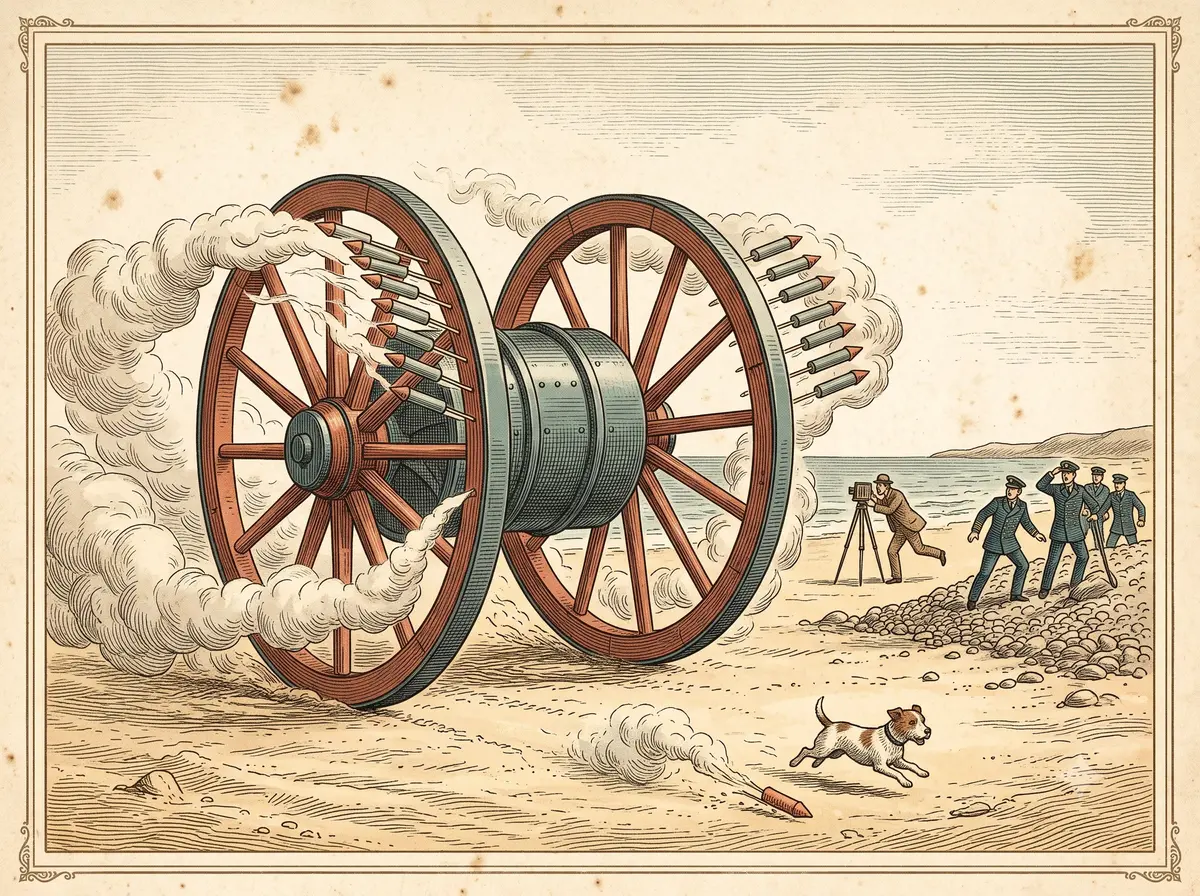
On a Devon holiday beach in January 1944, a pair of ten-foot wooden wheels came roaring out of the surf trailing seventy cordite rockets, veered hard off course, and bore down on the official cameraman — who kept filming until the roar got loud enough to look up. Behind him, an assembly of admirals and generals scrambled over a pebble ridge and into their own barbed wire. Somewhere in the smoke, an Airedale named Ammonal chased a loose rocket down the sand.
By the Curiosities Desk · · 5 read · Filed under Engineering · Today’s round
Part of Built to Do the Impossible
What happened: The Panjandrum
The machine was called the Great Panjandrum, and it was a serious attempt to solve a serious problem.
By 1943, Allied planners knew that any invasion of occupied France meant landing in front of the Atlantic Wall — a belt of German coastal fortifications including concrete sea walls roughly ten feet high and seven feet thick. Something had to punch a tank-sized hole in that concrete, and walking a bomb up by hand was not an option; the sand in front of those walls was designed to be a killing ground. Whatever did the job had to launch from a landing craft and cross the beach alone.
The work went to the Admiralty’s Directorate of Miscellaneous Weapons Development, a small unit of improvisers known around the Navy as the “Wheezers and Dodgers.” Its members included a sub-lieutenant named Nevil Shute Norway — an aeronautical engineer better remembered under his pen name, the novelist Nevil Shute. Shute calculated that breaching the wall would take more than a long ton of explosive.
The design that emerged was almost aggressively simple. Take a steel drum packed with explosive. Hang it on an axle between two wooden wheels ten feet across and a foot wide, shod with steel treads. Bolt banks of cordite rockets around the rims. Light them, and the whole assembly should spin itself up the beach at something like 60 mph, carrying a 4,000-pound load through anything in the way. Shute named it after a bit of eighteenth-century nonsense verse by the actor Samuel Foote, whose “grand Panjandrum” turns up in a paragraph ending with everyone dancing till the gunpowder runs out of their boot heels.
The prototype was built quietly in Leytonstone, in east London, and driven down to Westward Ho!, Devon, under cover of darkness. The secrecy lasted about as long as the first test. The beach was a popular holiday spot, and from the first trial on 7 September 1943 onward, the Navy’s most confidential rocket experiment was performed in front of curious civilians who could not be persuaded to go home.
The trials followed one pattern. The Panjandrum launched beautifully. Then a few rockets on one wheel failed or tore loose, the thrust went lopsided, and the machine swerved off toward the crowd, the sea, or the cameraman. The team added a stabilising third wheel, then more rockets — over seventy at one point. They tried steering it with steel cables paid out from the beach; the wheels snapped the cables and whipped them back over the operators’ heads. Word came down that the weapon did not need to be accurate. It only needed to travel, reliably, in the general direction of the enemy.
Even that proved too much. The final demonstration in January 1944, staged for senior officers and scientists, ended with rockets loose across the beach, brass hats in the barbed wire, and the Panjandrum disintegrating in the sand. Nobody was killed. The project was cancelled almost immediately.
Why it was strange: The Panjandrum
The strange part is not that the Panjandrum failed. It’s how it failed — and how consistently.
The machine was never underpowered. It had thrust to spare; that was the whole problem. What it never had was any way of knowing where it was going. It was a weapon with an accelerator and no steering wheel, no driver, and no brakes, launched on the assumption that a heavy enough object moving fast enough in roughly the right direction would sort itself out.
It’s also strange as theatre. Britain’s most secret beach-assault weapon was tested, repeatedly, in front of holidaymakers. Some have since wondered whether that was the point — that the Panjandrum was deliberately conspicuous, meant to convince German intelligence the invasion was aimed at the heavily fortified Pas-de-Calais. That’s a later suggestion rather than a documented order, and the surviving footage looks far more like engineers earnestly trying to make a thing work than like men putting on a show.
The same thread — World War II — continues in The Wooden Flying Boat That Flew Once, for 26 Seconds — and Was Kept Ready to Fly for 29 More Years.
What scientists learned: The Panjandrum
The Panjandrum is a textbook lesson in what engineers call open-loop control: a system that executes a fixed command and never checks the result. Light the rockets, and the machine does whatever the physics of that instant dictate. Nothing measures its heading. Nothing compares where it is to where it should be. Nothing adjusts.
The failure mode was differential thrust. With rockets firing symmetrically on both rims, the forces balance and the wheel tracks straight. Lose two or three on one side — a clamp shears, a charge misfires — and the survivors produce a net turning force. The wheels are also gyroscopes: a spinning ten-foot wheel resists changes to its axis, so once it starts to turn, it does so with enormous authority. A soft, rutted beach full of tidal craters guaranteed the initial disturbance.
The fix is closed-loop control — measure, compare, correct, many times a second. The tools to do that at the speed a Panjandrum needed simply did not exist in 1943. Cable steering was an attempt at feedback with a human in the loop, and it failed because the human could not react faster than the machine could misbehave.
Another machine that should not have worked: The Aircraft Carrier Britain Tried to Build Out of Ice.
How it reaches us today: The Panjandrum
Every rocket that lands upright on a barge is running the answer the Panjandrum lacked. Modern launch vehicles steer by thrust vector control, gimbaling the engine nozzle a few degrees at a time, guided by inertial sensors sampling the vehicle’s attitude many times per second. The same closed-loop logic keeps a quadcopter level in a gust and holds a car in its lane.
The Panjandrum is a reminder of the order in which these things had to arrive. Enormous power came first and was, on its own, close to useless. What turned rockets into precision instruments was not more thrust. It was cheap, fast feedback.
Another invention that refused to stay on paper: The Mechanical Duck That Fooled Paris With Fake Poop.
Fun fact: The Panjandrum
The Imperial War Museum’s film of the trials, catalogued as ADM 1038, records a detail no scriptwriter would dare invent: chasing the loose rockets across the sand is an army officer’s Airedale terrier named Ammonal — after the high explosive. The dog appears in more than one reel. As far as the record shows, Ammonal survived the Great Panjandrum, which is more than can be said for the Great Panjandrum.
Sources: The Panjandrum
- Imperial War Museums, film ADM 1038, “The Great Panjandrum” — seven reels of the original trial footage, with reel-by-reel descriptions of the cable steering, the crashes, and the dog.
- Imperial War Museums, photograph IWM FLM 1627, “The Great Panjandrum Trials, c 1944”, Westward Ho!, Devon.
- The National Archives (UK), ADM 227: Admiralty, Directorate of Miscellaneous Weapon Development: Reports and Papers, 1940–1946.
- Brian Johnson, The Secret War (Pen & Sword, 2004 ed.), p. 270 — the detailed eyewitness account of the January 1944 trial.
- “Back to the drawing board: The Great Panjandrum”, Military History Matters / The Past — overview of the design brief and the 2009 replica run at Westward Ho!.
Related stories: The Panjandrum
- The Flying Saucer the Air Force Built That Maxed Out at 35 MPH — The Air Force built a flying saucer that hovered at walking speed
- The Bomb Full of Sleeping Bats That Burned Down Its Own Air Base — Bats carrying tiny incendiaries burned down the base that built them
- The Truck Driver Who Flew a Lawn Chair to 16,000 Feet on 42 Weather Balloons — A truck driver flew a lawn chair to 16,000 feet on weather balloons