Impossible Inventions · Engineering
The Mechanical Duck That Fooled Paris With Fake Poop
In the winter of 1738, Parisians paid three livres — about a week's wages for a laborer — to crowd into a rented hall and watch a gold-plated copper duck eat grain from a man's hand, gulp it down, and then, after a dignified pause, poop. The crowd was watching what its creator called digestion happening inside a machine. What they were actually watching was one of the most elegant frauds in the history of engineering: the poop was fake, dyed green, and loaded into the duck's rear end before every show.
By the Curiosities Desk · · 5 min read · Filed under Engineering · Today’s round
Part of Built to Do the Impossible
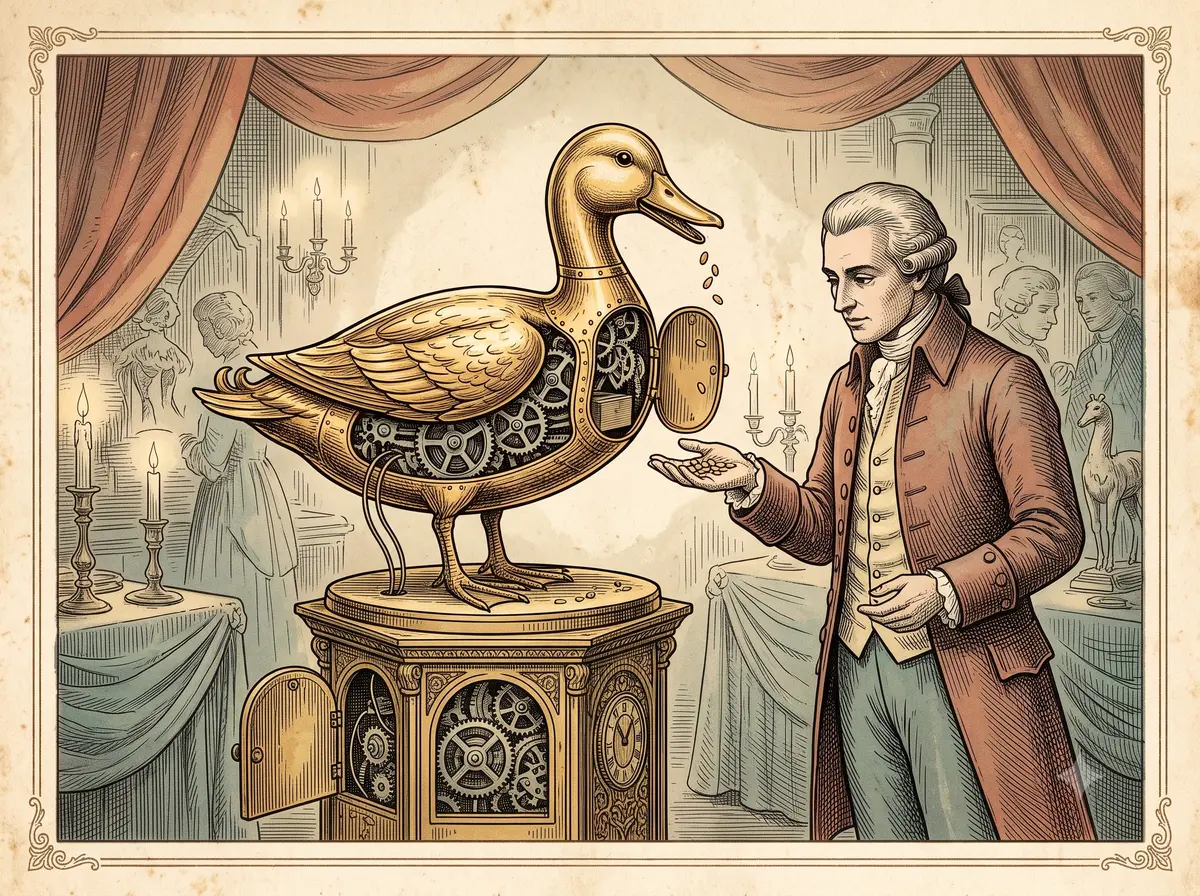
What happened: Vaucanson's Digesting Duck
Jacques de Vaucanson, the son of a Grenoble glove maker, arrived in Paris with a plan to build machines that didn’t just look alive — they would work alive. In February 1738 he exhibited a mechanical flute player, a life-size android that genuinely played a real flute, blowing air from bellows-driven lungs through soft, flexible lips and fingers. It was a sensation. The Académie des Sciences examined it and approved.
That winter, at the Hôtel de Longueville, Vaucanson unveiled his masterpiece alongside the Flute-player and a Pipe-and-Tabor player: the Canard Digérateur, or Digesting Duck. The duck was the size of a real duck and cased in gilded copper. It quacked, muddled water with its bill, made what one account called “a gurgling Noise like a real living Duck,” rose up on its feet, stretched its neck, and flapped wings that each contained over four hundred articulated pieces — Vaucanson had copied every bump on every bone of a real duck’s wing.
Then came the showstopper. The duck took kernels of grain from a hand, swallowed them with a visible gulp, and a few moments later excreted what appeared to be digested food. Vaucanson claimed the duck’s interior held a small “chemical laboratory” that dissolved the grain, as in a real animal. In a 1738 letter, he wrote plainly that the duck “swallows it, digests it, and discharges it digested by the usual Passage.”
It didn’t. The swallowed grain stopped at the base of the duck’s throat and collected in a hidden container. The “excrement” was a stash of pre-prepared pellets — by later accounts, breadcrumbs dyed green — stored in a separate compartment and pushed out on cue. Nothing was digested. The two ends of the duck were not even connected.
The deception took decades to unravel. In 1755 one critic sniffed that the duck was “nothing more than a coffee-grinder.” In 1783 a sharp-eyed observer noticed that the swallowed food never actually left the mouth tube and reasoned the poop had to be loaded in advance. And in the mid-1840s, the great stage magician Jean-Eugène Robert-Houdin examined a duck said to be Vaucanson’s while repairing it and confirmed the trick, admiring it as “a piece of artifice I would happily have incorporated in a conjuring trick.” The duck itself is thought to have been destroyed in a museum fire in 1879.
Why it was strange: Vaucanson's Digesting Duck
The strangest part isn’t the fraud — it’s how much genuine engineering surrounded it. Vaucanson faked exactly one thing: the digestion. Everything else was obsessively real. The wings were anatomically faithful down to individual bones. The Flute-player next to the duck wasn’t a music box with a decorative statue on top; it really played the flute, and you could reportedly hand it a different flute and it would play that one too.
So Europe’s most honest machine-builder and one of its most successful con artists were the same person, standing next to the same duck. Vaucanson seems to have regarded the fake digestion as a placeholder for a machine he sincerely believed could one day be built — he sketched plans for a “moving anatomy” with a working circulatory system, proposing to use an exotic new material, rubber, for the veins. The scam wasn’t cynicism. It was a promissory note.
Another invention that refused to stay on paper: The 3,000 Letters the Post Office Fired at Florida Inside a Cruise Missile.
What scientists learned: Vaucanson's Digesting Duck
Vaucanson’s automata were experiments, not just toys. To make the Flute-player work, he had to figure out what actually governs the pitch of a flute note — blowing pressure, aperture, and sounding length — producing one of the first real theories of how the instrument works. Building the Pipe-and-Tabor player, he discovered that human pipers unconsciously vary their breath depending on the previous note played, a subtlety of overtones that physics wouldn’t fully explain until Hermann von Helmholtz in the 1860s.
The duck posed a deeper question that researchers still argue about: what counts as simulating life? Vaucanson’s machines forced philosophers of the Enlightenment to ask whether an animal is, at bottom, a very good machine — and whether copying the mechanism is the same as copying the life. Historian Jessica Riskin calls the duck a founding artifact of artificial life research: partly genuine imitation, partly theater, exactly like many AI demos since.
Another machine that should not have worked: The Aircraft Carrier Britain Tried to Build Out of Ice.
How it reaches us today: Vaucanson's Digesting Duck
Vaucanson’s path from fake duck to real automation was short. In 1741 France appointed him inspector of its silk industry, and by 1745 he had designed an automated loom controlled by a punched cylinder — workers rioted, and the idea sat mostly ignored until Joseph-Marie Jacquard revived and perfected it around 1804. Jacquard’s punched cards went on to inspire Charles Babbage and, eventually, the punched cards of early computing. There is a reasonably straight line from a poop-faking duck to the machine you’re reading this on.
The duck also set the template for every overhyped tech demo since: dazzling real engineering out front, a hidden shortcut where the hardest problem should be. Engineers even have a name for passing off human work as machine work — “mechanical Turk,” after a chess automaton with a man hidden inside. The duck got there first.
A close cousin: The Concentration Helmet That Needed Its Own Oxygen Tank.
Fun fact: Vaucanson's Digesting Duck
The duck outlived its own trick. When Goethe saw Vaucanson’s aging automata around 1805, he reported that the Flute-player had fallen mute and the machines were “utterly paralyzed” — but the duck “still devoured his oats briskly enough,” having merely “lost its powers of digestion.” It had, in fairness, never had them.
Sources: Vaucanson's Digesting Duck
- Jessica Riskin, “The Defecating Duck, or, the Ambiguous Origins of Artificial Life,” Critical Inquiry 29, no. 4 (2003) — peer-reviewed history including Vaucanson’s own 1738 letter
- Gaby Wood, “Living Dolls: A Magical History of the Quest for Mechanical Life” (extract), The Guardian, 2002
- Voltaire, Œuvres complètes, vol. 32 — the “glory of France” remark (primary source)
- Encyclopaedia Britannica, “Jacques de Vaucanson”
- “A Brief History of Robot Birds,” Smithsonian Magazine
Related stories: Vaucanson's Digesting Duck
- The Chess-Playing Machine That Beat Napoleon (With a Man Hidden Inside) — A chess automaton that beat Napoleon, with an operator folded inside
- The Motor That Ran for Twenty-Six Years on a Secret Room Full of Compressed Air — A perpetual motion motor secretly fed by a hidden room of compressed air
- The Flying Saucer the Air Force Built That Maxed Out at 35 MPH — The Air Force built a flying saucer that hovered at walking speed