The Chess-Playing Machine That Beat Napoleon (With a Man Hidden Inside)
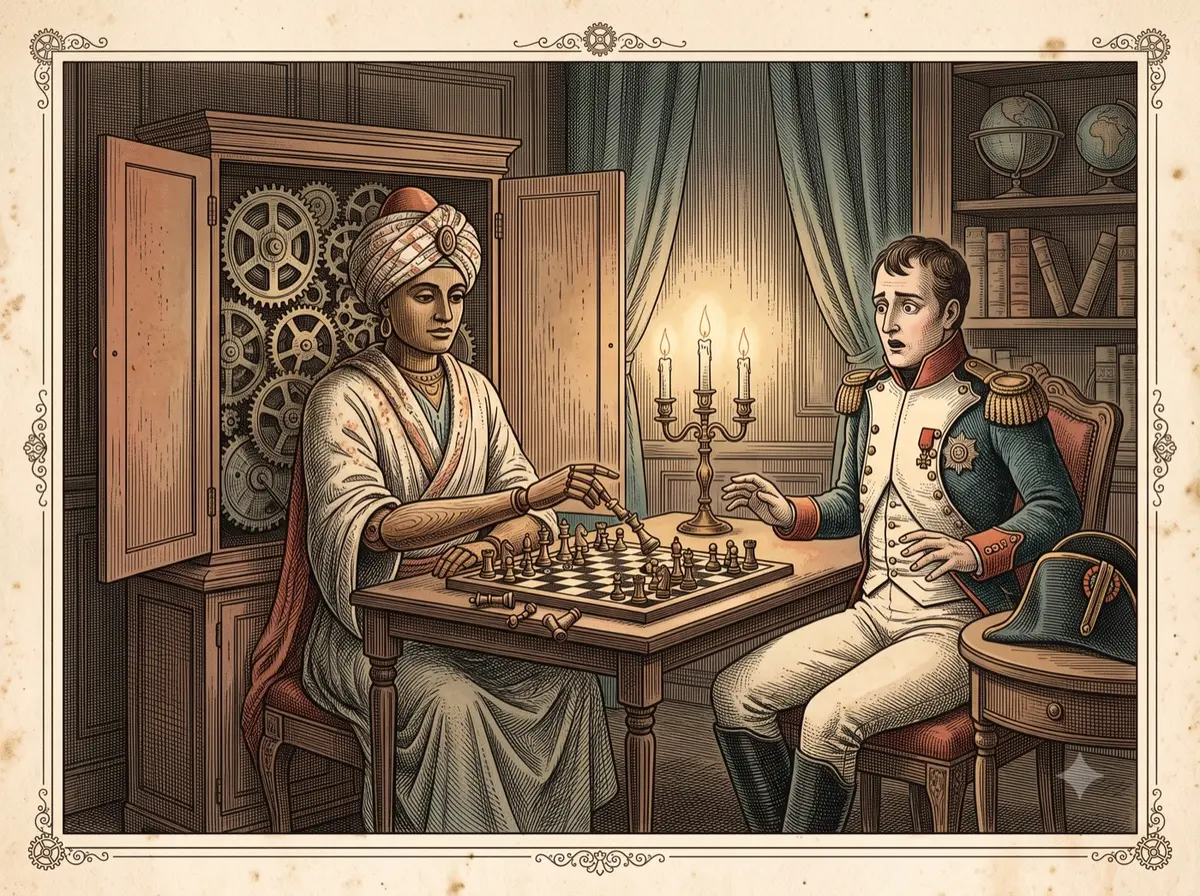
In 1809, Napoleon Bonaparte sat down across from the Mechanical Turk, a life-size wooden figure in a turban, and made an illegal chess move — twice, to test the machine. Both times the automaton calmly put his piece back. On the third try, the "machine" swept its carved arm across the board, scattering the pieces to the floor. Then it settled in and beat the emperor of France in nineteen moves. A person was hidden inside. Napoleon's opponent was breathing quietly a few feet away, folded into the cabinet, sliding along a hidden seat by candlelight.
By the Curiosities Desk · · 6 min read · Filed under Engineering · Today’s round
Part of The Version Everyone Remembers
What happened: Hidden Inside the Mechanical Turk
In 1769, a Hungarian inventor named Wolfgang von Kempelen watched a conjuror perform for Empress Maria Theresa at Schönbrunn Palace and, unimpressed, boasted he could build something better. Within a year he made good on the promise. In 1770 he unveiled a chess-playing “automaton”: a carved figure dressed in Ottoman robes, seated behind a wooden cabinet about three and a half feet long, with a chessboard on top. Because of its costume, everyone called it the Turk.
Before each performance, Kempelen opened the cabinet’s doors one by one to show the audience the interior — a dense thicket of gears and cogs that looked exactly like clockwork. He would even open the front and back doors at once so spectators could see straight through. Then he closed it up, wound a key for dramatic effect, and the Turk began to play. And it played well, usually crushing challengers within half an hour. It could also perform the knight’s tour, a notoriously hard puzzle of moving a knight to every square exactly once, and it could spell out answers to questions on a letterboard.
The secret was a person. A skilled human chess master crouched inside the cabinet on a sliding seat that let him shift position as each door was opened, always staying in the shadow. The clockwork was fake scenery. The operator watched the game from below: the chess pieces were magnetized, and small metal markers beneath the board’s underside told him which piece had moved where. He steered the Turk’s arm with a lever-and-pantograph mechanism to reach out, grasp a piece, and set it down, while other gears clunked to sell the illusion.
Kempelen toured the Turk reluctantly — he seemed more interested in his serious work on steam engines and speaking machines — but it became a sensation. After his death, the showman Johann Nepomuk Mälzel bought it in 1804 and turned it into a full-blown attraction, even adding a voice box that announced “Échec!” (“Check!”). Over its lifetime, a rotating cast of hidden masters operated it, including Johann Allgaier (likely the man who beat Napoleon), Jacques Mouret, and William Schlumberger. In Paris, the Turk played Benjamin Franklin, then the American ambassador to France; Franklin stayed fascinated with it for the rest of his life. The reigning chess champion François-André Philidor beat the machine — but reportedly called it his most exhausting game ever.
Why it was strange: Hidden Inside the Mechanical Turk
The strangeness isn’t just that people were fooled. It’s how badly they wanted to be. The Turk toured for 84 years, across two continents, in front of some of the sharpest minds of the age — and while almost everyone suspected a trick, no one could prove exactly how it worked while the machine still existed. Skeptics wrote entire books arguing it must contain a person, and they were right, yet they got the details wrong. One famous cross-section diagram of the operator’s hiding spot, published in the 1780s, was simply incorrect about where he sat and how big the cabinet was.
The deeper weirdness is that the Turk sat right on the border between wonder and deception, at the exact moment the world was falling in love with machines. This was the dawn of the age of automata, when clockmakers built mechanical ducks that “digested” food and dolls that wrote poems. A machine that could think — that could reason its way through chess — felt like it might be just one more clever gearbox away. The Turk exploited that hope. It wasn’t lying about the future so much as arriving 250 years early and faking it.
Another story that outran the evidence: The Frozen Chicken Cannon That Supposedly Wrecked a British Train.
What scientists learned: Hidden Inside the Mechanical Turk
Ironically, the fraud taught real lessons. The Turk became a case study in how easily expert observers deceive themselves, and it drew serious analytical attention. In Richmond, Virginia, a young writer named Edgar Allan Poe examined it and published an 1836 essay, “Maelzel’s Chess-Player,” reasoning through why it had to be operated by a human. Many of Poe’s specific deductions were wrong, but the essay is often cited as a milestone in the logic of detection — the same deductive-reasoning style he would soon pour into inventing the modern detective story.
The Turk also forced a real question that still matters: what would it actually take to build a machine that plays chess? For over a century the honest answer was “we have no idea.” Chess is a problem of staggering combinatorial size, and genuinely mechanizing it had to wait for electronic computers, formal game theory, and search algorithms. When IBM’s Deep Blue finally beat world champion Garry Kasparov in 1997, it was doing — with brute-force calculation — what the Turk had only pretended to do. The pretense had marked the finish line long before anyone could reach it.
Another claim that stuck harder than the correction: The Lemmings That Never Jumped Off the Cliff.
How it reaches us today: Hidden Inside the Mechanical Turk
The Turk’s real legacy is a warning label for the modern world. When Amazon launched a service in 2005 that pays people small sums to do tasks computers can’t, it named it Amazon Mechanical Turk — an unusually honest joke about “artificial artificial intelligence,” where humans hide behind software the way a chess master once hid behind gears. That phrase has become shorthand for a recurring tech-industry pattern: products marketed as automated that quietly rely on people behind the curtain, from “AI” customer-service bots to self-driving demos with remote operators. Every time a company overstates what its machine can do on its own, it’s building another Turk. Kempelen’s cabinet is 250 years old and still teaching us to ask the same question: is anyone hiding inside?
A close cousin: The Million-Dollar Space Pen Myth — and the $128.89 Pencils NASA Actually Bought.
Fun fact: Hidden Inside the Mechanical Turk
The hoax’s most dramatic near-unmasking came in Baltimore in 1827, when the operator William Schlumberger, overheating inside the cabinet, panicked and scrambled out mid-exhibition. Two teenagers watching for free from a nearby rooftop saw the whole thing. One told his father, who told the Baltimore Gazette — and the paper printed it. The Turk kept touring anyway.
Sources: Hidden Inside the Mechanical Turk
- The Turk / Mechanical Turk — Wikipedia (cross-referenced against its cited sources, including Silas Weir Mitchell’s 1857 reveal in The Chess Monthly)
- Poe, Edgar Allan. “Maelzel’s Chess-Player,” Southern Literary Messenger, April 1836 (Edgar Allan Poe Society of Baltimore)
- Smithsonian Magazine, “Debunking the Mechanical Turk Helped Set the Stage for the Real AI”
- Amazon Mechanical Turk — Wikipedia (on the modern service named for the automaton)
Related stories: Hidden Inside the Mechanical Turk
- The Mechanical Duck That Fooled Paris With Fake Poop — A mechanical duck that ate, digested, and pooped, fraudulently
- The Petrified Giant That Was a Fake of a Fake — A fake stone giant, and then a fake of the fake
- Clever Hans: The Horse That Could ‘Do Math’ — A horse that seemed to do arithmetic, and the bias it exposed