The Space Shuttle Boosters Supposedly Sized by the Rear Ends of Two Roman Horses
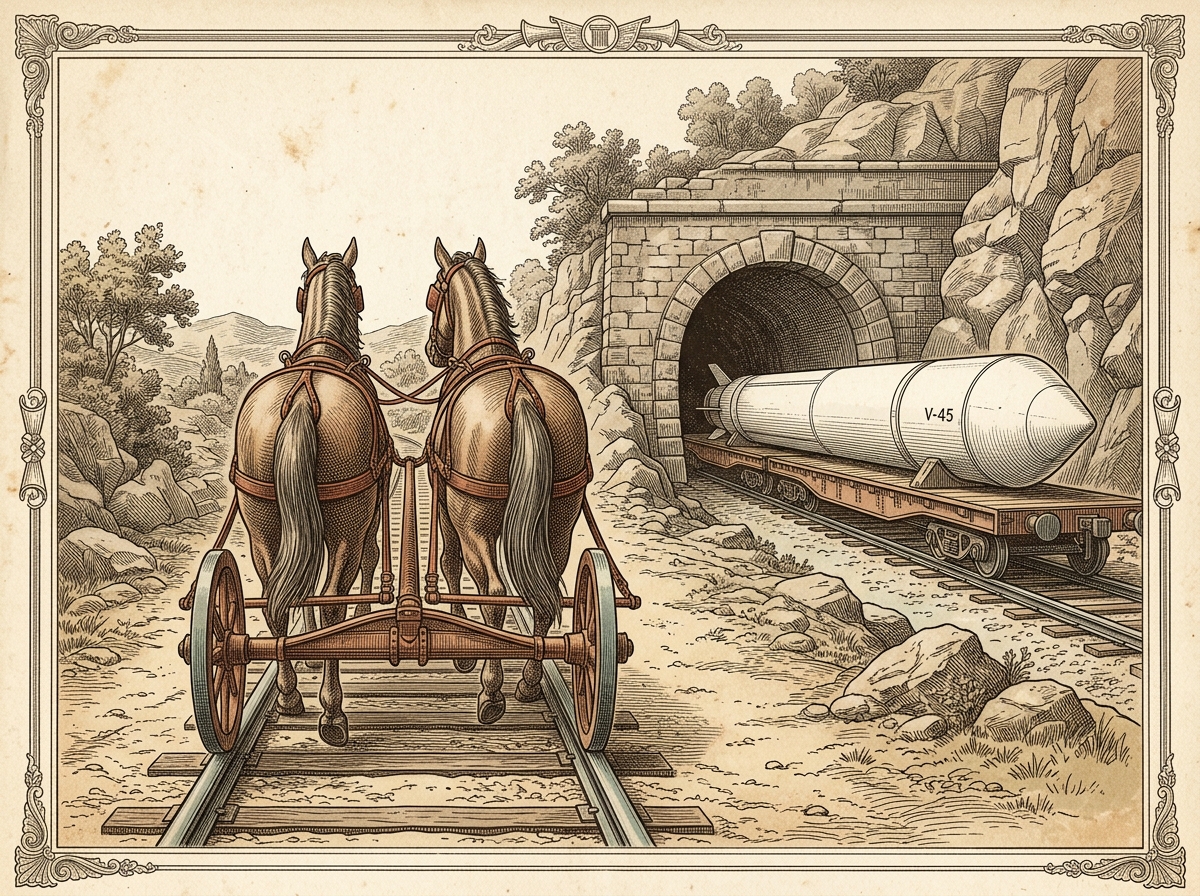
Picture a space shuttle on the launch pad in Florida, two white rocket boosters strapped to its sides. Now picture a pair of Roman war horses, harnessed side by side, plodding down a road nearly two thousand years earlier. According to one of the internet's most-forwarded stories, the second picture decided the first. The boosters, it says, could only be as wide as a railroad tunnel, the tunnel was set by the track, the track was set by Roman ruts, and the ruts were set by the width of two horses' backsides.
By the Curiosities Desk · · 5 min read · Filed under Engineering · Today’s round
What happened?
The story starts with a real and oddly specific number. Standard-gauge railway track, which covers more than half of the world’s railway lines, has its rails exactly 4 feet 8½ inches (1,435 millimeters) apart. “Gauge” here simply means the distance between the inner edges of the two rails. Nobody picks a number like that at random.
The legend offers an answer in a chain of questions. Why that gauge? Because English railways were built by the same people who built horse-drawn tramways. Why did the tramways use it? Because their wagons were built with the same jigs as road wagons. Why those? Because wagon wheels had to fit the old ruts in Britain’s roads, which were laid down by Imperial Rome. And why were the Roman ruts that wide? Because Roman chariots were built just wide enough for the rear ends of two war horses. A December 1998 printing of the tale ended on exactly that punchline.
At some point, someone added a sequel. NASA’s Space Shuttle used two solid rocket boosters, which were built by Thiokol in Utah and shipped to Florida by train. In the expanded version, the boosters had to squeeze through railroad tunnels barely wider than the track, so their size was ultimately set by a horse’s behind.
The tale is older than email. The fact-checking site Snopes found a version in a 1905 issue of Popular Mechanics, which claimed that the railway pioneer George Stephenson chose his gauge after measuring Roman chariot ruts. Australian newspapers were repeating the chariot link by 1937. The internet just gave it a rocket.
The real history is less tidy. In the coalfields of northeast England, horse-drawn wagons ran on wooden and then iron rails called wagonways long before steam locomotives. Gauges varied from line to line. Stephenson, who worked for the Durham and Northumberland collieries, favored about 4 feet 8 inches, and he used it on the Killingworth colliery line and the Stockton and Darlington Railway, which opened in 1825 to match the coal wagons already in use there.
The famous half inch came next. When Stephenson built the Liverpool and Manchester Railway, which opened on September 30, 1830, the gauge was widened to 4 feet 8½ inches. The usual explanation is that the extra half inch gave the wheels a little more play on curves, though historians note the exact reason isn’t recorded for certain. Robert Stephenson, George’s son, later said that if he could choose again he would take “a few inches more, but a very few.”
From there, the gauge spread because it was already everywhere. After a “gauge war” with the Great Western Railway, whose engineer Isambard Kingdom Brunel had laid track a roomy 7 feet ¼ inch wide, Parliament’s Gauge Act of 1846 made 4 feet 8½ inches the rule for new passenger lines in Great Britain. The Great Western held out until it finished converting its broad-gauge track in 1892.
Why was it strange?
The legend is so satisfying because it feels like a secret: modern technology secretly shaped by ancient livestock. And like many good myths, it is wrapped around a grain of truth. Engineering standards really do get locked in by whatever came before, long after anyone remembers why.
But almost every link in the chain breaks under weight. Roman roads were a small part of Britain’s road network by the time of the wagonways, and there’s no evidence that coal-country wagon builders copied Roman ruts. And the American gauge wasn’t simply inherited. In the 1860s the United States had a patchwork of gauges, and much of the South ran on 5-foot track until 1886.
The shuttle sequel fails most plainly of all. A Space Shuttle booster was about 12 feet across, more than two and a half times the width of the track it rode on. Tunnel clearances along the route did limit what could be shipped, but tunnels are sized for the cars, not the rails, and the cargo was always far wider than the gauge. Snopes found no sign that Thiokol reshaped the boosters to fit a horse-width tunnel.
What did scientists learn?
The match between Roman ruts and Stephenson’s rails is real, but it is a coincidence with a sensible cause. Ruts excavated at Pompeii sit roughly the same distance apart as modern rails, and so do ruts at Housesteads, a Roman fort on Hadrian’s Wall. The archaeologist James Crow, writing about Housesteads, explained the similarity simply: a cart pulled by two horses side by side tends to have an axle about 1.4 meters (4 feet 8 inches) long. The Romans and the English coal haulers weren’t copying each other. They were solving the same problem, with the same animals.
Economic historians have a name for what happened next: path dependence, the idea that an early, somewhat arbitrary choice can become impossible to undo once enough is built around it. The economist Douglas Puffert has studied railway gauges as a classic case. Stephenson’s gauge was not chosen because it was ideal. It won because it got there first and spread.
How does it affect us today?
Changing a gauge is staggeringly expensive, which is why so many countries still live with the choices of the 19th century. Australia’s states once built incompatible gauges, forcing travelers to change trains at state borders, and Spain, Russia, and India still run broad-gauge networks that make cross-border freight swap wheels or cargo.
The same logic shapes engineering everywhere, from keyboard layouts to plug shapes. The gauge myth sticks around because it captures something true in a false way: standards outlive their reasons. They just don’t usually go back to a horse.
Fun fact
When the American South finally converted its track in 1886, tens of thousands of workers shifted one rail three inches over about 36 hours, starting on May 31. They moved it to 4 feet 9 inches, the Pennsylvania Railroad’s gauge, so the South’s “standard” track was still half an inch off true standard.
Sources
- Snopes: “Railroad Gauge and Roman Chariots” (David Mikkelson)
- The Straight Dope: “Was standard railroad gauge (4’8½”) determined by Roman chariot ruts?" (Cecil Adams, February 18, 2000)
- NASA Kennedy Space Center: NASA Railroad fact sheet on shipping solid rocket booster segments from Utah
- Douglas J. Puffert, Tracks Across Continents, Paths Through History: The Economic Dynamics of Standardization in Railway Gauge (University of Chicago Press, 2009)
- Brotherhood of Maintenance of Way Employes Journal, December 1998: “The U.S. Standard railroad gauge”