The Frozen Chicken Cannon That Supposedly Wrecked a British Train
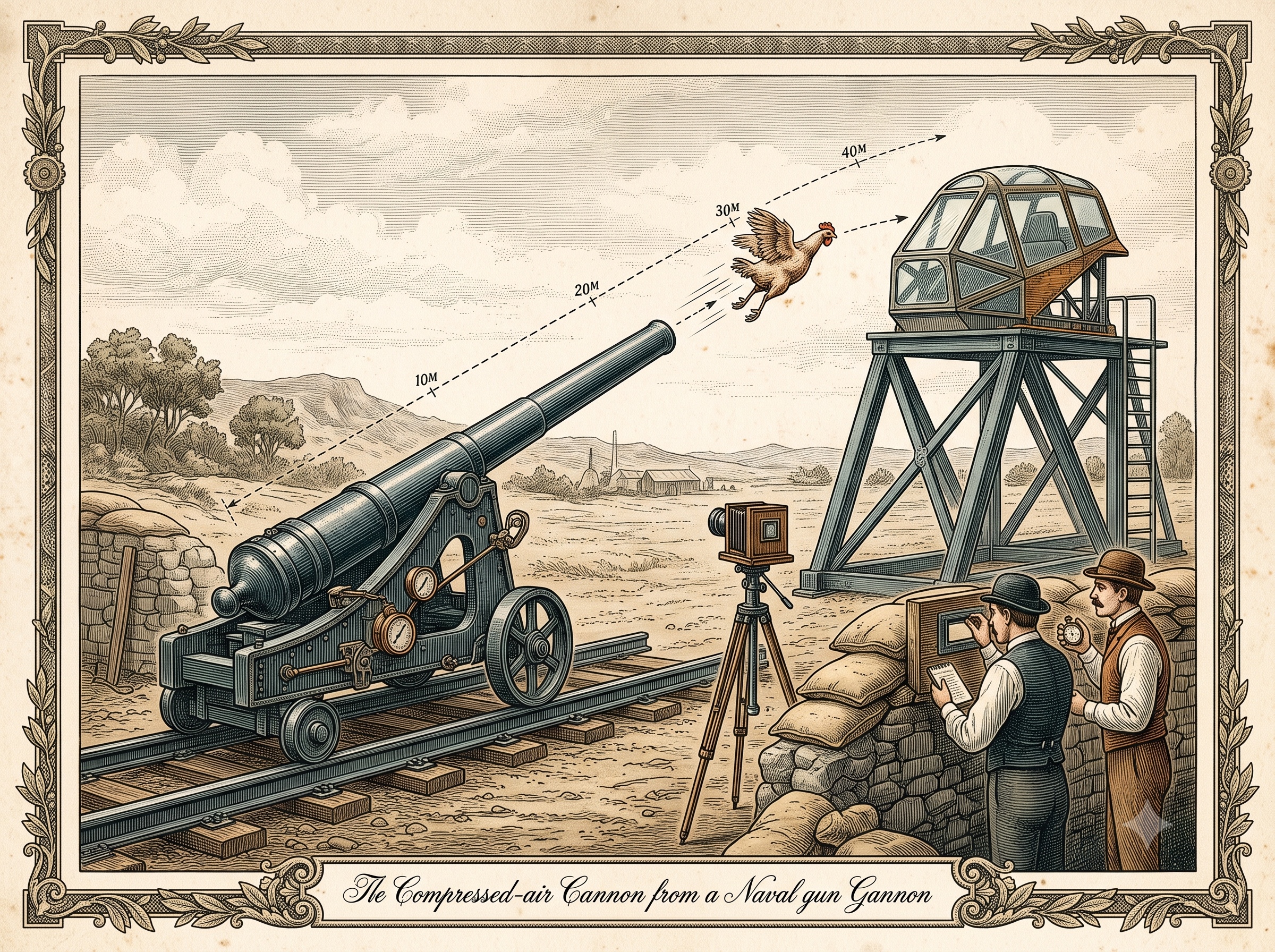
A chicken carcass sits in a balsa-wood cradle at the back of a sixty-foot barrel built from a surplus eight-inch naval gun. Compressed air bursts a plastic diaphragm, the bird leaves the muzzle at better than 700 miles an hour, and high-speed cameras record what it does to a fighter jet's canopy. All of that is real, and it happened more than a thousand times in a field in Tennessee. The part everyone actually knows — the British engineers who borrowed the gun, forgot to thaw the chicken, and got a one-line memo back — is the part nobody has ever been able to find.
By the Curiosities Desk · · 5 min read · Filed under Engineering · Today’s round
What happened?
The story usually goes like this. American engineers keep a cannon that fires dead chickens at windshields to see whether the glass will survive a bird strike. British engineers, developing a fast new train, ask to borrow it. They load the gun, fire, and the chicken goes through the windshield, through the driver’s seat, and into the back wall of the cab. Baffled, they send the data across the Atlantic. The reply comes back: use a thawed chicken.
It is a perfect joke — setup, escalation, four-word punchline — and it has been told about almost everyone. Snopes, which has been collecting versions since the 1990s, found the train-windshield telling printed in November 1995 in Feathers, the newsletter of the California Poultry Industry Federation, which had picked it up secondhand like everybody else. But a 1990 version made the fools American jet-engine designers rather than British train builders. A 1988 book on Australian urban legends had it too, and already described it as an old story of uncertain origin. In one beloved variant, a cat crawls into the barrel during the lunch break, drawn by the smell of poultry, and becomes part of the test. The lender is variously NASA, the FAA, the Air Force, or “an American aircraft company.” Retired U.S. Army general Wesley Clark liked the story enough to tell it in speeches as fact.
The machine at the center of it, though, is entirely real, and older than most people assume. In June 1944, The Engineer reported on a device built by the Westinghouse Electric and Manufacturing Company to fire “such missiles as chickens and turkeys” at candidate windshield materials — an air compressor feeding a barrel made of ordinary pipe, with test panels mounted on a sheet-steel easel. The magazine noted the problem it was meant to solve: a bird had once punched through an airliner’s windscreen, through the metal bulkhead behind the pilot, down the length of the cabin, and come to rest among the luggage.
The most famous version came later. After the U.S. Air Force began losing F-111 Aardvarks to bird strikes in Vietnam — the planes flew low and fast on terrain-following radar, straight through Southeast Asian birdlife — engineers at Arnold Air Force Base in Tennessee built the S-3 Bird Impact Range out of scrap hardware, including that surplus naval gun. The first shot was fired in the fall of 1972 at an F-111 crew escape module. Staff called it the Chicken Gun, or sometimes the Rooster Booster. The ammunition was four-pound carcasses bought from a local chicken farmer.
Why was it strange?
The legend’s whole engine is the assumption that thawing the bird is obvious — that anyone with sense would have known. That is exactly what turns out not to be true.
Before switching to synthetic birds, the U.S. Air Force routinely fired frozen ones on purpose. The reasoning was conservative and deliberate: if a canopy survives a frozen bird, it will certainly survive a live one, and a stiff carcass was thought to be a closer stand-in for a bird that had tensed up an instant before impact. Firing a frozen chicken at a windshield is not the mistake in the story. It was, for years, the procedure.
So the joke’s superiority runs backward. As Snopes put it, the appeal of the legend is the pat on the back — we would have known better, and they couldn’t even work it out themselves. The nationalities swap around depending on who is telling it, which is usually the tell that a story is doing social work rather than reporting an event.
Another story that outran the evidence: The Chess-Playing Machine That Beat Napoleon (With a Man Hidden Inside).
What did scientists learn?
The serious question underneath the joke is what a bird actually is, mechanically, at 500 miles an hour. Mostly it is water. At impact speeds, a soft-bodied bird behaves less like a projectile and more like a slug of fluid hitting a wall: it spreads, and the load is dominated by how much mass arrives how fast. Freezing it changes the local behavior — a rigid mass concentrates force differently than one that splatters — without changing the momentum. That is why the frozen-versus-thawed question is a real engineering argument and not a punchline.
MythBusters took a run at it in January 2004 and initially called the myth busted, measuring similar force transfer either way. They revisited it in the show’s second season using more representative glass and downgraded their verdict to “plausible” — a fair reflection of a question that genuine test engineers have gone back and forth on for decades.
Engineers also learned that faking the bird is harder than it sounds. Arnold’s team tried water bags and other substitutes and found the data unreliable. “The best thing to use to simulate a bird strike is a bird,” project manager Randall Watt said in 1996. “And chickens are the easiest to come by.” They found, too, that surviving the hit isn’t enough: a canopy can hold together and still flex far enough inward to strike a pilot’s head, sometimes only an inch or two away.
Another claim that stuck harder than the correction: The Recipe for Making Mice Out of a Sweaty Shirt and a Jar of Wheat.
How does it affect us today?
Every large airliner you have ever boarded carries glass certified against a bird. U.S. federal regulation 14 CFR 25.775 requires that the windshield panes directly in front of the pilots withstand, without penetration, the impact of a four-pound bird at the airplane’s design cruising speed at sea level. Jet engines face their own ingestion tests. Those rules are why the chicken guns existed in the first place, and why bird strikes — which happen constantly — usually end as a maintenance inspection rather than a headline.
The Arnold gun fired more than a thousand times over three decades, testing canopies for the A-10, F-15, F-16, F/A-18, B-1, C-130 and more. Animal-welfare concerns and better materials science have since pushed much of the field toward gelatin and synthetic birds, though real carcasses were long preferred for their fidelity.
A close cousin: The Starlings America Blamed on Shakespeare — and the One Sentence That Invented the Story.
Fun fact
The Chicken Gun’s last major job involved no chickens at all. After the loss of Columbia in February 2003, the range was revamped for NASA’s Return to Flight program and used to fire hundreds of blocks of external-tank insulating foam at shuttle hardware, at a range of angles and speeds, to work out exactly what falling foam could do. A cannon built to throw poultry at fighter jets ended its career helping the space shuttle fly again.
Sources
- The Engineer, archive: “June 1944: Chicken cannon aids design of bird resistant wind screens” — contemporary account of the Westinghouse chicken cannon
- U.S. Air Force / Arnold Engineering Development Complex: “Chickens first took flight at Arnold AFB 50 years ago” (2022) — official history of the S-3 Bird Impact Range
- Snopes: “The Chicken Cannon” — documentation of the legend’s variants and print sightings
- eCFR: 14 CFR § 25.775, Windshields and windows — the four-pound bird certification requirement
- MythBusters Results: Episode 9, “Chicken Gun” (2004) — the frozen-versus-thawed test and its revised verdict