The Recipe for Making Mice Out of a Sweaty Shirt and a Jar of Wheat
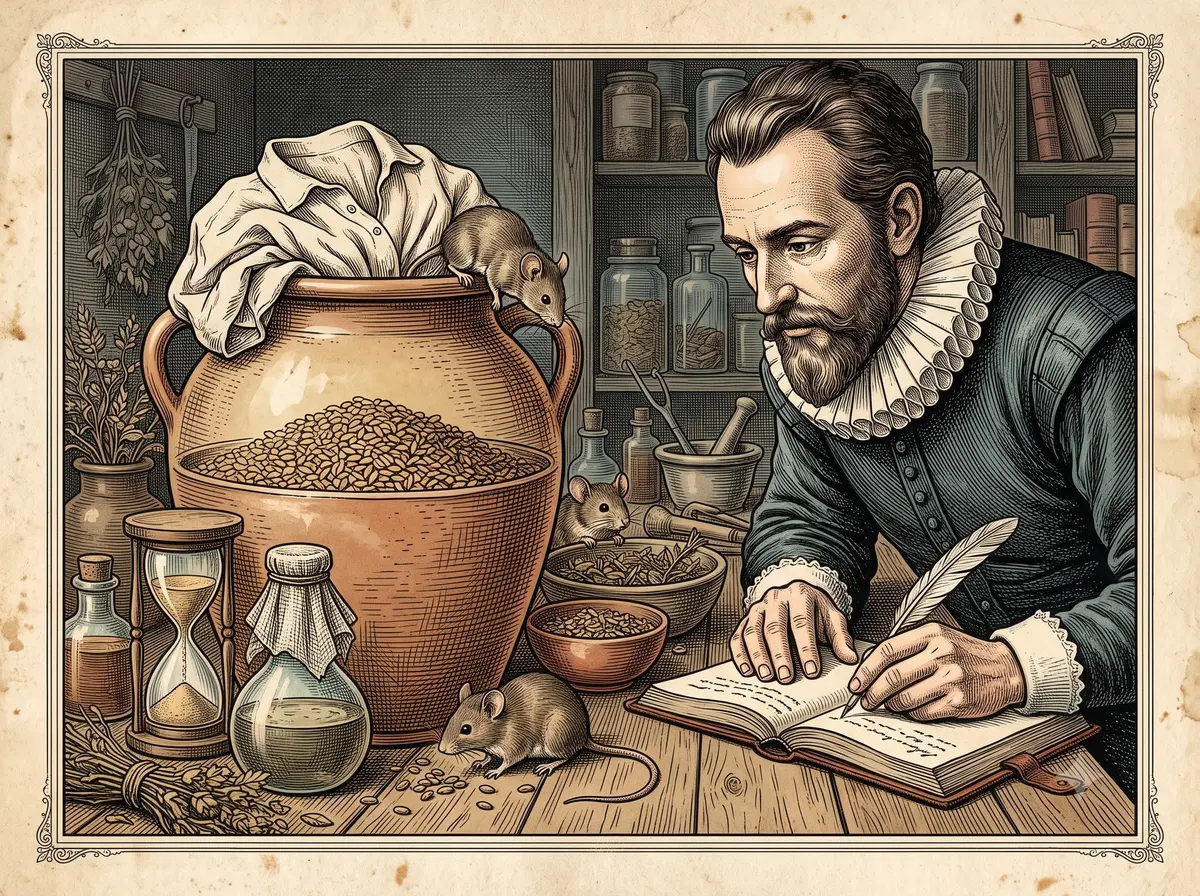
Take a dirty shirt — the sweatier the better. Stuff it into the mouth of a jar packed with wheat. Leave it alone for twenty-one days. At the end of three weeks, according to a respected seventeenth-century physician, you will have mice. Not mice that wandered in. Mice that the wheat *became*.
By the Curiosities Desk · · 5 min read · Filed under Biology · Today’s round
Part of The Version Everyone Remembers
What happened: The Recipe for Making Mice Out of a Sweaty Shirt and a Jar of Wheat
The recipe belongs to Jan Baptist van Helmont, a Flemish physician born in Brussels around 1580, and he was not a crank. Van Helmont was one of the most serious experimental chemists of his century. He coined the word gas — from the Greek chaos — and was the first to argue that some “airs” were chemically distinct from ordinary air, identifying what we now call carbon dioxide and methane. He also ran what may be the earliest careful quantitative experiment in plant biology, growing a willow sapling in a weighed tub of soil for five years and discovering that the tree gained roughly 160 pounds while the soil lost only a couple of ounces. He got the conclusion wrong (he decided the tree was made of water) but the method — weigh everything, before and after — was ahead of its time.
So when van Helmont wrote down a procedure for producing mice, he was not doing magic. He was doing what he thought was chemistry. He had a working theory: living things could be assembled out of non-living matter when the right ferment — a shaping principle, roughly what we’d now call an active ingredient — met the right raw material. Wheat supplied the substance. Sweat, soaked into cloth, supplied the ferment. Twenty-one days supplied the time.
The recipes survive in Ortus medicinae (The Rise of Medicine), the collection of his writings published in 1648, four years after his death, by his son Franciscus Mercurius. Two things are worth saying carefully. The crisp English “recipe” quoted in textbooks today is a loose modern rendering, not a verbatim translation; the wording drifts from telling to telling. And it isn’t clear how far he actually tested it — his notes suggest he may have tried, but no one has produced a notebook showing him standing over a jar counting days.
He was also not an outlier. Spontaneous generation — the idea that living things routinely arise from non-living matter — had been mainstream since Aristotle. Eels came from river mud. Frogs came from spring rain. Maggots came from meat. Everybody could see it happening.
Then, in 1668, an Italian physician named Francesco Redi decided to actually check.
Redi, court physician in Florence, had read William Harvey’s speculation that small creatures might come from seeds or eggs too tiny to see. So he put meat in a series of flasks — some open, some sealed. Maggots appeared only in the open ones. Suggestive, but Redi spotted the flaw himself: the sealed flasks had no air, and maybe air was what the meat needed. So he ran it again with a third condition, flasks covered with what he called “a fine Naples veil” — gauze fine enough to stop insects but open enough to let air through.
The result is one of the most quietly satisfying paragraphs in the history of biology. “I never saw any worms in the meat,” Redi wrote, “though many were to be seen moving about on the net-covered frame.” Flies buzzed around the gauze and laid their eggs on the outside of it. The meat rotted, undisturbed, maggot-free.
Why it was strange: The Recipe for Making Mice Out of a Sweaty Shirt and a Jar of Wheat
The strange part is not that a smart man believed something wrong. It’s that the belief was, by the standards of ordinary observation, extremely well supported. Nobody in 1600 had ever watched a fly lay eggs on a joint of meat and then watched those specks become maggots. What they had watched, thousands of times, was meat sitting out and maggots appearing. Grain stored in a barn and mice appearing. The theory fit the data. The data were incomplete in a way no amount of looking harder could fix.
What Redi added was not a better microscope or a sharper eye. It was a control — a version of the setup that differs in exactly one respect. Air got into both. Only the flies were excluded. That single change turned a story into a test.
Another claim that stuck harder than the correction: The Starlings America Blamed on Shakespeare — and the One Sentence That Invented the Story.
What scientists learned: The Recipe for Making Mice Out of a Sweaty Shirt and a Jar of Wheat
Redi’s flasks are usually taught as the moment spontaneous generation died. They weren’t. Redi himself kept believing that some organisms — gall wasps that emerge from swellings on oak leaves, worms found inside animal intestines — really did arise spontaneously, since he couldn’t see how they got in. Historians have argued he was more careful about this than the caricature suggests. He had reasons; they just weren’t good enough.
The idea took another two centuries to finish dying. John Needham boiled broth in 1745, saw it cloud, and declared spontaneous generation alive. Lazzaro Spallanzani boiled longer and sealed better and saw nothing grow — but critics said he’d just cooked the air. Louis Pasteur settled it in the 1860s with swan-necked flasks: broth open to the air through a long S-curve that let gases pass but trapped falling dust. The broth stayed clear for years. Tip the flask so the liquid touched the neck, and it clouded within days.
The real lesson wasn’t about mice. It was that “I have watched this happen many times” is not the same as “I know why this happens.”
Another story that outran the evidence: The Lemmings That Never Jumped Off the Cliff.
How it reaches us today: The Recipe for Making Mice Out of a Sweaty Shirt and a Jar of Wheat
Redi’s gauze is the ancestor of every sterile technique in modern life. Canning, pasteurization, the autoclave in a dentist’s office, the filter on a laboratory air handler — all downstream of the discovery that contamination arrives from somewhere and can be kept out.
And the experimental structure outlived the question. When a drug trial gives half its subjects a placebo, when an ecology study fences off a plot to exclude grazers, when a factory keeps one production line unchanged to compare against a new one, that is Redi’s third flask. Change one thing. Leave the rest alone. See what happens.
One clarification: none of this rules out that life arose from non-living chemistry once, very long ago. That question — abiogenesis — is an active research field, and it is not the same claim as “mice come from wheat.” The difference is a few billion years and a much stricter standard of evidence.
A close cousin: The Myth That You Only Use 10% of Your Brain.
Fun fact: The Recipe for Making Mice Out of a Sweaty Shirt and a Jar of Wheat
Mice weren’t van Helmont’s only recipe. He also described how to make scorpions: hollow out a depression in a brick, pack it with crushed basil, cover it with a second brick, and leave the whole thing in the sun. The fumes, he reasoned, would do the rest. As far as anyone knows, no basil has ever complied.
Sources: The Recipe for Making Mice Out of a Sweaty Shirt and a Jar of Wheat
- Francesco Redi, Experiments on the Generation of Insects (1688 Italian edition, trans. Mab Bigelow, 1909) — the primary source, including the “fine Naples veil” experiment in Redi’s own words.
- Jan Baptist van Helmont, Ortus medicinae (1648) — the posthumous collection containing the spontaneous-generation recipes.
- Linda Hall Library, “Scientist of the Day: Joan Baptista van Helmont” — on van Helmont’s coinage of “gas,” the willow-tree experiment, and his house arrest.
- Encyclopædia Britannica, “Francesco Redi” — on the flask experiments and Redi’s continuing belief in spontaneous generation for gall flies and intestinal worms.
- E. C. Parke, “Flies from meat and wasps from trees: Reevaluating Francesco Redi’s spontaneous generation experiments,” Studies in History and Philosophy of Biological and Biomedical Sciences (2014) — a scholarly reassessment of what Redi actually concluded.
Related stories: The Recipe for Making Mice Out of a Sweaty Shirt and a Jar of Wheat
- Spontaneous Human Combustion: The Myth That Refused to Burn Out — The myth of people bursting into flame, and the physics behind it
- The Lemmings That Never Jumped Off the Cliff — Disney pushed the lemmings off the cliff, not the lemmings
- The Myth That You Only Use 10% of Your Brain — You use all of your brain; the myth just will not die