The Lemmings That Never Jumped Off the Cliff
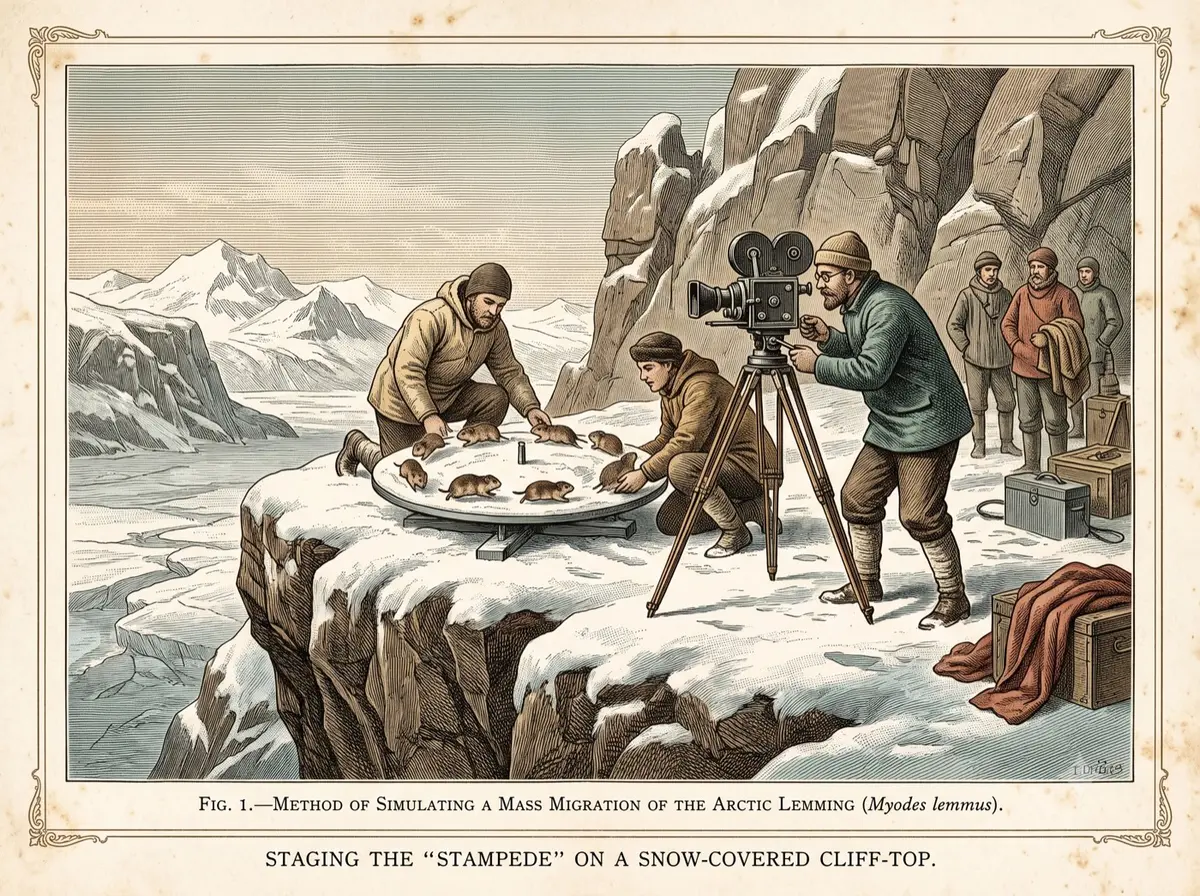
A camera crew stands on a clifftop in Alberta, Canada. Below them is a river — not the Arctic Ocean, though the film will say it is. A few dozen small Arctic rodents are tipped onto a snow-covered turntable and spun to make a handful look like a stampeding multitude. Then they are pushed, again and again, off the edge. The narrator's voice, warm and assured, calls it nature's most haunting ritual: a mass march to a watery grave. None of it is real. And it would convince the world for decades.
By the Curiosities Desk · · 5 min read · Filed under Biology · Today’s round
Part of The Version Everyone Remembers
What happened: The Lemmings That Never Jumped Off the Cliff
In 1958, Walt Disney Productions released White Wilderness, a feature-length nature film in its popular True-Life Adventures series. It was directed by James Algar, narrated by Winston Hibler, and filmed over roughly three years. Audiences loved it. Critics loved it. The film won the Academy Award for Best Documentary Feature at the 31st Academy Awards in 1959.
Its most unforgettable sequence showed lemmings — small, round, Arctic rodents — surging across the tundra in a great migration, then pouring over a cliff into the sea below, where they swam until they drowned. The footage seemed to confirm something people had whispered about for generations: that lemmings, gripped by some dark instinct, periodically commit mass suicide.
The truth came out in 1982. The Canadian Broadcasting Corporation’s investigative program The Fifth Estate aired a documentary called Cruel Camera, examining animal mistreatment in film and television. Host Bob McKeown traced the famous lemming scene and found that it had been staged. The lemmings were not filmed in their native range plunging into the Arctic Ocean. They were transported to a location near the Bow River by Canmore, Alberta — a landlocked spot far from any sea. The filmmakers had only a small number of animals, so they used a snow-covered turntable and tight camera angles to fake the look of an unstoppable horde. Then the crew drove the lemmings off the cliff. Wildlife filmmaker James R. Simon, who worked freelance for Disney, has been credited with staging the sequence; the Walt Disney Family Museum has maintained he did so without the studio’s knowledge.
The cruelest irony? The species used reportedly doesn’t even migrate the way the film claimed.
Why it was strange: The Lemmings That Never Jumped Off the Cliff
The strangeness isn’t only that a beloved, Oscar-winning documentary faked one of its signature scenes. It’s that the film didn’t invent the myth — it inherited one and gave it a polished, official-looking face.
The idea that lemmings hurl themselves to their deaths is old. Centuries ago, naturalists couldn’t explain why lemming numbers seemed to explode and then vanish, so they reached for fantastical answers. In 1532, the geographer Jacob Ziegler proposed that lemmings fell from the sky during storms and died when the spring grass grew. By the late 1800s the suicide version was circulating: an 1877 article in Popular Science Monthly described lemmings supposedly swimming out into the Atlantic in search of a sunken continent. In 1955, a Disney comic by artist Carl Barks, The Lemming with the Locket, drew swarms of lemmings leaping over Norwegian cliffs.
So when White Wilderness arrived, it dropped a moving picture into a story people were already primed to believe. A myth that had survived on hearsay suddenly had “footage.”
Another story that outran the evidence: The Starlings America Blamed on Shakespeare — and the One Sentence That Invented the Story.
What scientists learned: The Lemmings That Never Jumped Off the Cliff
Real lemming biology is, if anything, stranger than the legend. Lemmings live in Arctic tundra and don’t hibernate; they tunnel beneath the snow all winter. Their populations swing wildly, booming roughly every four years and then crashing toward near-extinction. The Norway lemming and West Siberian lemming reproduce so explosively that biologists describe their population dynamics as genuinely chaotic — not smooth cycles, but mathematically unpredictable swings. Exactly why this happens is still not fully settled, though predators like stoats and owls appear to be deeply involved.
When numbers get too dense, some lemmings disperse, striking out in search of food and space. Driven by powerful biological urges, they may move in large groups and, on reaching a river or lake, try to cross it. Some misjudge the distance, tire, and drown. That is the kernel of truth the myth grew around: not a chosen death, but a risky migration with casualties — ordinary animal behavior, not a suicide pact. Lemmings have no desire to die. They are simply trying, sometimes fatally, to live.
Another claim that stuck harder than the correction: The Myth That You Only Use 10% of Your Brain.
How it reaches us today: The Lemmings That Never Jumped Off the Cliff
The word “lemming” has become shorthand for mindless conformity — for people who follow the crowd off a metaphorical cliff. That meaning rests entirely on a story that isn’t true, which makes the myth a small masterclass in how misinformation works. A real mystery (why do populations crash?) gets a tidy false answer (they kill themselves), the false answer gets repeated until it feels obvious, and then a single vivid image — here, staged film — locks it in place.
It’s also a useful reminder to watch how a claim is delivered. The lemming footage felt authoritative precisely because it was beautifully shot, professionally narrated, and award-winning. Polish is not proof. The most convincing-looking evidence can be the most carefully arranged.
A close cousin: The Recipe for Making Mice Out of a Sweaty Shirt and a Jar of Wheat.
Fun fact: The Lemmings That Never Jumped Off the Cliff
The myth is so embedded in culture that the hit 1991 puzzle video game Lemmings — in which you guide hordes of little creatures away from walking blindly to their doom — takes its entire premise from a behavior the animals never actually had.
Sources: The Lemmings That Never Jumped Off the Cliff
- “Lemming,” Wikipedia — https://en.wikipedia.org/wiki/Lemming
- “White Wilderness (film),” Wikipedia — https://en.wikipedia.org/wiki/White_Wilderness_(film)
- Henry Nicholls, “The truth about Norwegian lemmings,” BBC Earth, Nov. 21, 2014 — https://www.bbc.com/future/article/20141127-the-truth-about-norwegian-lemmings
- “White Wilderness Faked Lemming Suicides,” Snopes, Dec. 12, 2015 — https://www.snopes.com/fact-check/lemming-suicide-myth/
Related stories: The Lemmings That Never Jumped Off the Cliff
- The Myth That You Only Use 10% of Your Brain — You use all of your brain; the myth just will not die
- The Recipe for Making Mice Out of a Sweaty Shirt and a Jar of Wheat — A recipe that promised to make mice from a sweaty shirt
- The Million-Dollar Space Pen Myth — and the $128.89 Pencils NASA Actually Bought — NASA never spent millions on a zero-gravity pen