The Million-Dollar Space Pen Myth — and the $128.89 Pencils NASA Actually Bought
You've probably heard the story. Faced with the problem that ballpoint pens don't work in zero gravity, NASA spent millions of taxpayer dollars engineering a pen that could write in space — while the Soviets, with unbeatable common sense, just used a pencil. It's the perfect parable about overthinking. It's been retold in chain emails, at dinner parties, and on an episode of *The West Wing*. And nearly every part of it is wrong — including the part where the real writing-utensil scandal at NASA involved pencils that cost $128.89 apiece.
By the Curiosities Desk · · 5 min read · Filed under Space · Today’s round
Part of The Version Everyone Remembers
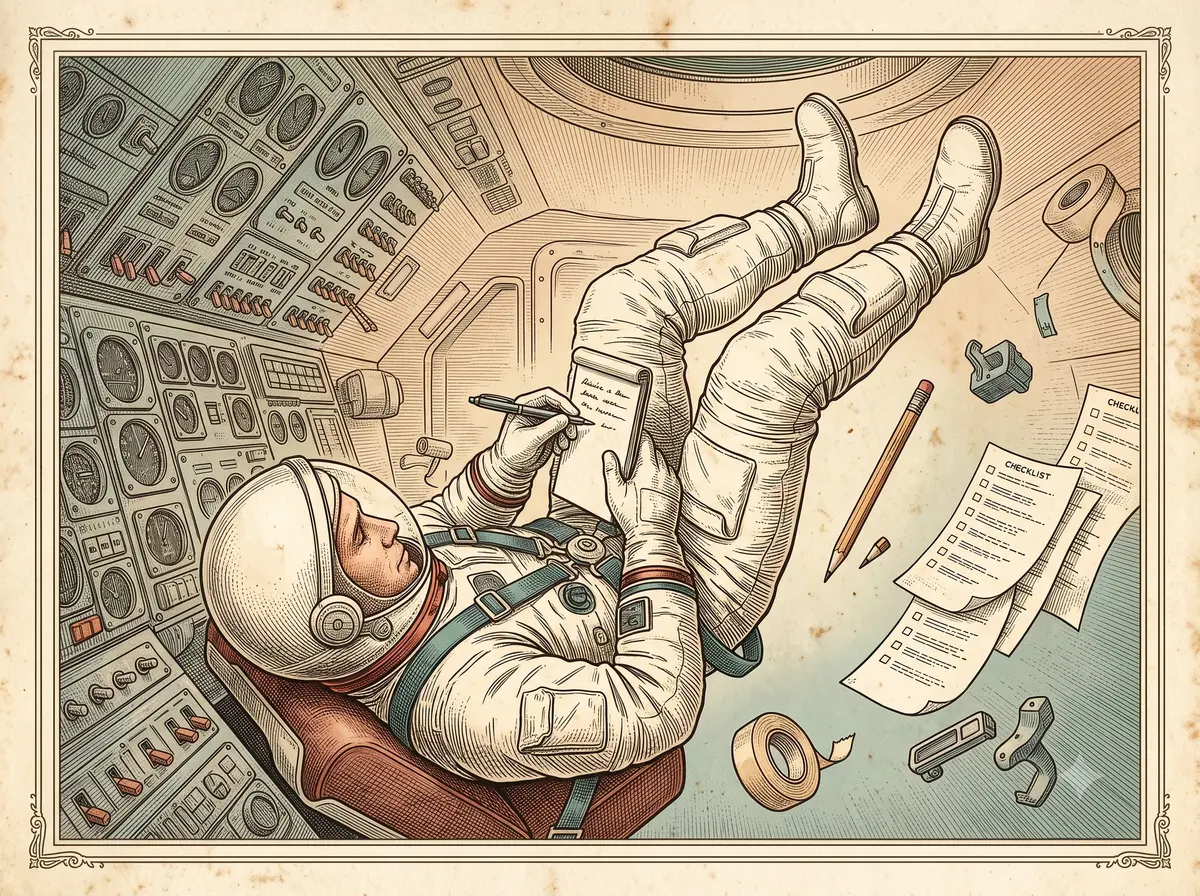
What happened: The Million-Dollar Space Pen Myth — and the $128.89 Pencils NASA Actually
In the early years of American spaceflight, astronauts wrote things down the same way Soviet cosmonauts did: with pencils. Nobody had spent millions on anything. In fact, in 1965 NASA ordered 34 mechanical pencils from Tycam Engineering Manufacturing of Houston, paying $4,382.50 — which works out to $128.89 per pencil. When that price became public, there was an outcry over government waste, and NASA scrambled to find something cheaper.
So the one documented writing-instrument spending scandal of the space race was about pencils, not pens.
Pencils had bigger problems than price. In microgravity, a snapped-off pencil tip doesn’t fall to the floor — it floats, and a drifting shard of conductive graphite can find its way into an eye, a nose, or an electrical panel. Wood and graphite also burn, which became an unbearable risk after the Apollo 1 fire killed three astronauts in January 1967.
Enter Paul C. Fisher, the head of the Fisher Pen Company. Without any contract from NASA — the agency wasn’t involved at all — Fisher reportedly spent about $1 million of his company’s own money developing a pen that didn’t need gravity. In 1965 he patented the result and offered it to NASA as the AG-7 “Anti-Gravity” pen. It could write upside down, underwater, in temperatures from roughly –50 to 400 degrees Fahrenheit, and, most importantly, in orbit. (It had one endearing quirk: if it got too hot, the blue ink wrote green.)
Still smarting from the pencil fiasco, NASA was wary of fancy writing instruments. The agency tested the pen intensively before approving it for spaceflight in 1967. According to an Associated Press report from February 1968, NASA then ordered 400 of Fisher’s pens for the Apollo program. And here’s the punchline the myth never includes: a year later, the Soviet Union ordered 100 of the very same pens, plus 1,000 ink cartridges, for its Soyuz missions. Both superpowers got the same 40 percent bulk discount, paying $2.39 per pen instead of the list price of $3.98.
The Cold War’s two space programs, locked in a battle for the heavens, were haggling for the same ballpoint at the same volume discount.
Why it was strange: The Million-Dollar Space Pen Myth — and the $128.89 Pencils NASA Actually
The myth survives because it flatters a satisfying belief: that big institutions overcomplicate everything, and that a plain, humble fix — the pencil — was sitting there all along. The reality inverts every beat of the story. NASA never spent millions on a pen; a private businessman did, betting his own money that the space program would want it. The pencil wasn’t the smart solution; it was the hazard. And the thrifty Soviets didn’t outwit anyone — they bought the American pen too, at the same price.
It’s rare for a legend to be wrong in such a perfectly symmetrical way. The story of bureaucratic excess turns out to be a story of private invention solving a real safety problem for $2.39 a unit.
Another story that outran the evidence: The Great Wall ‘Visible From the Moon’ — Promised 215 Years Before Anyone Could Check.
What scientists learned: The Million-Dollar Space Pen Myth — and the $128.89 Pencils NASA Actually
The engineering inside the Fisher pen is a small masterclass in working with physics instead of against it. An ordinary ballpoint is gravity-fed: ink slides down onto the rotating ball because down exists. In orbit, there is no down. Fisher’s cartridge is sealed and pressurized with nitrogen at 35 pounds per square inch, so the gas — not gravity — pushes ink toward the tungsten carbide ball at the tip.
The ink itself is thixotropic, meaning it behaves like a gel-like solid until it’s stirred or sheared — in this case by the rolling ball — at which point it flows like a liquid. That keeps a pressurized pen from leaking in your pocket. The sealed nitrogen also keeps air away from the ink, so it can’t evaporate or oxidize, which is why the cartridges have shelf lives measured in decades.
The pencil episode taught a broader lesson about spacecraft design: in a sealed capsule full of pure oxygen and delicate electronics, there is no such thing as a trivial object. Even a pencil tip is a system risk.
Another claim that stuck harder than the correction: The Newspaper Hoax That Put Bat-People on the Moon.
How it reaches us today: The Million-Dollar Space Pen Myth — and the $128.89 Pencils NASA Actually
Fisher Space Pens have flown with American astronauts and Russian cosmonauts continuously since the late 1960s, through the shuttle era, the Mir space station, and the International Space Station. You can buy essentially the same pen today at an ordinary price — one of the cheapest pieces of genuine space hardware a person can own.
The myth, meanwhile, has its own legacy. “NASA spent millions on a pen; the Russians used a pencil” is still deployed in business books and meetings as a lesson about overengineering. It’s worth knowing the true version, because the real lesson is nearly the opposite: sometimes the simple solution is quietly dangerous, and the “overengineered” one is cheap, safe, and so good that your rival buys it too.
A close cousin: The Moon Golf Shot That Went ‘Miles and Miles and Miles’ — and Actually Went 40 Yards.
Fun fact: The Million-Dollar Space Pen Myth — and the $128.89 Pencils NASA Actually
A pen really did help save Apollo 11 — just not the Space Pen. When a circuit breaker switch needed to arm the ascent engine snapped off inside the lunar module, Buzz Aldrin pushed the breaker in with a felt-tip marker, chosen because its plastic body wouldn’t short the live circuit. The Fisher company’s version of the tale features its own pen, but Aldrin has been clear it was a humble felt-tip that got the astronauts off the Moon.
Sources: The Million-Dollar Space Pen Myth — and the $128.89 Pencils NASA Actually
Related stories: The Million-Dollar Space Pen Myth — and the $128.89 Pencils NASA Actually
- The Corned Beef Sandwich That Got NASA Hauled Before Congress — A smuggled sandwich in orbit triggered a congressional hearing
- The Lemmings That Never Jumped Off the Cliff — Disney pushed the lemmings off the cliff, not the lemmings
- The Myth That You Only Use 10% of Your Brain — You use all of your brain; the myth just will not die