The Great Wall 'Visible From the Moon' — Promised 215 Years Before Anyone Could Check
In May 2004, the European Space Agency proudly published a satellite photo showing the Great Wall of China snaking across the hills northeast of Beijing — settling, at last, an argument that had run for 250 years. Eight days later, ESA published a correction. The winding line in the picture wasn't the Great Wall. It was a river.
By the Curiosities Desk · · 5 min read · Filed under Space · Today’s round
What happened?
The idea that you can see the Great Wall from space is older than spaceflight. Much older. In 1754, the English physician and antiquarian William Stukeley — best known for his studies of Stonehenge — wrote in a letter that “the Chinese wall … makes a considerable figure upon the terrestrial globe, and may be discerned at the moon.” Stukeley had never been to China, and nobody had been to the Moon. It was a flourish about scale, not a measurement.
The line stuck anyway. In 1895, the journalist Henry Norman wrote that the wall “enjoys the reputation of being the only work of human hands on the globe visible from the moon.” In 1932, a Ripley’s Believe It or Not! cartoon called it “the mightiest work of man, the only one that would be visible to the human eye from the moon.” And in 1938, the bestselling adventure writer Richard Halliburton told young readers in his Second Book of Marvels that “astronomers say that the Great Wall is the only man-made thing on our planet visible to the human eye from the moon.” No astronomer seems to have been named.
Then, in 1969, people actually went to the Moon — 215 years after Stukeley’s letter. Neil Armstrong, according to a NASA oral history, saw continents, lakes, and splotches of white on blue, but no human structures. Apollo 12’s Alan Bean put it plainly: from the Moon you see “a beautiful sphere, mostly white, some blue and patches of yellow, and every once in a while some green vegetation. No man-made object is visible at this scale.”
That should have ended it. Instead, the myth quietly downshifted from “visible from the Moon” to “visible from space.” The new version got its real test in October 2003, when Yang Liwei became China’s first astronaut, circling Earth 14 times aboard Shenzhou 5. Back on the ground, reporters asked the obvious question. He said he hadn’t seen the wall. Online forums in China erupted with disappointment, and the Ministry of Education moved to revise elementary-school textbooks that had long said the wall was visible from orbit.
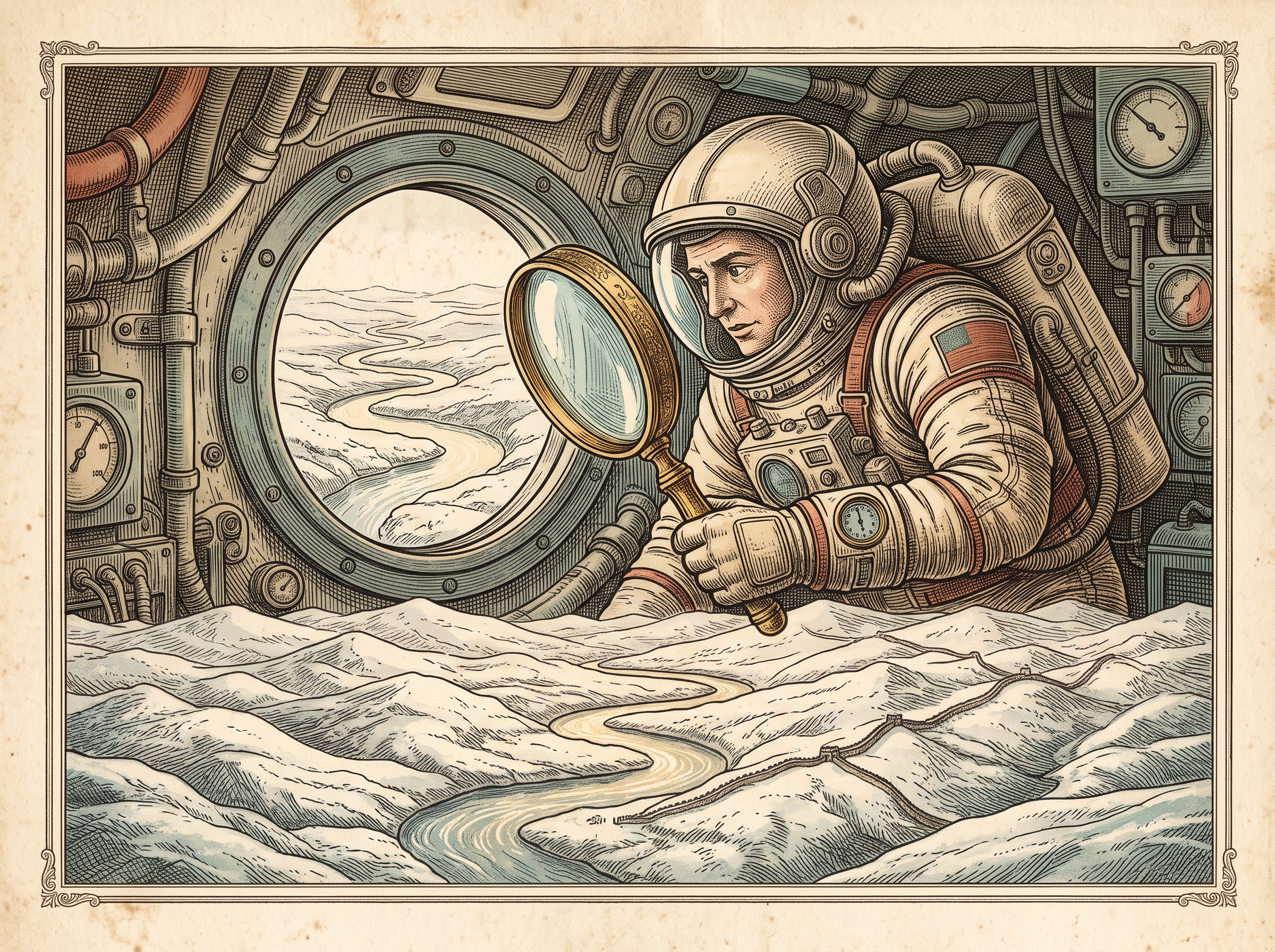
Months later, retired Apollo astronaut Eugene Cernan said that from low orbit the wall was visible to the naked eye under the right conditions. On May 11, 2004, ESA ran its feature with a satellite image from its PROBA spacecraft that appeared to back him up. Readers — including researchers at California State University and Fudan University in Shanghai — wrote in. On May 19, ESA apologized: the “wall” was a river running into the Miyun Reservoir, and “the image was not properly investigated in advance of publication.”
The wall finally did get its portrait that November. On November 24, 2004, NASA astronaut Leroy Chiao photographed a stretch of Inner Mongolia from the International Space Station using a digital camera with a 180mm lens — a zoom lens, well beyond what the eye can do. NASA analysts concluded it showed small sections of the wall, helped by a sunny day and a fresh snowfall. Chiao himself said he hadn’t seen the wall and wasn’t sure the photo showed it.
Why was it strange?
Because the claim was “proven” for two centuries without a single observation. It sounded right: the wall is enormous, so surely it must stand out. But that intuition confuses length with width. And there’s a human twist: the wall’s visibility had become a point of national pride in China, so the person who finally punctured the myth was the one with the most reason to want it true — a Chinese astronaut who simply reported what he saw.
And when a space agency finally thought it had proof, it fell into the same trap: a long, winding line looks like a wall if you’re expecting one.
Another story that outran the evidence: The Astronomer Who Saw Canals on Mars That Weren’t Real.
What did scientists learn?
Whether you can see something from far away depends on its angular size — how wide it appears from where you stand — and on contrast, how different it looks from its background. Length barely matters.
In a 2008 letter to the Journal of Optometry, vision scientist Norberto López-Gil of the University of Murcia ran the numbers. The wall runs for thousands of kilometers but is usually less than 6 meters wide. Looking at it from 160 kilometers up is like looking at a 2-centimeter cable from more than half a kilometer away. To spot it at a glance, you’d need visual acuity (sharpness of vision) about 7.7 times better than normal — more than three times sharper than an eagle’s. From the Moon, he calculated, you’d need eyes about 17,000 times better than normal.
Contrast makes it harder still. “The color of the wall is not that different from the ground on either side of it,” former NASA astronaut Jeffrey Hoffman told Scientific American; in five shuttle flights, he never saw it. NASA’s Kamlesh Lulla made the same point: the wall’s materials are similar in color and texture to the surrounding dirt. Meanwhile, astronauts readily spot roads, runways, reservoirs, irrigation ditches, and cities at night — things that are wide, straight, or bright against their surroundings.
Another claim that stuck harder than the correction: The Million-Dollar Space Pen Myth — and the $128.89 Pencils NASA Actually Bought.
How does it affect us today?
The wall is visible from space — to the right instruments. In 1994, the Spaceborne Imaging Radar flown on Space Shuttle Endeavour captured sections of it in the desert west of Beijing as a crisp line, and even detected older, buried segments invisible from the ground. Radar works because it measures surface texture and structure, not color, so a wall that blends in to the eye can stand out to a radar beam. Satellite analysts today still lean on contrast tricks; the U.S. Geological Survey has noted that Landsat images show the wall best when snow covers the fields but has been cleared from the wall itself.
The myth itself has become a teaching tool: a claim can feel scientific — an unnamed “astronomers say” — without ever being tested.
A close cousin: The Moon Golf Shot That Went ‘Miles and Miles and Miles’ — and Actually Went 40 Yards.
Fun fact
If a 6-meter-wide wall were visible from orbit, it wouldn’t be the only human-made thing up there worth spotting. As López-Gil pointed out, astronauts would also be able to see the Pyramids, the Golden Gate Bridge, the Eiffel Tower — and probably their own house, if it were more than 6 meters wide.
Sources
- NASA, “China’s Wall Less Great in View from Space” (2005): https://www.nasa.gov/wp-content/uploads/static/history/PDFs/great_wall_less_great_from_space.pdf
- López-Gil, N., “Is it Really Possible to See the Great Wall of China from Space with a Naked Eye?” Journal of Optometry 1(1):3–4 (2008), doi:10.3921/joptom.2008.3: https://www.journalofoptometry.org/en-download-pdf-S1888429608700542
- Hvistendahl, M., “Is China’s Great Wall Visible from Space?” Scientific American (2008): https://www.scientificamerican.com/article/is-chinas-great-wall-visible-from-space/
- European Space Agency correction, “‘Great Wall of China’ image was a river” (May 19, 2004), reprinted by Times Higher Education: https://www.timeshighereducation.com/news/correction-great-wall-of-china-image-was-a-river/188872.article
- Snopes, “Is the Great Wall of China Visible from the Moon?”: https://www.snopes.com/fact-check/great-wall-from-moon/