The Astronomer Who Saw Canals on Mars That Weren't Real
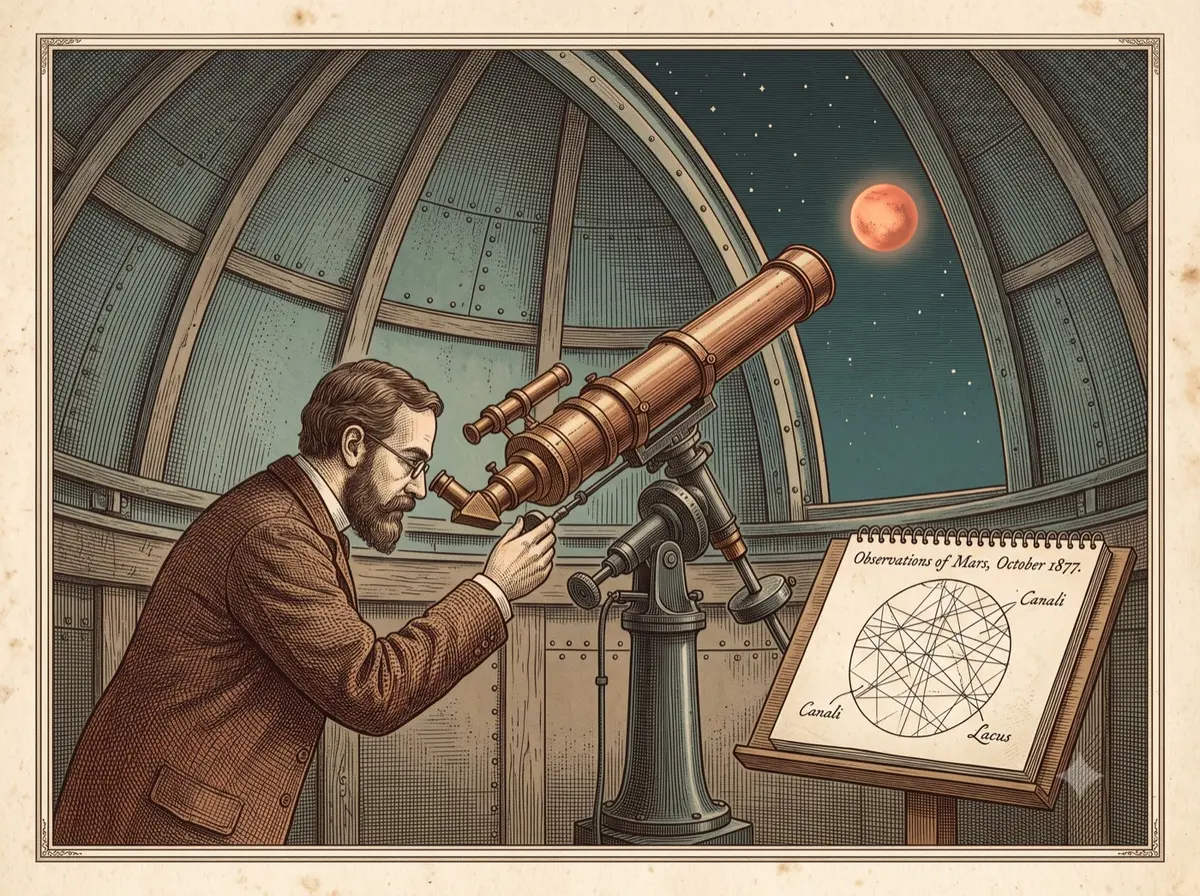
On clear desert nights in the 1890s, a wealthy Bostonian named Percival Lowell climbed into the dome of his private observatory in Flagstaff, Arizona, pressed his eye to the telescope, and sketched something no one else on Earth could confirm: a network of perfectly straight lines crisscrossing the surface of Mars. He believed he was watching the last engineering project of a dying alien civilization. He spent the rest of his life trying to prove it.
By the Curiosities Desk · · 6 min read · Filed under Space · Today’s round
What happened: The Astronomer Who Saw Canals on Mars That Weren't Real
The story starts with a mistranslation. During Mars’s close approach to Earth in 1877, Italian astronomer Giovanni Schiaparelli spent hours at the eyepiece of the Brera Observatory’s telescope in Milan, sketching faint linear features across the planet’s ochre disk. He called them canali — Italian for “channels” or “grooves,” a neutral word that could describe a natural gully as easily as a man-made ditch. When his work was translated into English, canali became “canals.” The word implied something Schiaparelli never claimed: that someone had built them.
Percival Lowell picked up that implication and ran with it. A Harvard-educated businessman and diplomat, Lowell turned to astronomy in his late thirties, inspired partly by French astronomer Camille Flammarion’s popular writing on the possibility of life on other worlds. In the winter of 1893–94, he founded his own observatory on a mesa outside Flagstaff, chosen for its high altitude, dry air, and dark skies — ideal conditions for observing Mars.
Lowell didn’t just confirm Schiaparelli’s canals. He expanded on them dramatically, eventually charting several hundred, some of which appeared to run in mysterious parallel pairs he called “gemination,” or doubling. He built an entire theory around what he saw: Mars, he argued, was an old, dying world whose surface water had retreated to the polar ice caps. An advanced Martian civilization, facing planet-wide drought, had built a global irrigation network to funnel meltwater from the poles to farmland near the equator. Lowell laid out this vision across three books — Mars (1895), Mars and Its Canals (1906), and Mars As the Abode of Life (1908) — and the public devoured it. Newspapers ran maps of the “canals.” The idea of a Martian civilization, however doomed, became a fixture of popular culture; H. G. Wells’s novel The War of the Worlds, serialized in 1897, arrived in the middle of that same wave of Mars fascination.
Not everyone was convinced — including Schiaparelli, who considered much of Lowell’s fine detail imaginary. The British naturalist Alfred Russel Wallace, co-discoverer of the theory of evolution by natural selection, published a book-length rebuttal in 1907, Is Mars Habitable?, arguing on physical grounds that Mars was almost certainly too cold, and its atmosphere too thin, for liquid water to exist on its surface.
The most telling challenge came from an experiment, not a telescope. In 1903, astronomers Joseph Evans and E. Walter Maunder tested whether the eye could be fooled into seeing lines that weren’t there. They sat schoolboys at various distances from a disc marked with random, disconnected blotches and asked them to sketch what they saw. Seated far enough away, the boys’ eyes did exactly what Lowell’s had done: they linked the scattered marks into straight lines. By 1909, sharper instruments settled the matter further. Mount Wilson Observatory’s 60-inch telescope in California, and separately the 32-inch telescope at Meudon Observatory near Paris, resolved Mars’s surface into irregular natural terrain — craters, ridges, shading — with no straight lines anywhere.
Even so, the myth had enough cultural momentum to survive for decades. As late as 1965, an official U.S. government reference, the Sourcebook on the Space Sciences, still hedged on whether Mars had genuine linear surface markings. It took a spacecraft to end the debate. On the night of July 14–15, 1965, NASA’s Mariner 4 probe flew within 6,118 miles of Mars — the first spacecraft ever to do so — and beamed back 22 grainy photographs covering roughly 1% of the planet’s surface. They showed a cratered, moonlike wasteland: no canals, no vegetation, no oceans. Instruments recorded an atmosphere about 1% as dense as Earth’s, surface temperatures near -100°C, and no detectable magnetic field or radiation belts. The Mars of Lowell’s dying civilization dissolved in a week of data.
Why it was strange: The Astronomer Who Saw Canals on Mars That Weren't Real
This wasn’t a fringe theory pushed by an outsider. Lowell was a serious, well-funded, Harvard-trained astronomer who built an entire research institution to chase this idea and published his findings through respectable channels for two decades. Other trained observers, using real telescopes, reported seeing the same lines. The strangeness isn’t that one man got carried away — it’s that a substantial slice of the scientific and public establishment took the possibility of an engineered Martian civilization seriously, based on nothing more exotic than eyes and glass pointed at a red dot in the sky.
It shares a shelf with The Sea Monster Rebuilt With Its Head on the End of Its Tail, in Science’s Most Embarrassing Mistakes.
What scientists learned: The Astronomer Who Saw Canals on Mars That Weren't Real
The deeper lesson was about human perception under uncertainty. When the eye strains at the limit of a telescope’s resolving power, the brain doesn’t register a blank — it fills the gap with the simplest coherent shape it can find, often a straight line connecting faint, disconnected points. Combine that built-in shortcut with an observer who already expects to find intelligent design, and an optical illusion can calcify into hundreds of hand-drawn “data” maps over twenty years. The canals affair pushed astronomy toward photography over hand sketches, and toward insisting a striking result be independently reproduced with better instruments before it counts as real.
Also in Science’s Most Embarrassing Mistakes: Clever Hans: The Horse That Could ‘Do Math’.
How it reaches us today: The Astronomer Who Saw Canals on Mars That Weren't Real
The same perceptual trap resurfaced with Mars itself. In 1976, NASA’s Viking 1 orbiter photographed a mesa in the planet’s Cydonia region that, in low resolution and dramatic shadow, looked eerily like a carved human face. The “Face on Mars” fueled fresh speculation for over twenty years, until the Mars Global Surveyor and Mars Reconnaissance Orbiter re-photographed the same mesa at much higher resolution in 1998 and 2001 and revealed an ordinary eroded landform. NASA now treats high-resolution, independently repeated imaging as standard practice for exactly this reason. There’s a quieter irony, too: the observatory Lowell built to chase a civilization that never existed spent the rest of the century doing real astronomy, and in 1930 one of its staff astronomers used it to discover something genuinely new in the outer solar system — the dwarf planet Pluto.
Another from Science’s Most Embarrassing Mistakes: Piltdown Man: The Fake Fossil That Fooled Science for 40 Years.
Fun fact: The Astronomer Who Saw Canals on Mars That Weren't Real
The Italian word Schiaparelli actually used, canali, is closer in meaning to “channels” or “grooves” — a term you might use for something carved by water, wind, or geology. English-language newspapers turned that ordinary word into “canals,” and an entire imagined civilization followed from a single choice of translation.
Sources: The Astronomer Who Saw Canals on Mars That Weren't Real
- NASA — “55 Years Ago: Mariner 4 First to Explore Mars”
- Wikipedia — “Martian canals”
- Evans, J. E. & Maunder, E. W. (1903), “Experiments as to the actuality of the ‘canals’ observed on Mars,” Monthly Notices of the Royal Astronomical Society, 63(8), 488
- Alfred Russel Wallace, “Is Mars Habitable?” (1907), full text via Western Kentucky University’s Wallace archive
- Sharps, Matthew J., “Percival Lowell and the Canals of Mars, Part II: How to See Things That Aren’t There,” Skeptical Inquirer (Nov/Dec 2019)
Related stories: The Astronomer Who Saw Canals on Mars That Weren't Real
- Part of Science’s Most Embarrassing Mistakes
- The Newspaper Hoax That Put Bat-People on the Moon — A newspaper reported bat-winged people living on the Moon
- N-Rays: The Radiation 300 Scientists Saw That Was Never There — Three hundred scientists saw a radiation that did not exist
- The Army Captain Who Asked Congress to Fund a Trip Inside the Earth — An army officer asked Congress to fund an expedition inside the Earth