Science Gone Wrong · Archaeology
The Sea Monster Rebuilt With Its Head on the End of Its Tail
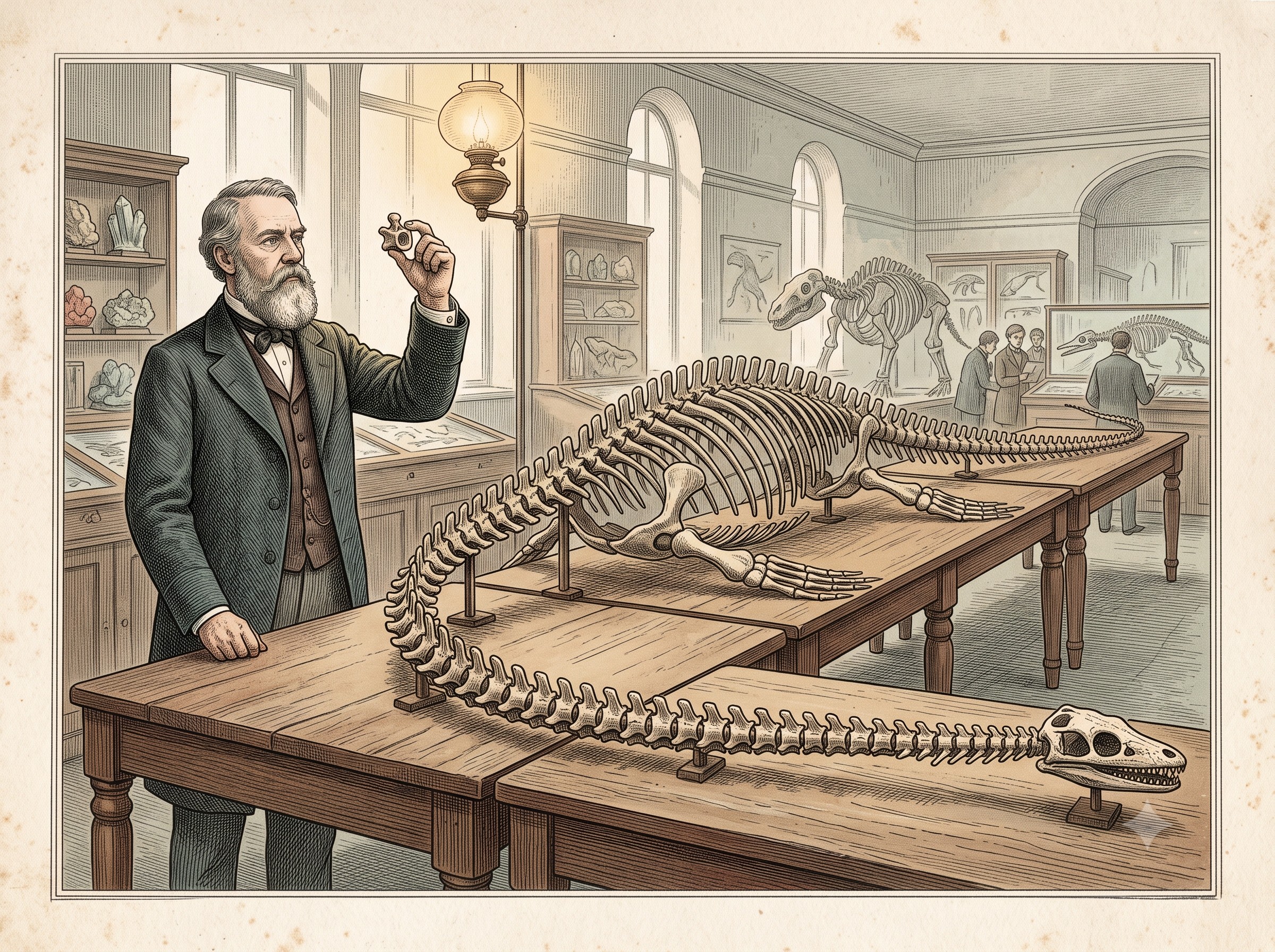
On a March evening in 1870, in a lecture room at the Academy of Natural Sciences in Philadelphia, a soft-spoken anatomist picked up the last vertebra from what everyone had been told was a sea monster's tail. Cradled inside it, still socketed neatly in place, was a knob of bone from the back of the animal's skull. The tail, it turned out, was the neck. The most spectacular fossil in America had been rebuilt backwards, and its head had spent two years attached to the wrong end.
· 5 min read · Filed under Archaeology
What happened?
The bones came out of western Kansas. In the spring of 1867, Dr. Theophilus Hunt Turner — a 26-year-old U.S. Army surgeon posted to Fort Wallace, one of the last outposts on the road to Denver — spotted large fossil bones weathering out of a ravine about twelve miles northeast of the fort.
Turner handed a few vertebrae to a passing railroad survey party, and in November they reached Edward Drinker Cope at the Academy of Natural Sciences of Philadelphia. Cope wrote back immediately asking for the rest. Through the winter of 1867–68, Turner and fellow soldiers dug the animal out with picks and shovels, freeing roughly 35 feet of vertebral column, much of it locked inside limestone concretions weighing a hundred pounds apiece. The crates that rolled east on the Kansas Pacific Railroad weighed close to half a ton.
Cope was 28 and in a hurry. What he unpacked was the largest, most complete marine reptile yet found in North America, and he wanted it named. He could see two runs of articulated vertebrae. One was short. The other ran more than seventy bones, starting the width of a saucer and tapering to about the thickness of a broomstick.
To Cope — trained largely on lizards and snakes, which have short necks and long tails — the answer was obvious. The long tapering run was a tail. The short run was the neck, and it helped that the animal’s crushed muzzle had been found near that end, and that the short vertebrae carried chevron-shaped bones underneath, a feature reptiles usually wear on their tails. He named the creature Elasmosaurus platyurus — roughly, “plated lizard with a flat tail” — and described a beast that sculled through the Cretaceous sea with an enormous paddle-like tail.
One detail nagged. The articulating processes of the vertebrae all seemed to point the wrong way. Rather than treat that as a warning, Cope treated it as a discovery: he erected an entirely new order of reptiles, Streptosauria, meaning “reversed lizards,” to hold this backwards animal. In August 1869 he printed an advance copy of his Synopsis of the Extinct Batrachia and Reptilia of North America with the restored Elasmosaurus as its centerpiece plate, and mailed it to colleagues around the world.
At the Academy meeting of March 8, 1870, Joseph Leidy — Cope’s former mentor and the founding figure of American vertebrate paleontology — said plainly that “Prof. Cope has described the skeleton in a reversed position to the true one.” His evidence was the atlas and axis, the first two neck vertebrae, fused together at the far end of the long series. Still sitting in the cup of the atlas was the occipital condyle, the ball at the base of the skull that the neck plugs into. The vertebrae weren’t reversed. The whole animal was.
Cope moved fast. He asked colleagues to mail his pre-prints back at his own expense, rewrote the description, and reissued the volume in the spring of 1870 with the head where it belonged.
Why was it strange?
The strange part isn’t the error. It’s how thoroughly the error got built upon before it was caught.
Cope didn’t just misread a skeleton. Faced with anatomy that made no sense, he added a whole new branch to the reptile family tree — an order whose defining trait existed only because the animal was pointed the wrong way. Leidy ended it in one sentence: turned around, “the so-called order of Streptosauria fails to maintain its position.” An entire order of reptiles blinked out of existence, not because it went extinct, but because someone flipped the skeleton.
What did scientists learn?
Cope’s mistake was a reasonable one made confidently, which is the most expensive kind. In 1868 nobody knew what a plesiosaur’s proportions should be, because nothing like this had been found in North America, and every clue Cope had — his lizard background, the chevron bones, the muzzle near the short end — pointed the same wrong way. A single unexamined assumption propagated all the way up into a new order of reptiles.
And the animal really was hard to believe. Leidy counted 72 vertebrae in the neck alone, against 24 to 41 for the European plesiosaurs then known, and put the neck at roughly 22 feet without the head. A 2013 re-examination in PLOS ONE confirmed 72 preserved neck vertebrae — still among the longest necks of any animal ever found, beaten only narrowly by its relative Albertonectes. Cope’s real problem was that the truth was more extreme than the mistake.
The other lesson is procedural. Leidy corrected the record in public, in the minutes, in front of twenty-five colleagues, and Cope’s revision was in print within months — messy, a little humiliating, and exactly the mechanism working as designed.
How does it affect us today?
Turn the skeleton the right way around and you get the shape everybody now pictures when they imagine a prehistoric sea: small head, absurd neck, barrel body, four paddles. That silhouette, first assembled correctly at Cope’s expense, went on to furnish a century of museum halls, natural-history illustrations, and every Loch Ness cartoon ever drawn.
The feud is the other legacy. Cope and Othniel Charles Marsh spent the following decades racing each other across the American West in the fossil rush known as the Bone Wars, naming well over a hundred new species between them. The Elasmosaurus blunder is usually told as the spark that lit it, and that version deserves a caveat: the claim that Marsh personally spotted the reversed head comes from an interview he gave the New York Herald in January 1890, twenty years after the fact. The contemporary record credits Leidy. When the Herald story ran, Cope answered with a one-word admission of guilt — peccavi, “I have sinned” — while noting that Leidy had once made a related error himself.
Fun fact
Theophilus Turner, who found the animal and dug it out of a Kansas ravine in the dead of winter, never saw what Cope made of it. He died of acute gastritis at Fort Wallace in July 1869, aged 28 — a month before the backwards restoration went to press, and eight months before it was corrected.
Sources
- Leidy, J. (1870). Remarks on Elasmosaurus platyurus. Proceedings of the Academy of Natural Sciences of Philadelphia 22:9–10 (meeting of March 8, 1870). — the primary source in which the error was announced.
- Everhart, M. J. The Tale of a Tail: how easy it was to put the head on the wrong end of Elasmosaurus platyurus Cope 1868. Oceans of Kansas Paleontology — includes photographs of the type specimen at the Academy of Natural Sciences and transcriptions of the 1868–1890 correspondence.
- Davidson, J. P. (2002). Bonehead mistakes: The background in scientific literature and illustrations for Edward Drinker Cope’s first restoration of Elasmosaurus platyurus. Proceedings of the Academy of Natural Sciences of Philadelphia 152:215–240.
- Sachs, S., Kear, B. P., & Everhart, M. J. (2013). Revised vertebral count in the “longest-necked vertebrate” Elasmosaurus platyurus Cope 1868. PLOS ONE 8(8): e70877.
- PBS American Experience, O.C. Marsh and E.D. Cope: A Rivalry.
Related stories
- Piltdown Man: The Fake Fossil That Fooled Science for 40 Years — A skull that fooled paleoanthropology for four decades
- The Fish Extinct for 66 Million Years That Rode to the Museum in a Taxi — A fish extinct for 66 million years turned up on a trawler
- The Fake Fossils Carved to Humiliate a Professor — Who Then Published a Book About Them — Students planted fake fossils; the professor published a book on them