Strange Animals Scientists Studied · Biology
Clever Hans: The Horse That Could 'Do Math'
A crowd gathers in a Berlin courtyard at the turn of the twentieth century. A retired math teacher asks his horse what 4 plus 6 makes. The horse — a handsome trotter named Hans — lowers his head and begins striking the cobblestones with one hoof. Tap, tap, tap… he stops, exactly, at ten. The audience gasps. The horse, it seems, can count. What no one in that courtyard realized was that they themselves were giving away every answer.
By the Curiosities Desk · · 5 min read · Filed under Biology · Today’s round
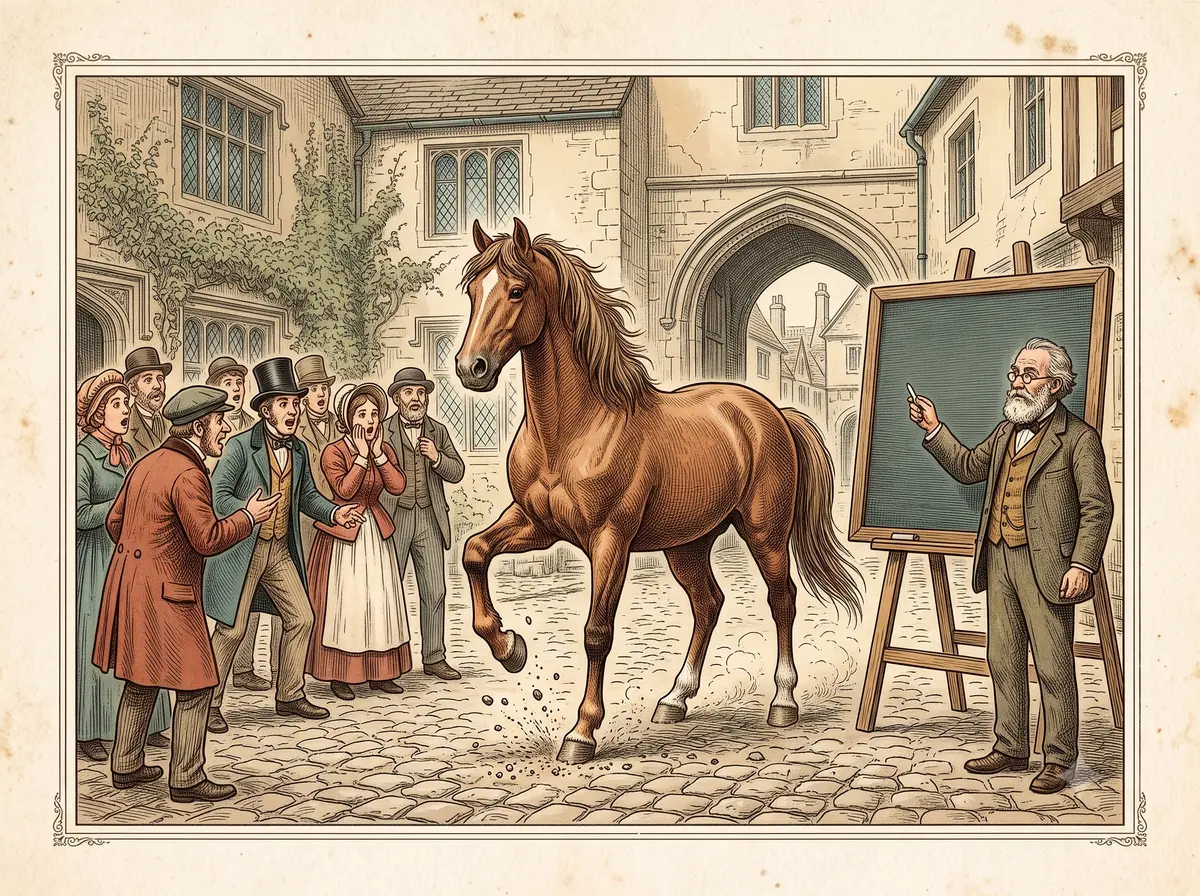
What happened: Clever Hans: The Horse That Could 'Do Math'
Hans belonged to Wilhelm von Osten, a German schoolteacher with an amateur passion for animal intelligence. Beginning in the late 1880s, von Osten set out to teach his horse the way he might teach a child — with a chalkboard, a counting frame, and endless patience. By the early 1900s he was convinced he had succeeded beyond anyone’s expectations.
According to von Osten, Hans could add, subtract, multiply, and divide. He could tell time, read a calendar, identify musical notes, and spell out words by tapping his hoof to indicate letters of the alphabet. Ask Hans a question and he would answer by pawing the ground the correct number of times, or by nodding and shaking his head. He appeared to be right the overwhelming majority of the time.
Von Osten charged nothing for his demonstrations, which only deepened the public’s fascination — this was clearly not a carnival hustle. Newspapers covered the “thinking horse.” Crowds turned out across Germany. The phenomenon grew large enough that, in 1904, the German board of education convened a formal commission to investigate. The group — sometimes called the Hans Commission — included a veterinarian, a circus manager, cavalry officers, schoolteachers, and the eminent psychologist Carl Stumpf. After observing Hans, the commission concluded that no trickery or deliberate signaling was involved. Whatever was happening, von Osten was not a fraud.
That verdict didn’t actually explain anything, so Stumpf handed the puzzle to a young assistant named Oskar Pfungst. And Pfungst, working through 1904 and into 1907, finally cracked it.
Why it was strange: Clever Hans: The Horse That Could 'Do Math'
The strangeness wasn’t that a horse seemed smart. It was that the horse seemed smart and everybody had checked. A respected commission had ruled out fraud. Von Osten genuinely believed in his horse and earned nothing from the act. The simplest cynical explanation — a con artist with a hidden cue — had been examined and dismissed.
So the real mystery was deeper: how could a horse produce right answers to math problems again and again if it wasn’t doing math and nobody was cheating? The answer turned out to overturn assumptions not about horses, but about the humans standing in front of them.
It shares a shelf with Cold Fusion: The Breakthrough That Wasn’t, in Science’s Most Embarrassing Mistakes.
What scientists learned: Clever Hans: The Horse That Could 'Do Math'
Pfungst ran careful, controlled tests, and two variables changed everything.
The first was whether the questioner knew the answer. When the person posing the question knew the solution, Hans was usually right. When the questioner did not know the answer — for example, when one person whispered a first number into the horse’s ear and a second person added a number Hans’s handler never heard — the horse’s accuracy collapsed. Hans could only be right when someone present already knew what right looked like.
The second variable was whether Hans could see the questioner. Block the horse’s view of the person with the answer, and the performance fell apart.
Putting those together, Pfungst worked out what was really happening. As Hans tapped toward the correct number, the questioner — and often the whole crowd — would unconsciously tense up with anticipation. The instant Hans reached the right count, that tension released: a tiny relaxation of posture, a slight upward tilt of the head, a barely perceptible change in breathing or expression. Hans had learned to read those involuntary signals as a cue to stop tapping. He wasn’t solving equations. He was watching people, with astonishing sensitivity, for the moment they expected him to quit.
Pfungst confirmed it by becoming the cue himself: once he understood the signal, he could make Hans “answer” by controlling his own posture, no questions required. He even found he produced the same unconscious movements involuntarily, despite trying not to. He published his findings in 1907, and the work appeared in English in 1911 as Clever Hans (The Horse of Mr. von Osten).
The horse, in other words, was a genius — just not at arithmetic. He was a genius at reading body language.
Also in Science’s Most Embarrassing Mistakes: Polywater: The New Form of Water That Almost Ate the World.
How it reaches us today: Clever Hans: The Horse That Could 'Do Math'
The episode gave science a permanent piece of vocabulary: the Clever Hans effect, the name for any case where a subject appears to perform a task but is really responding to subtle, unintended cues from an observer. It’s a cousin of the observer-expectancy effect, in which an experimenter’s hopes leak out and shape the result.
The fix Pfungst’s work pointed toward is now standard practice everywhere careful research is done: keep the people running a test from unconsciously tipping off the outcome. Modern double-blind trials — where neither the subject nor the experimenter knows who got the real treatment — exist partly because Clever Hans showed how easily an honest researcher can contaminate an honest result without meaning to.
The lesson keeps resurfacing in new forms. Studies of “talking” apes, drug-sniffing and cadaver dogs, facilitated communication, and even some early claims about animal “psychics” have all had to reckon with the Clever Hans problem: is the animal doing the task, or reading the human? Good experimental design now assumes the cue is there until proven otherwise.
Another from Science’s Most Embarrassing Mistakes: The Astronomer Who Saw Canals on Mars That Weren’t Real.
Fun fact: Clever Hans: The Horse That Could 'Do Math'
Wilhelm von Osten never accepted Pfungst’s explanation. He believed to the end that Hans truly reasoned, and he reportedly grew resentful of the scientists who had “exposed” his horse. He died in 1909. Hans changed hands and, by some accounts, was eventually pressed into service in the German army during World War I — after which the trail of the world’s most famous mathematician horse goes cold.
Sources: Clever Hans: The Horse That Could 'Do Math'
- Pfungst, Oskar. Clever Hans (The Horse of Mr. von Osten): A Contribution to Experimental Animal and Human Psychology. New York: Henry Holt, 1911 (English translation of the 1907 German original).
- “Clever Hans,” Encyclopædia Britannica — https://www.britannica.com/topic/Clever-Hans
- “Clever Hans,” Wikipedia — https://en.wikipedia.org/wiki/Clever_Hans
- Samhita, Laasya, and Hans J. Gross. “The ‘Clever Hans Phenomenon’ revisited.” Communicative & Integrative Biology, vol. 6, no. 6, 2013 (available via PubMed Central) — https://www.ncbi.nlm.nih.gov/pmc/
Related stories: Clever Hans: The Horse That Could 'Do Math'
- Part of Science’s Most Embarrassing Mistakes
- The Parrot That Asked What Color Am I — A parrot that asked a question about himself
- The Fake Metal Rods That Accidentally Invented the Placebo-Controlled Trial — Fake metal rods that accidentally invented the placebo-controlled trial
- N-Rays: The Radiation 300 Scientists Saw That Was Never There — Three hundred scientists saw a radiation that did not exist