The Rays 300 Scientists Saw That Were Never There
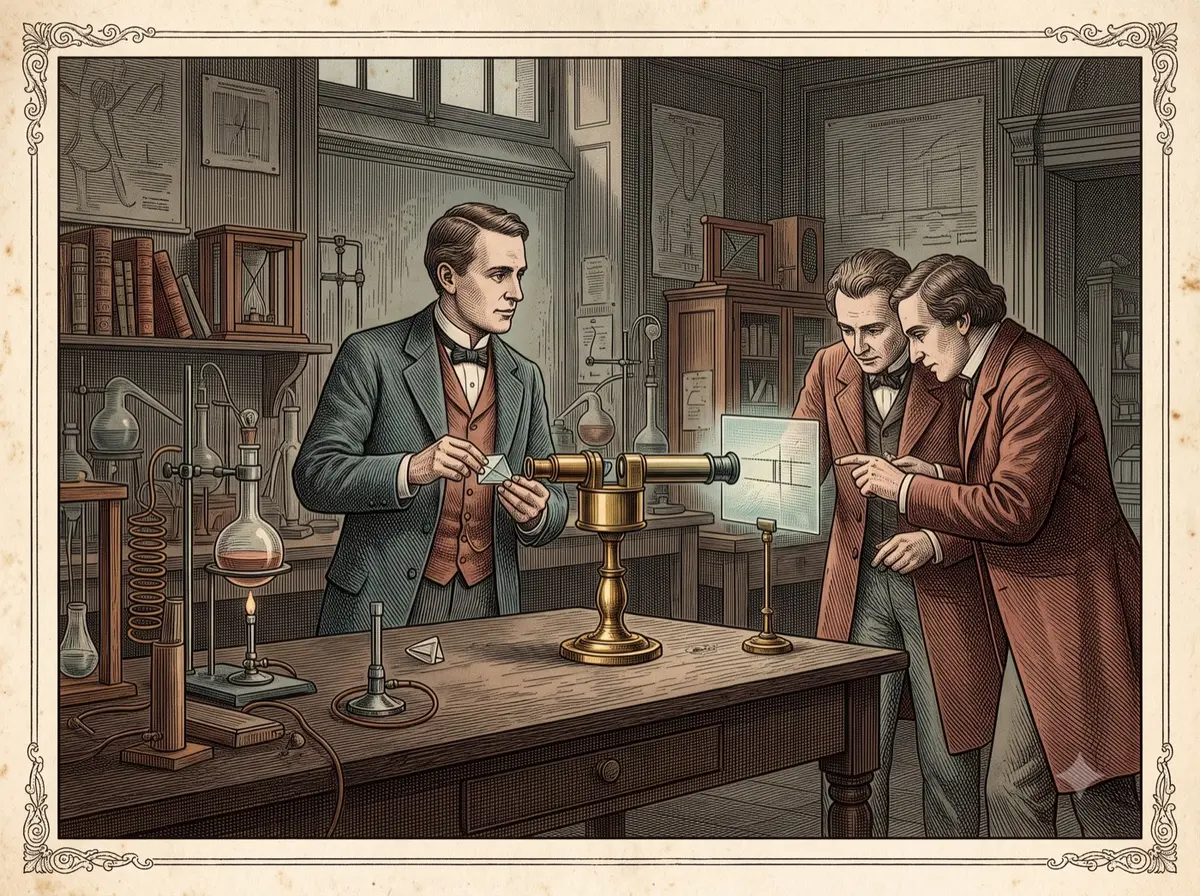
In 1903, in a blacked-out laboratory in Nancy, Prosper-René Blondlot bent over his apparatus and read off the brightness of a faint glow, exactly as he had a hundred times before. What he didn't know was that a visiting American had just quietly slipped the essential prism out of the machine and into his pocket. The N-rays could no longer possibly be there. Blondlot saw them anyway.
By the Curiosities Desk · · 6 min read · Filed under Physics · Today’s round
What happened: N-Rays? They Were Never There
In 1903, Prosper-René Blondlot was one of the most respected physicists in France. A professor at the University of Nancy and a corresponding member of the French Academy of Sciences, he had already won the Academy’s Gaston Planté prize in 1893 and its LaCaze prize in 1899. He was working on the hot new problem of the day: trying to figure out whether X-rays, discovered by Wilhelm Röntgen only eight years earlier, behaved like waves or like particles.
While studying the light of an electric spark placed in an X-ray beam, Blondlot noticed something odd. The spark seemed to get slightly brighter when a certain kind of radiation fell on it. He concluded he had discovered an entirely new form of radiation, and named it the N-ray after his university’s home city, Nancy.
The claim spread fast. Blondlot reported that N-rays streamed out of almost everything: heated wires, the sun, chemicals, even the human nervous system and the muscles of a flexed bicep. Fellow researchers Augustin Charpentier and Arsène d’Arsonval confirmed it. In all, roughly 120 scientists published around 300 papers on N-rays over the next three years, describing their spectra, their refraction, their storage in bricks. It was a booming new field of physics.
There was just one problem. Detecting an N-ray meant sitting in a darkened room and judging, by eye, whether a dim phosphorescent surface or a small spark had grown a little brighter. Outside France, the effect refused to appear. Heavyweights including Lord Kelvin, William Crookes, Otto Lummer, and Heinrich Rubens all tried to reproduce it and failed. Rubens was especially mortified: Kaiser Wilhelm II had asked him to repeat the French experiments, and after two weeks he had to report that he simply could not.
The British journal Nature dispatched the American physicist Robert W. Wood, a Johns Hopkins professor with a growing reputation for exposing scientific nonsense, to visit Blondlot’s lab and settle the matter. In the darkened room, as Blondlot’s team demonstrated their spectroscope, Wood reached out unseen and removed the aluminum prism that was supposedly bending the N-rays into a spectrum — the one part without which the whole experiment was meaningless. The experimenters kept reading off the spectral lines. In another test, he secretly swapped a metal file that was said to emit N-rays for an inert piece of wood. The rays were still “observed.”
Wood published his account in Nature on 29 September 1904. After watching the demonstrations for three hours, he wrote, he was left convinced that the researchers who reported positive results had “been in some way deluded.” The verdict landed hard. By 1905, essentially no one outside Nancy believed in N-rays anymore.
Why it was strange: N-Rays? They Were Never There
The strangeness here isn’t a crackpot fooling the public. It’s that dozens of trained, credentialed physicists — people who understood optics and measurement — collectively detected, described, and quantified something that did not exist. They weren’t lying. They published detailed spectra of a phantom. The N-ray affair is unsettling precisely because the people involved were competent and sincere, and the method they trusted, the human eye judging faint light in the dark, betrayed them all in the same direction.
It shares a shelf with Piltdown Man: The Fake Fossil That Fooled Science for 40 Years, in Science’s Most Embarrassing Mistakes.
What scientists learned: N-Rays? They Were Never There
The lesson of N-rays is about the observer, not the instrument. When measurement depends on a subjective human judgment — is this glow slightly brighter or not? — and the observer already expects a particular answer, the mind can quietly supply it. Contemporary work even showed the perceived brightening was a physiological quirk of the eye adapting in darkness, not any real change in the light.
Decades later, the chemist Irving Langmuir folded the episode into his famous idea of “pathological science”: research that goes wrong not through fraud but through wishful self-deception, where effects hover at the very edge of detectability and results always seem to confirm the hoped-for result. N-rays became the textbook case, taught alongside cold fusion and polywater as a warning of what happens when enthusiasm outruns controls.
The fix is now standard practice. Blind and double-blind procedures, where neither the subject nor the person recording the data knows which condition is which, exist precisely so that a Wood-style hidden prism can’t change the result. Objective, machine-recorded measurement replaced the “trust your eyes in the dark” approach that N-rays exposed as fragile.
The same thread — Pathological Science — continues in Polywater: The New Form of Water That Almost Ate the World.
How it reaches us today: N-Rays? They Were Never There
Every time a modern drug trial is run double-blind, or a physics result is checked by an independent lab before anyone celebrates, the ghost of N-rays is in the room. The affair helped cement the idea that a discovery isn’t real until skeptics who want it to fail have tried and failed to make it disappear. Replication by outsiders, not confirmation by the discoverer’s friends, is the test. The story survives in classrooms and lab meetings as shorthand for the most dangerous kind of error: the one you commit while being completely honest.
Also in Science’s Most Embarrassing Mistakes: Cold Fusion: The Breakthrough That Wasn’t.
FAQ
What were N-rays?
N-rays were a form of radiation Prosper-René Blondlot said he had discovered at the University of Nancy in 1903, named for the city. Over the next three years about 120 scientists published some 300 papers on them. The rays were not there. In 1904 Robert W. Wood took the prism out of Blondlot’s spectroscope during a demonstration, and the team kept reporting the spectrum.
Who was Blondlot?
Prosper-René Blondlot was a professor of physics at the University of Nancy and a corresponding member of the French Academy of Sciences. He announced N-rays in 1903 and, by some accounts, still believed in them as late as 1926.
Fun fact: N-Rays? They Were Never There
Blondlot was never publicly disgraced by name in the way legend suggests, and the popular tale that the scandal drove him insane and killed him appears to be exaggerated — he kept working for years and reportedly still believed in N-rays as late as 1926. The city of Nancy, for its part, quietly honored him anyway: he left his house and garden to the city, and there is a small public park named Parc Blondlot in the center of town. When the skeptic James Randi later visited, he found that many locals and university staff had never even heard of the rays that briefly made their city famous.
Sources: N-Rays? They Were Never There
- Wood, R. W. (29 September 1904). “The n-Rays.” Nature 70 (1822): 530–531. https://www.nature.com/articles/070530a0
- Klotz, I. M. (May 1980). “The N-Ray Affair.” Scientific American 242 (5): 168–175. https://www.scientificamerican.com/article/the-n-ray-affair/
- Nye, M. J. (1980). “N-rays: An episode in the history and psychology of science.” Historical Studies in the Physical Sciences 11 (1): 125–156. https://www.jstor.org/stable/27757473
- Lagemann, R. T. (1977). “New light on old rays: N rays.” American Journal of Physics 45 (3): 281–284. https://doi.org/10.1119/1.10643
- “N-ray.” Wikipedia. https://en.wikipedia.org/wiki/N-ray
Related stories: N-Rays? They Were Never There
- Part of Science’s Most Embarrassing Mistakes
- Polywater: The New Form of Water That Almost Ate the World — A ‘new form of water’ that turned out to be sweat
- Cold Fusion: The Breakthrough That Wasn’t — Two chemists announced fusion in a jar; nobody could repeat it
- Clever Hans: The Horse That Could ‘Do Math’ — A horse that seemed to do arithmetic, and the bias it exposed