Science Gone Wrong · Archaeology
Piltdown Man: The Fake Fossil That Fooled Science for 40 Years
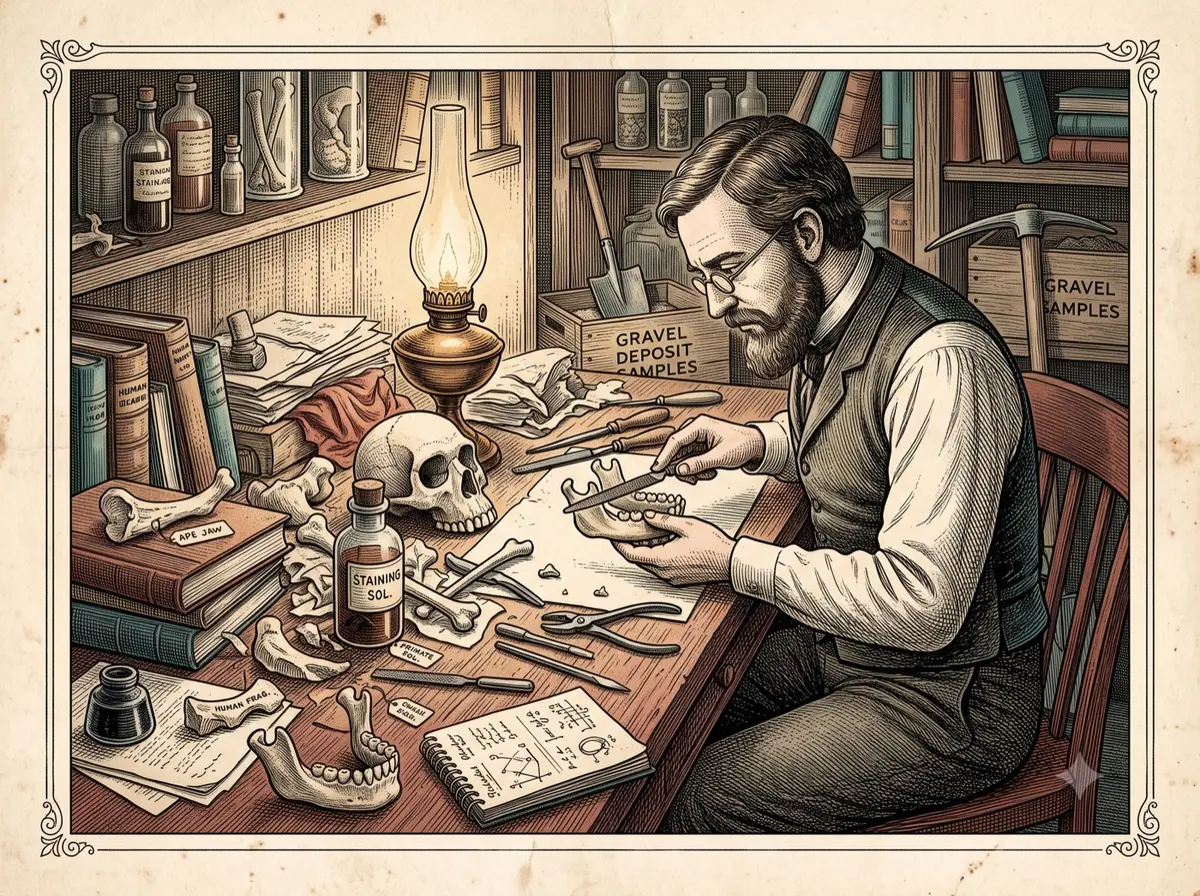
In a glass case in London sat the skull of humanity's earliest ancestor — the long-sought "missing link" between ape and human, dug from an English gravel pit. Scholars wrote books about it. Textbooks drew its family tree. For roughly four decades, it shaped how the world pictured its own origins. Then chemists got hold of it, and discovered that the most famous fossil in Britain was a medieval human skull, an orangutan's jaw, and a set of teeth someone had filed down with a metal tool and stained brown to look old.
By the Curiosities Desk · · 6 min read · Filed under Archaeology · Today’s round
What happened: Piltdown Man: The Fake Fossil That Fooled Science for 40 Years
Around 1912, an amateur antiquarian named Charles Dawson, a solicitor by trade and a fossil-hunter by passion, said that workmen at a gravel pit at Barkham Manor near the village of Piltdown, in East Sussex, England, had handed him fragments of an ancient-looking human skull. Over the following months Dawson reported recovering more pieces, including part of a lower jaw with two molar teeth still in place.
Dawson took his finds to Arthur Smith Woodward, the respected keeper of geology at what is now the Natural History Museum in London. On December 18, 1912, the two men presented the remains to the Geological Society of London. The skull, they argued, was strikingly human, while the jaw was strikingly ape-like — exactly the in-between creature evolutionary theory predicted. They gave it a scientific name: Eoanthropus dawsoni, “Dawson’s dawn-man.”
The press loved it. Here, at last, was an “earliest Englishman,” and a discovery that put Britain on the map of human origins alongside finds in France and Germany. Further material turned up at the site over the next few years, including a curiously shaped carved bone that observers nicknamed “the cricket bat.” Some scientists harbored quiet doubts about whether the human-looking skull and the ape-like jaw really belonged to the same individual. But the specimen fit the expectations of the day so neatly that Piltdown Man settled into the textbooks and stayed there.
The unraveling came in 1953. Working at the Natural History Museum, the anatomist Joseph Weiner, the geologist Kenneth Oakley, and the anatomist Wilfrid Le Gros Clark subjected the bones to closer chemical and microscopic scrutiny than they had ever received. Oakley applied fluorine absorption dating — bones buried for long ages slowly absorb fluorine from groundwater — and found that the Piltdown remains contained far too little fluorine to be ancient. Under magnification, the team saw that the molars had been filed flat to mimic the wear pattern of human chewing, and that the bones had been deliberately stained to give them an aged, fossilized color. The skull was a relatively recent human one; the jaw belonged to an orangutan. The most celebrated fossil in the country was a forgery, assembled and planted by someone who knew exactly what scientists hoped to find.
Why it was strange: Piltdown Man: The Fake Fossil That Fooled Science for 40 Years
The strangest thing about Piltdown is not that a hoax happened — it is that it worked for so long, and worked precisely because it told experts what they already believed. In the early twentieth century, a popular assumption held that the human story began with the brain: that our ancestors evolved big, clever heads first, and only later acquired modern jaws, teeth, and upright bodies. Piltdown Man, with its large human braincase and its primitive ape jaw, was the dream fossil for that “brain-first” idea.
So the forgery didn’t have to be flawless. It only had to be flattering. It confirmed a cherished theory and gratified national pride, and that combination dulled the scrutiny it should have received. The fake survived not in spite of the scientists, but partly because of what they wanted to see.
It shares a shelf with Clever Hans: The Horse That Could ‘Do Math’, in Science’s Most Embarrassing Mistakes.
What scientists learned: Piltdown Man: The Fake Fossil That Fooled Science for 40 Years
The deeper lesson outlasted the embarrassment. Piltdown is now a standard case study in how expectation can corrupt evidence, and in why independent testing matters more than the prestige of the people involved. The same fluorine method that exposed the hoax was a sign of where the field was heading: toward physical and chemical dating techniques that don’t care what story a fossil seems to tell.
Piltdown also did real damage while it lived. When Raymond Dart described the Taung Child from South Africa in 1925 — a genuine early human relative now classified as Australopithecus — many authorities brushed it aside. It had a small, ape-sized braincase and more human-like teeth, the exact opposite of the brain-first pattern Piltdown seemed to prove. The fake fossil helped the real one get ignored for years. Human evolution, the actual fossils kept insisting, ran jaw-and-body first, brain later — the reverse of the comfortable assumption.
The mystery of who did it lingered for decades, with suspicion falling on Dawson, on Smith Woodward’s circle, and on a long list of others. In 2016 a research team led by Isabelle De Groote published an analysis in the journal Royal Society Open Science that combined DNA sampling and CT imaging of the remains. They concluded that the jaw and isolated teeth most likely came from a single orangutan, and that the forger’s consistent method pointed to one person working alone — Charles Dawson, the man who “found” almost every piece.
Also in Science’s Most Embarrassing Mistakes: The Sea Monster Rebuilt With Its Head on the End of Its Tail.
How it reaches us today: Piltdown Man: The Fake Fossil That Fooled Science for 40 Years
Every time a museum runs a new artifact through chemical dating, isotope analysis, or DNA testing before announcing it, the ghost of Piltdown is in the room. The hoax helped push paleoanthropology toward hard verification and away from taking a charismatic discoverer at his word, and it remains a fixture in classrooms as the textbook example of confirmation bias — the human tendency to embrace evidence that fits what we already think.
It also left a humbling reminder that science is done by people, with pride and blind spots intact. The discipline’s defense is not that individuals are immune to being fooled, but that the system keeps re-checking its own treasures. Piltdown Man fooled a generation; it could not survive a fluorine test.
Another from Science’s Most Embarrassing Mistakes: The Rays 300 Scientists Saw That Were Never There.
Fun fact: Piltdown Man: The Fake Fossil That Fooled Science for 40 Years
When investigators tallied the Piltdown “evidence,” it included that carved bone implement shaped, as more than one observer noted, remarkably like a cricket bat — an almost comic detail for the supposed earliest Englishman. To skeptics looking back, it reads less like an ancient tool than like a forger’s inside joke.
Sources: Piltdown Man: The Fake Fossil That Fooled Science for 40 Years
- Natural History Museum, London — “Piltdown Man” (museum feature on the hoax and its exposure): https://www.nhm.ac.uk/discover/piltdown-man.html
- De Groote, I. et al. (2016). “New genetic and morphological evidence suggests a single hoaxer created ‘Piltdown man’.” Royal Society Open Science, 3: 160328. https://doi.org/10.1098/rsos.160328
- Smithsonian Institution, Human Origins Program — “Piltdown Man”: https://humanorigins.si.edu/about/history-human-origins-research/piltdown-man
- Encyclopaedia Britannica — “Piltdown man”: https://www.britannica.com/topic/Piltdown-man
Related stories: Piltdown Man: The Fake Fossil That Fooled Science for 40 Years
- Part of Science’s Most Embarrassing Mistakes
- The Petrified Giant That Was a Fake of a Fake — A fake stone giant, and then a fake of the fake
- The Fake Fossils Carved to Humiliate a Professor — Who Then Published a Book About Them — Students planted fake fossils; the professor published a book on them
- The Sea Monster Rebuilt With Its Head on the End of Its Tail — A fossil reconstructed with its skull on the wrong end