Science Gone Wrong · Archaeology
The Fake Fossils Carved to Humiliate a Professor — Who Then Published a Book About Them
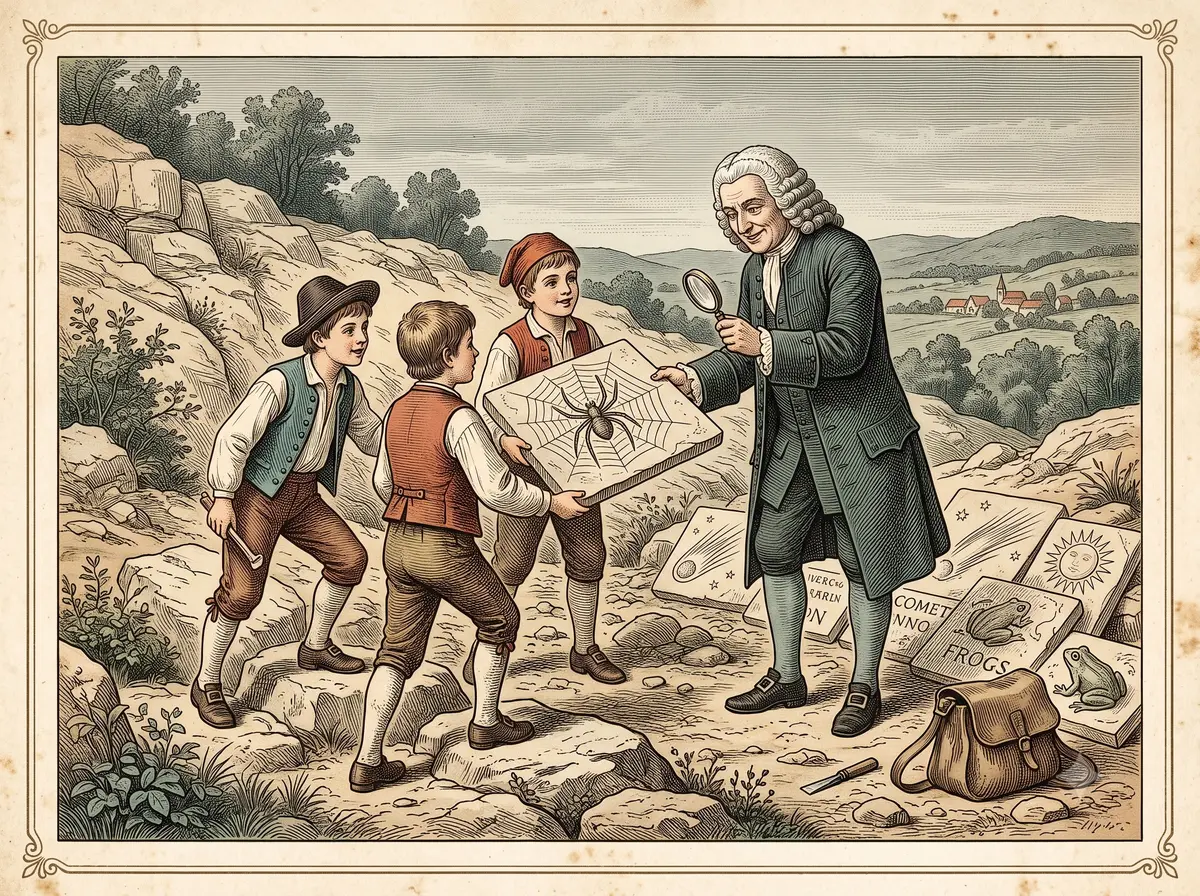
On a hillside outside Würzburg in the summer of 1725, three teenage boys kept coming back down the slope with limestone slabs unlike anything in any collection in Europe: spiders sitting on complete webs, birds perched over clutches of eggs, comets with tails, blazing suns, and — most astonishing of all — tablets bearing the name of God in Hebrew. The professor who bought them was thrilled. Somebody had carved every single one.
By the Curiosities Desk · · 5 min read · Filed under Archaeology · Today’s round
Part of When the Experiment Left the Lab
What happened: The Lying Stones
Johann Bartholomäus Adam Beringer was, by the standards of his day, a serious man. Born in 1667, he earned his medical doctorate at the University of Würzburg and became a professor there in 1694 at twenty-seven, later serving as chief physician of the Juliusspital and dean of the faculty of medicine. He kept a cabinet of curiosities and had a particular passion for what the era called “figured stones” — the odd, patterned rocks turning up in the shell-limestone beds of Mount Eibelstadt, a few miles from town.
To feed the collection, Beringer hired local help: seventeen-year-old Christian Zänger and the brothers Niklaus and Valentin Hehn, aged eighteen and fourteen. Beginning around late May 1725, they started bringing him things that were extraordinary not because they were rare, but because they were impossible. Real fossils in that limestone are broken shells and ammonites — fragments, mostly. What the boys carried down were tidy little scenes: a frog, a lizard, a spider mid-web, a flower complete with root, stem, leaves, and bloom. Then came the sky: rays, crescents, shooting stars. Then came the writing — letters in Hebrew, Latin, and Arabic characters, several spelling out the name of God.
The traditional account, drawn from the surviving court record, is that two of Beringer’s colleagues carved them. J. Ignatz Roderick, a professor of geography, algebra, and analysis, and Johann Georg von Eckhart, the university librarian, thought Beringer arrogant. In their testimony they said plainly that they wanted to discredit him “because he was so arrogant and despised us all.” They carved the stones, planted them on the hillside, and used one of the boys as an unwitting — or at least half-witting — courier.
Beringer studied his haul with genuine care, and that is the part that still stings. He worked through the competing explanations of his century: that the stones were relics of the biblical Flood, that they had been shaped by some formative power inside the earth (the vis plastica, a supposed sculpting force in rock), that they were the carvings of ancient pagans. He rejected the pagan theory on the reasonable-sounding grounds that pagans would not have known the Hebrew name of God.
He even noticed the tool marks. He wrote that the figures were “so exactly fitted to the dimensions of the stones, that one would swear that they are the work of a very meticulous sculptor,” and that he could see “the strokes of a knife gone awry.” He concluded that the sculptor was God.
In 1726 he published Lithographiae Wirceburgensis, illustrating 204 of the specimens across twenty-one engraved plates. Word of doubt had already reached him — by one account Roderick carved a stone in front of him at Eibelstadt to prove the point — and Beringer hastily added a chapter attacking his critics as jealous frauds. Shortly after publication, he finally accepted what had happened.
He sued. The 1726 court cleared the three boys and exposed Roderick and Eckhart; Roderick was banished from Würzburg, and Eckhart was cut off from the archives he needed for his own scholarship, which he never finished. Beringer stayed on the Würzburg faculty for his remaining thirteen years and published two more books. None of it mattered. He is remembered for the stones.
Why it was strange: The Lying Stones
The famous punchline — that Beringer’s blood ran cold when he finally translated a stone and found his own name carved on it — appears to be a later invention. It traces to a nineteenth-century retelling and has no documentary foundation. So does the story that buying back copies of his book bankrupted him; there is no evidence he was ruined financially.
The stranger truth is the one underneath. Beringer was not a credulous fool who missed the obvious. He looked at the chisel marks, described them accurately in print, and reasoned his way past them. He had a framework in which a carving in stone could plausibly be a message rather than a forgery — and once you hold that framework, the evidence of a knife is not a red flag. It is a signature.
And there is a live dissenting reading. A 2005 study by Birgit Niebuhr and Gerd Geyer noted that Roderick did not formally take up his Würzburg post until 11 December 1725, months after the stones began appearing, and may still have been in Münster that summer. Their controversial suggestion is that Beringer himself was behind the fraud, and that Roderick was trying to save him from publishing. That reading is not the consensus, but it is a reminder that even the tidy version of a 300-year-old scandal rests on an incomplete court record.
The same thread — Fossils — continues in The Sea Monster Rebuilt With Its Head on the End of Its Tail.
What scientists learned: The Lying Stones
In 1725, nobody was certain what a fossil was. The question was genuinely open: were these shapes the remains of dead organisms, patterns grown inside rock by natural forces, or divine ornaments? Beringer’s book lays out all of those options seriously, which is why historians of science value it despite everything — it is a snapshot of a discipline mid-argument.
The lasting lesson is less about gullibility than about method. Beringer had no independent check. The stones came from one hillside, through one supply chain, in a form conveniently matched to what he hoped to find. Modern paleontology’s defenses — documented provenance, independent excavation, examining the surrounding rock matrix rather than the specimen alone — exist precisely because a beautiful specimen with no verifiable history is the easiest thing in the world to fake.
Another good intention with a bad landing: The Copper Tools That Scraped History Off the Parthenon Marbles.
How it reaches us today: The Lying Stones
Fossil forgery never stopped. Commercially manufactured “specimens” still move through mineral markets, and at least one high-profile fake — Archaeoraptor, a chimera assembled from two real Chinese fossils and publicized in 1999 — briefly slipped past serious scrutiny. Every museum acquisition process that demands documented provenance is descended from cases like Beringer’s.
The stones themselves became collectibles. Roughly 493 have been catalogued from fourteen collections across Germany, the Netherlands, and Britain, with examples at Oxford University Museum of Natural History and Teylers Museum in Haarlem. And the book meant to end a man’s credibility is now a prized item in rare-book rooms, including the Smithsonian’s Cullman Library.
Another time it went sideways: The 3,300-Year-Old Golden Beard That Got Glued Back On With Epoxy.
Fun fact: The Lying Stones
Beringer’s book was reprinted decades after his death, apparently using the very sheets he had spent years recalling from booksellers. The one thing he most wanted out of print became the version that survived.
Sources: The Lying Stones
- Beringer, Johann Bartholomäus Adam. Lithographiae Wirceburgensis (digitized facsimile, Biodiversity Heritage Library) — the primary source. https://www.biodiversitylibrary.org/item/252852
- Alvis, Alexandra K. “A Heavy Hoax: The ‘Lying Stones’ of Johann Beringer.” Smithsonian Libraries and Archives, 25 July 2019. https://blog.library.si.edu/blog/2019/07/25/a-heavy-hoax-the-lying-stones-of-johann-beringer/
- Taylor, Paul D. “Fossil fraud: A new interpretation of the Beringer story.” Acta Palaeontologica Polonica 51(2): 314, 2006. https://www.app.pan.pl/archive/published/app51/app51-314.pdf
- Mallatt, Jon M. “Dr Beringer’s fossils: A study in the evolution of scientific world view.” Annals of Science 39(4): 371–380, 1982. https://www.tandfonline.com/doi/full/10.1080/00033798200200471
- Edmonds, J.M. and Powell, H.P. “Beringer ‘Lügensteine’ at Oxford.” Proceedings of the Geologists’ Association 85(4), 1974. https://doi.org/10.1016/S0016-7878(74)80075-1
Related stories: The Lying Stones
- Piltdown Man: The Fake Fossil That Fooled Science for 40 Years — A skull that fooled paleoanthropology for four decades
- The Petrified Giant That Was a Fake of a Fake — A fake stone giant, and then a fake of the fake
- The Sea Monster Rebuilt With Its Head on the End of Its Tail — A fossil reconstructed with its skull on the wrong end