Science Gone Wrong · Archaeology
The Copper Tools That Scraped History Off the Parthenon Marbles
In the autumn of 1938, the director of the British Museum walked into a basement workshop and found a 2,400-year-old marble horse's head sitting on a bench, half-scrubbed white, with copper scrapers and a lump of gritty abrasive lying nearby. Six workmen had been quietly grinding away at the surface of the Parthenon's sculptures for more than a year, at the urging of the wealthy donor paying for their new gallery. The museum would spend the next sixty years trying to make sure almost nobody found out.
By the Curiosities Desk · · 6 min read · Filed under Archaeology · Today’s round
Part of When the Experiment Left the Lab
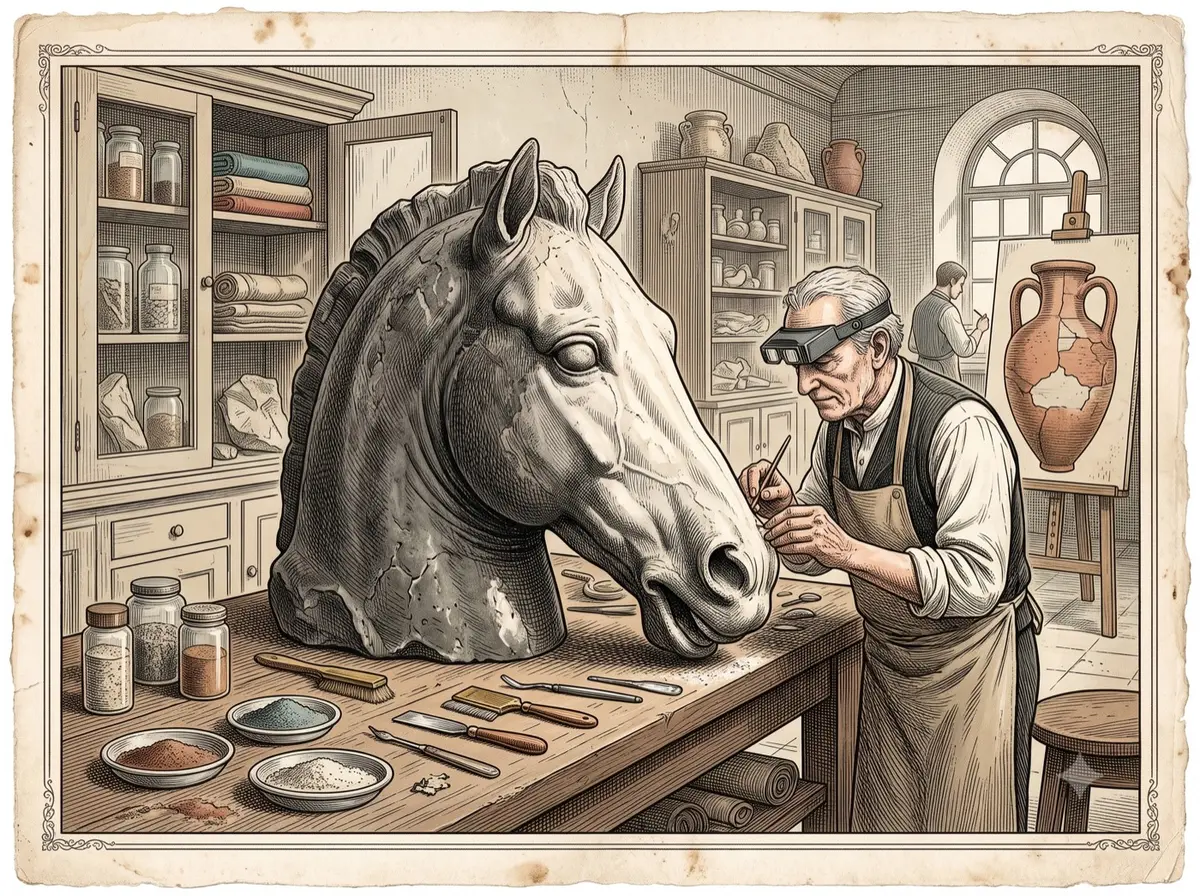
What happened: The Copper Tools That Scraped History Off the Parthenon Marbles
The sculptures at the center of the story are the Parthenon Marbles, sometimes called the Elgin Marbles after Thomas Bruce, 7th Earl of Elgin, the British diplomat who had them removed from the Parthenon in Athens between 1801 and 1811, while Greece was under Ottoman rule. Britain bought them from Elgin in 1816 for £35,000, and they’ve been in the British Museum since — a history that remains disputed, as Greece has long argued the marbles were taken improperly and should be returned.
By the time they reached London, the marble had developed a warm, orange-brown surface coloring called patina. Nineteenth-century scholars argued over whether this was a natural byproduct of age or the remains of something applied in antiquity, and museum staff cleaned the sculptures periodically over the decades, usually with water, soap, or mild alkaline solutions.
That changed after 1928, when the art dealer Joseph Duveen — a man who had built a fortune selling old masters to American millionaires — offered to fund a grand new gallery to house the marbles. Duveen believed the sculptures should look evenly white, like his idea of classical marble, and starting around 1932 he began pushing museum trustees to have them cleaned to match. A careful test-cleaning that year, done with a mild soap-and-ammonia solution under the supervision of the museum’s own conservator, Harold Plenderleith, was meant to settle the matter.
It didn’t. In the summer of 1937, with construction of the Duveen Gallery underway, the museum’s foreman of masons, Arthur Holcombe, and six laborers working under Duveen’s direction went much further. Using copper scrapers, at least one copper chisel, and an abrasive called carborundum (a form of silicon carbide, ordinarily used for grinding and polishing), they stripped the surface off roughly 60 percent of the metopes — the carved rectangular panels from the temple’s frieze — along with smaller portions of the frieze and the pedimental statues. According to later testimony, Duveen’s workers had their own set of keys to the department, and museum staff had stopped their usual daily inspections.
The unauthorized cleaning came to light in September 1938, when a curator noticed that part of the frieze had “a somewhat raw appearance” and reported it to the museum’s director, John Forsdyke. Forsdyke found sculptures mid-cleaning in the workshop, ordered the work stopped immediately, and convened a board of inquiry chaired by the judge Lord Macmillan. That board’s internal report, finished in November 1938, concluded that “the damage is obvious and cannot be exaggerated” — though the language was softened before anyone outside the museum saw it. Holcombe was dismissed; two curators, Frederick Pryce and Roger Hinks, were pushed into retirement and resignation, even though later historians argued that responsibility sat higher up, likely with Forsdyke and the trustees who had let Duveen’s men work unsupervised.
Why it was strange: The Copper Tools That Scraped History Off the Parthenon Marbles
What makes this story stand apart isn’t just that priceless ancient sculptures were scrubbed with tools they were never meant to touch — it’s what happened next. The museum decided, deliberately, to keep the whole episode quiet. Trustees worried that public knowledge would trigger embarrassing questions in Parliament and hand ammunition to countries already arguing that Britain shouldn’t hold the marbles at all. When British newspapers got wind of the story in early 1939 and reported that the sculptures had lost their patina, the museum’s director told the press the damage was “imperceptible” except to an expert — technically not a lie, but far from the full picture the internal report had already laid out. Documents about the affair were filed away, in one historian’s account, inside an oversized binder mixed in with unrelated papers specifically so they’d be hard to find. The cover-up held for roughly sixty years.
The same thread — Conservation — continues in The 3,300-Year-Old Golden Beard That Got Glued Back On With Epoxy.
What scientists learned: The Copper Tools That Scraped History Off the Parthenon Marbles
The scandal became a foundational case study in the then-young discipline of conservation science — the field devoted to preserving historical objects using evidence-based, minimally invasive methods. Patina isn’t dirt to be scrubbed away; on ancient marble it can be physical evidence of a sculpture’s age, chemical history, and possibly even traces of surface treatments applied in antiquity. Conservators who later examined the recovered tools — including Andrew Oddy, who studied them decades afterward — helped cement an enduring principle: any cleaning should be reversible, minimally abrasive, and tested on a small area first, treating the underlying material as data worth protecting rather than a surface to be polished. Estimates of how much stone was actually removed vary widely, from a fraction of a millimeter to several millimeters, and modern experts broadly agree the physical damage, while real, was less catastrophic than 1939 press coverage implied. The deeper lesson was about process: decisions about irreplaceable objects need documented oversight, not the preferences of one wealthy donor.
Another good intention with a bad landing: The Fake Fossils Carved to Humiliate a Professor — Who Then Published a Book About Them.
How it reaches us today: The Copper Tools That Scraped History Off the Parthenon Marbles
Museums today operate under conservation ethics codes — from bodies like the International Institute for Conservation and the American Institute for Conservation — that require documentation, reversibility, and minimal intervention before anyone touches an artifact’s surface, principles shaped in part by episodes like this one. The scandal also remains part of the ongoing, still-unresolved debate over whether the Parthenon Marbles should be returned to Greece: writers on both sides of that argument have cited the 1930s cleaning, either as evidence the marbles were mishandled in London or as one damaging episode in a much longer history of wear that includes centuries of exposure in Athens.
Another time it went sideways: The Sea Monster Rebuilt With Its Head on the End of Its Tail.
Fun fact: The Copper Tools That Scraped History Off the Parthenon Marbles
The scandal only became public knowledge decades later because a historian, William St Clair, spent years combing through the British Museum’s own archives; his findings, published in a 1998 edition of his book on the marbles, forced the museum to hold an academic conference on the affair in 1999 — sixty years after the cleaning happened, and after nearly everyone directly involved had died.
Sources: The Copper Tools That Scraped History Off the Parthenon Marbles
- 1937–1938 Elgin Marbles cleaning scandal — Wikipedia
- Elgin Marbles — Wikipedia
- The Parthenon Sculptures — British Museum, contested objects
- Ian Jenkins, Cleaning and Controversy: The Parthenon Sculptures 1811–1939, British Museum Occasional Paper 146 (2001)
- William St Clair, Lord Elgin and the Marbles, 3rd ed. (Oxford University Press, 1998)
Related stories: The Copper Tools That Scraped History Off the Parthenon Marbles
- The Circus Strongman Who Found Egypt’s Greatest Tomb — A circus strongman who muscled his way into Egyptology
- The Library Burned by Vesuvius That AI Is Finally Reading — Carbonized scrolls from Vesuvius, now being read by AI
- The Mummy’s Curse That Missed Its Main Target — The Tutankhamun curse skipped the man who actually opened the tomb