Science Gone Wrong · Archaeology
The Colonel Who Opened the Great Pyramid With Gunpowder — and Got His Drill Stuck in the Sphinx
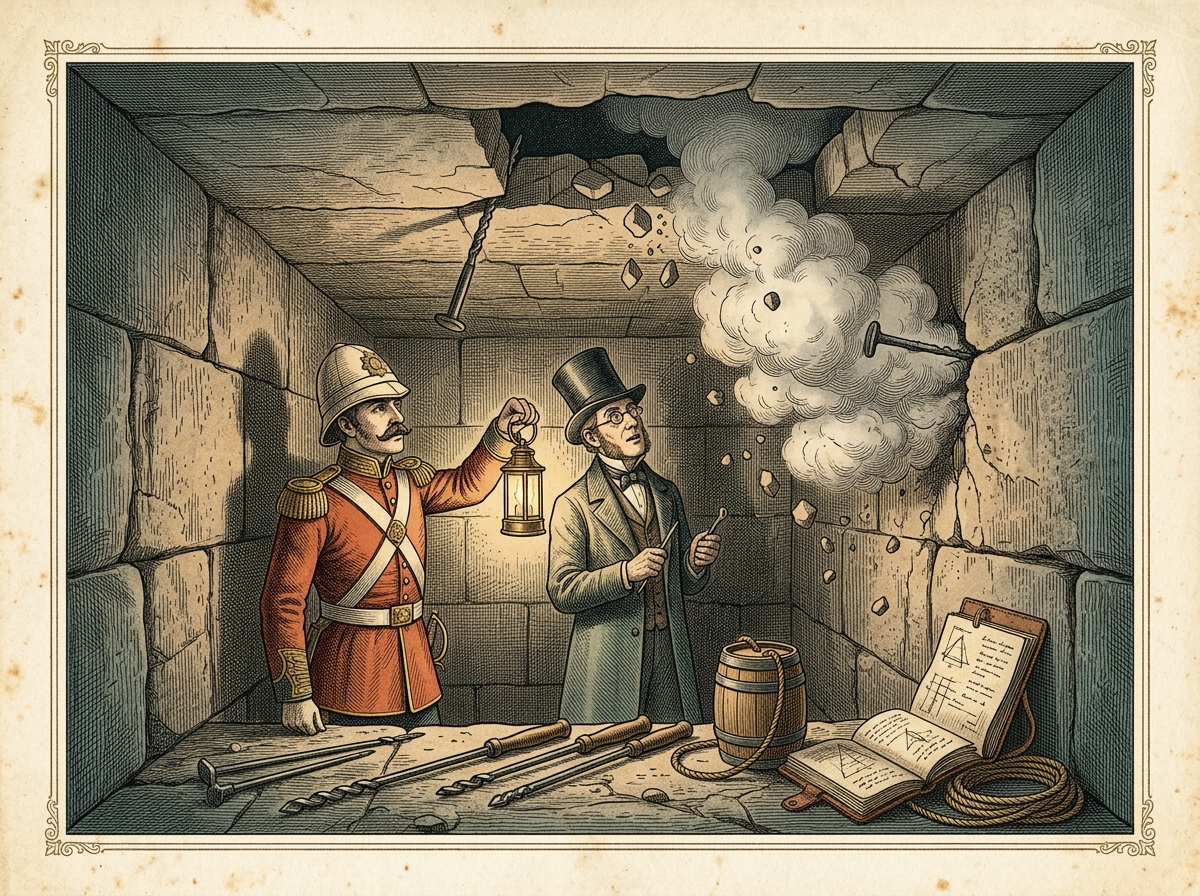
In 1837, Colonel Richard William Howard Vyse stood inside the Great Pyramid of Giza, convinced there was a hidden room somewhere above his head, and decided the quickest way to find it was to blow up the ceiling. Over the following months, gunpowder blasts boomed through a monument that had stood quietly for about 4,500 years. Meanwhile, out on the plateau, his crew drilled into the back of the Great Sphinx looking for secret chambers — until the drill jammed deep inside it and would not come out.
By the Curiosities Desk · · 6 min read · Filed under Archaeology · Today’s round
What happened?
Vyse was a British army officer and former Member of Parliament who first visited Egypt in 1835. He was not trained as an archaeologist; almost nobody was yet. In 1836 he began paying into the Giza excavations of Giovanni Battista Caviglia, an Italian sea captain turned pyramid explorer. Vyse soon judged Caviglia’s progress too slow, and in 1837 he took over, hiring a young engineer named John Shae Perring to survey and document the work.
His main target was a puzzle inside the Great Pyramid, the tomb of the pharaoh Khufu. Above the granite King’s Chamber sat a low crawlspace called Davison’s Chamber, discovered by the British diplomat Nathaniel Davison in 1765. Vyse suspected there was more above it. When his workers found a crack in the ceiling, he had them enlarge it the most direct way available in 1837: by drilling holes, packing them with gunpowder, and blasting. The tunneling took months.
It worked. Vyse broke into a second low chamber, then a third, a fourth, and a fifth, stacked one above another. He named them after people he admired: Wellington’s Chamber (for the Duke of Wellington), Nelson’s Chamber (for Admiral Nelson), Lady Arbuthnot’s Chamber (for a visiting aristocrat), and Campbell’s Chamber (for Patrick Campbell, the British consul general in Egypt). The rooms were empty. Vyse admitted his “mortification” on realizing the first one was simply “a chamber of construction” — part of the pyramid’s engineering, not a treasure room.
But the walls held something no one had seen before: red-painted marks left by the ancient builders, including work-gang names containing Khufu’s own name. These were among the first ancient Egyptian writings found inside the pyramid. Vyse’s team also cleared the narrow shafts leading from the King’s Chamber to the outside. When the southern one opened, Vyse wrote, “an immediate rush of air took place.”
The gunpowder kept coming out at the neighboring pyramid of Menkaure. There, Vyse started at an old gash in the north face — left over from a failed attempt to demolish the pyramid in the 1190s — and blasted inward for weeks without finding anything. On July 29, 1837, workers clearing sand found the real entrance. Inside, Vyse found a basalt sarcophagus (a stone coffin) and fragments of a wooden coffin naming Menkaure. Removing the sarcophagus took still more blasting. It was loaded onto a merchant ship, the Beatrice, bound for the British Museum. The ship left Alexandria in September 1838 and vanished, believed lost off Cartagena, Spain. The sarcophagus has never been found.
And the Sphinx? Searching for hidden rooms, Vyse’s men bored a hole into its back. According to later accounts, the boring rods jammed (some descriptions say they snapped) roughly 27 feet down. An attempt to free them with gunpowder was abandoned before it could do further damage to the monument. The hole, sometimes called “Perring’s Hole,” is still there.
Why was it strange?
We picture archaeology as brushes, trowels, and patience. In 1837, the toolkit for opening one of the world’s most famous buildings was explosives. Vyse was not a vandal for its own sake. He kept careful records, published three detailed volumes, and paid for precise surveys. He simply worked in an era before anyone had decided that the monument itself, not just what was hidden inside, was worth protecting.
The irony is that the destructive method produced real knowledge. The painted quarry marks in Campbell’s Chamber became key evidence tying the Great Pyramid to Khufu. Here, the hammer and the history book showed up together.
He wasn’t the only one: The Man Who Found Troy — and Dug Straight Through It.
What did scientists learn?
The stacked chambers answered an engineering question: how did the builders keep millions of tons of stone from crushing the King’s Chamber? The upper rooms are relieving chambers — open spaces roofed with huge granite beams, capped by a pointed gable of limestone blocks that channels weight sideways, away from the burial room below.
The graffiti mattered just as much. In 1980, author Zecharia Sitchin claimed Vyse had painted the Khufu marks himself. Egyptologists reject this. Some marks run into joints between blocks and onto surfaces that would have been hidden once the stones were set, meaning they had to be painted before construction. Later finds, including papyrus logbooks discovered in 2013 at Wadi al-Jarf on the Red Sea that record boat crews hauling limestone to Giza during Khufu’s reign, support the same date.
Another explorer who let the measurements win: The Archaeologist Who Measured the Great Pyramid in Pink Underwear — and Buried His Father’s Favorite Theory.
How does it affect us today?
Modern Egyptology runs almost the opposite way. In 2016, the ScanPyramids project used muons — particles created when cosmic rays strike the upper atmosphere, which pass through stone and are absorbed more by solid rock than by empty space — to map voids inside the Great Pyramid without moving a single block. In 2023, the team confirmed a hidden corridor about 30 feet long above the main entrance. To look inside, they slipped a camera just 6 millimeters wide through a tiny gap between stones.
Vyse’s lost sarcophagus is a reminder of what was at stake. Today, Egypt strictly regulates excavation and export, and a small fragment Vyse donated is one of the few surviving pieces of Menkaure’s original stone coffin.
Same century, different monument: The Copper Tools That Scraped History Off the Parthenon Marbles.
Fun fact
The wooden coffin Vyse found in Menkaure’s pyramid, now in the British Museum, names the pharaoh — but it was made nearly 2,000 years after he died, during a later restoration of his burial. Ancient Egyptians were already repairing their own antiquities.
Sources
- Vyse, Richard William Howard. Operations Carried On at the Pyramids of Gizeh in 1837, Vol. 1 (London: James Fraser, 1840) — digitized by Heidelberg University Library
- British Museum, Wooden coffin of Menkaure (EA6647), donated by Howard Vyse
- British Museum, Fragment of the basalt sarcophagus of Menkaura (EA6646)
- Procureur, S., et al. (ScanPyramids) “Precise characterization of a corridor-shaped structure in Khufu’s Pyramid by observation of cosmic-ray muons.” Nature Communications 14 (2023)
- Artnet News, on the search for Menkaure’s sarcophagus and the wreck of the Beatrice
Related stories
- The Circus Strongman Who Found Egypt’s Greatest Tomb — A former strongman became one of Egypt’s first great excavators
- The Botanist Who Ground Up a Piece of the Sphinx to See If It Would Wiggle — Another scientist who took a piece of the Sphinx home
- The Man Who Found Troy — and Dug Straight Through It — Schliemann’s trench sliced through the city he was hunting
#archaeology #great pyramid #giza #19th century #excavation #Egyptology