The Scientist Behind It · Archaeology
The Archaeologist Who Measured the Great Pyramid in Pink Underwear — and Buried His Father's Favorite Theory
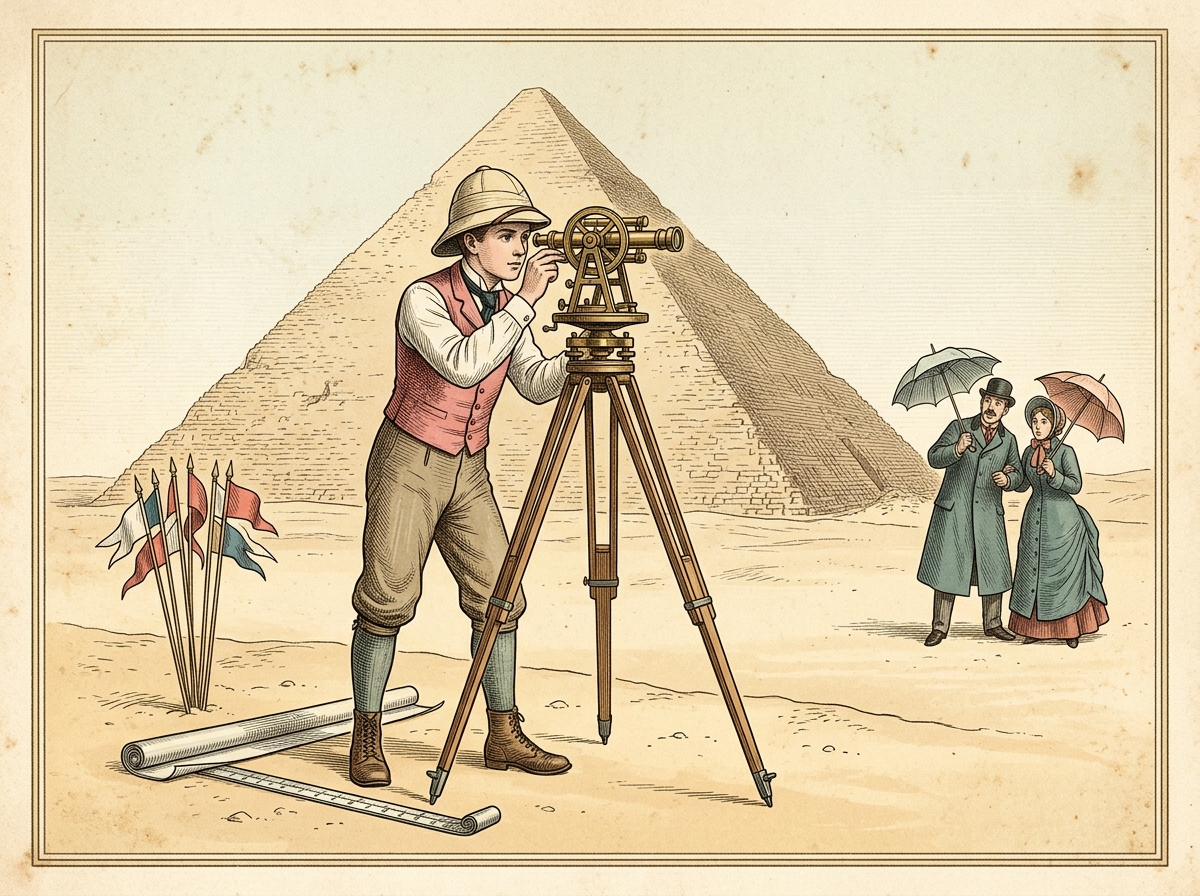
In 1881, tourists climbing around the Great Pyramid of Giza sometimes found a young Englishman at work beside it in nothing but a vest and underpants. Years later he explained that the outfit was practical in the heat, and that "if pink they kept the tourist at bay." The man was Flinders Petrie, and the instruments he was carefully setting up were about to bury a theory his own father had loved for years.
By the Curiosities Desk · · 5 min read · Filed under Archaeology · Today’s round
What happened?
The story starts with a book. In 1866, a young William Matthew Flinders Petrie brought home a copy of Our Inheritance in the Great Pyramid by Charles Piazzi Smyth, the Astronomer Royal for Scotland. Smyth, building on the ideas of a London publisher named John Taylor, argued that the Great Pyramid had been laid out using a special unit he called the “pyramid inch,” almost exactly one British inch (he put it at 1.001 inches). Measure the pyramid in that unit, the theory went, and its dimensions revealed things like the number of days in the year and the size of the Earth. For Smyth this meant the British inch had ancient, even divine, roots, which made it a handy argument against the French metric system.
Petrie’s father, William, an engineer and an old friend of Smyth’s, was strongly drawn to these views. He had also trained his son to survey with real precision; the two had practiced together at Stonehenge in 1872. Petrie later wrote that it was his father’s interest that encouraged him to go out and do the survey of the Great Pyramid himself.
He settled at Giza in December 1880, at age 27, and stayed until May 1881, then returned for a second season that ran to the end of April 1882, about nine months in all. Home was “a rock-hewn tomb, or rather three tombs joined together,” which he fitted with shelves and a hammock bed. The tombs, he noted approvingly, kept out the hot south-west winds.
His kit was serious: theodolites (telescopes mounted to measure precise angles), a box sextant, signal markers, and a steel measuring scale 100 inches long. He worked with Ali Gabri, a local assistant, and a few short-term companions. Because Giza was already a tourist destination, he did his work inside the Great Pyramid in the evenings, “after the travellers were clean away.” Inside, the air was so hot and still that he found it “most convenient to strip entirely for work.” Outdoors, it was the famous pink vest and pants.
Using triangulation, a method that pins down distances by measuring angles across a network of fixed points, Petrie mapped the whole plateau. His verdict on the Great Pyramid’s base: an average side of 9,068.8 inches, give or take about half an inch, or roughly 230 meters.
That number was smaller than the figure the pyramid-inch enthusiasts had relied on. Earlier measurers had worked from rock-cut sockets at the corners, which Petrie found sat two or three feet outside the line of the pyramid’s original casing stones. The extra length had been propping up the numerology. In his 1883 report, The Pyramids and Temples of Gizeh, he concluded that there was no example “that will bear examination” of any such measure.
Why was it strange?
Petrie wasn’t an outsider arriving to sneer at a fringe idea. He grew up with it. The theory came into his house through his father’s bookshelf and his father’s friendship, and he went to Egypt partly on that encouragement. The person who did the most to disprove the pyramid inch was, in a sense, raised inside it.
He also wasn’t cruel about it. In the introduction to his report, he recalled an American believer who reacted to the new measurements by saying, “I feel as if I had been to a funeral.” Petrie’s advice was to “let the old theories have a decent burial,” while taking care that none of the “wounded ones are buried alive.” Another archaeologist who arrived with a big idea had a rougher time with his site; see The Man Who Found Troy — and Dug Straight Through It.
What did scientists learn?
The big lesson was about where measurement errors hide. Smyth’s pyramid inch only “worked” if you used the right numbers and picked which features to measure. Historians at Cambridge’s Whipple Museum note that critics questioned how selectively he had used his data. Petrie’s approach was the opposite: measure everything, report the uncertainty, and let the pattern emerge.
When he did, the pattern pointed to the Egyptians’ own unit, the royal cubit, about 20.6 inches. The Great Pyramid’s sides come out close to 440 cubits. No sacred inch was needed.
Petrie also studied how the stones had been cut and fitted, looking for evidence of ancient tools and techniques. That habit of studying the workers, “not only their work, but their mistakes,” as he put it, became the core of his long career. A different tale of strongmen and Egyptian tombs makes a fun comparison: The Circus Strongman Who Found Egypt’s Greatest Tomb.
How does it affect us today?
Petrie went on to excavate across Egypt for decades and helped turn archaeology from treasure hunting into careful recording, logging even humble pottery fragments. His Giza survey is still a standard reference: modern researchers continue to use much of his basic data on the pyramid plateau.
The pyramid inch never quite died. It still turns up in “pyramidology” books and online. But the debate it was meant to win, imperial units versus metric, was settled by other means, and today even the inch is officially defined in metric terms, as exactly 2.54 centimeters. The story of how that metric system defined its own standards has strange twists of its own: The Cylinder in a Paris Vault That Defined the Kilogram — Until It Started Losing Weight.
Fun fact
Petrie left his head to science. When he died in Jerusalem in 1942, it was sent to the Royal College of Surgeons in London so his brain could be studied. Wartime delays and a lost label meant it sat unidentified for a time before anyone recognized it.
Sources
- W. M. Flinders Petrie, The Pyramids and Temples of Gizeh (1883), via the Giza Project at Harvard — the primary source for his dates at Giza, tomb lodgings, instruments, base measurements, and the “funeral” passage.
- UCL Petrie Museum, “Petrie’s Life” — Petrie’s own recollections of Piazzi Smyth’s book, his father, Stonehenge, and the pink vest and pants.
- Whipple Museum of the History of Science, University of Cambridge, “Charles Piazzi Smyth and His Imperial Measures” — the pyramid inch, Smyth’s 1864 expedition, and the imperial-versus-metric context.
- “Pyramid inch” and “Flinders Petrie”, Wikipedia — used as a guide to John Taylor’s theory and to Margaret Drower’s biography for details of Petrie’s death and the fate of his head.