The Scientist Behind It · Archaeology
The King Found Six Hours Into the Dig, Under a Parking Space Marked 'R'
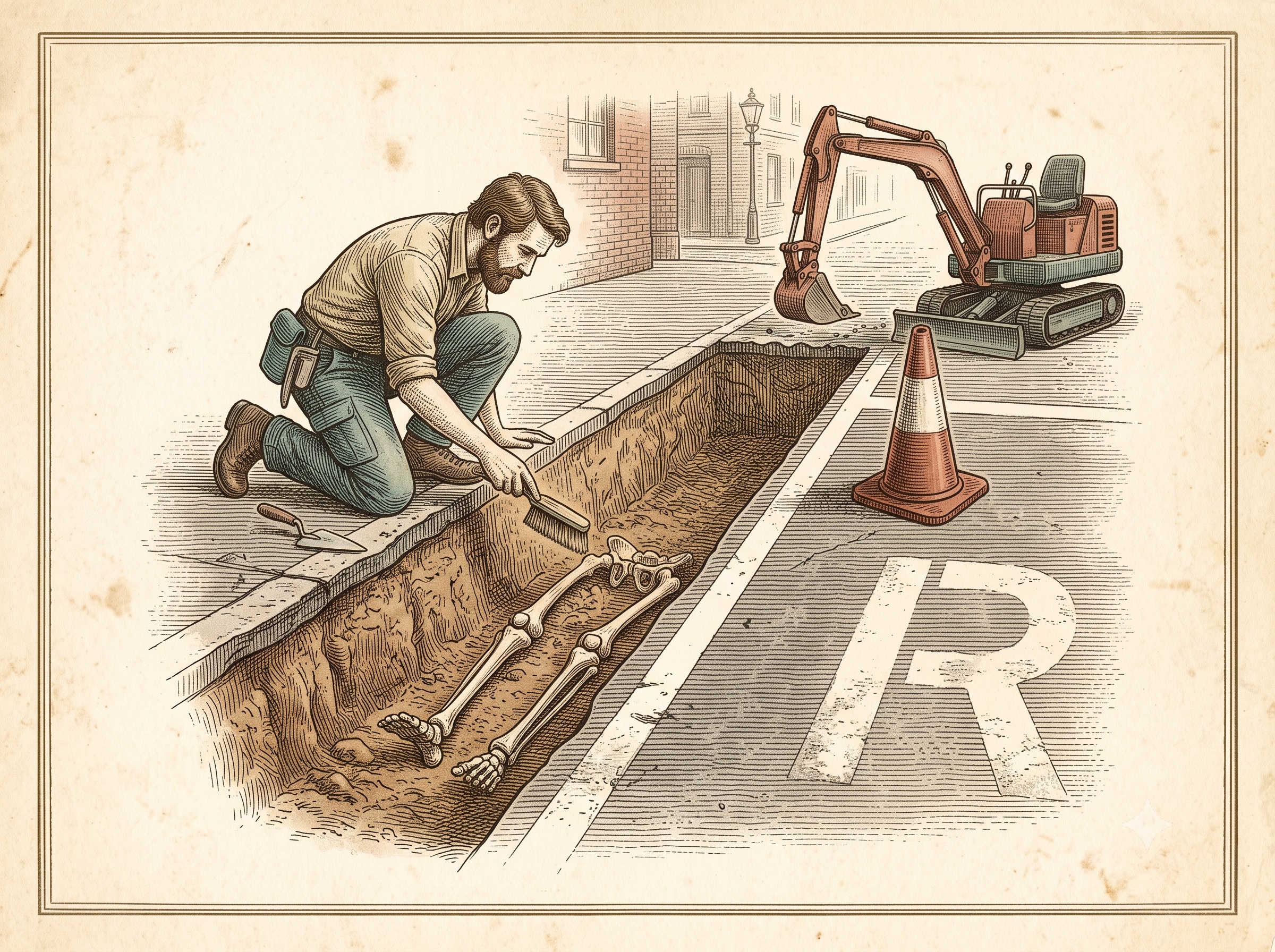
On the morning of 25 August 2012, a mechanical digger peeled the tarmac off a council car park in Leicester. Within a few hours, in the very first trench, site director Mathew Morris was staring at two human leg bones lying undisturbed in the soil — roughly beneath a parking bay that somebody had once painted with the letter **R**.
By the Curiosities Desk · · 5 min read · Filed under Archaeology · Today’s round
What happened?
On 22 August 1485, at the Battle of Bosworth in Leicestershire, Richard III led a cavalry charge and was killed, handing the crown to Henry Tudor and ending the Wars of the Roses. His body was carried to Leicester and buried with little ceremony in the church of the Franciscan friars — the Grey Friars.
Fifty-three years later the friary was dissolved, the church pulled down, and the site drifted through private hands until it vanished under buildings, a school playground, and two car parks. With the grave lost, a rumour hardened into common knowledge: that Richard’s bones had been dug up and thrown into the River Soar. Most people believed it for four centuries. A few historians didn’t — in 1986, University of Leicester tutor David Baldwin published a paper predicting the king’s remains might yet be found on the Grey Friars site by 21st-century archaeologists.
In January 2011, a screenwriter and Richard III Society member named Philippa Langley walked into University of Leicester Archaeological Services (ULAS) and proposed exactly that. The obstacles were considerable: most of the friary precinct was built over, and even finding the church would leave the problem of finding one grave inside it. Richard Buckley, then co-director of ULAS, put the chances slim enough that he said publicly he would eat his hat if they turned up the king.
Langley kept the project alive anyway. She commissioned background research and a ground-penetrating radar survey in 2011, and persuaded Leicester City Council and Leicester Shire Promotions to chip in; the University of Leicester underwrote the dig and paid most of its costs. When funding still fell short in the summer of 2012, Langley launched an appeal inside the Richard III Society and covered the gap within days.
Buckley’s plan was two trenches in the Social Services car park. The project launched with a press day on 24 August 2012; the next morning Morris cut the tarmac and machined trench one — 1.6 metres wide, 30 metres long. About five metres from its north end, roughly 1.5 metres down, two parallel leg bones appeared, lying in a position that indicated an undisturbed burial.
The team did the disciplined thing: they left the bones alone and spent the next ten days working out what building they were inside. The answer was the choir of the Grey Friars church — precisely where the historical sources said Richard had been buried. The grave was excavated on 5 September. It was scrappy work: no coffin, no shroud pins, untidy sloping sides, and a hole dug too short for its occupant, so the head had been propped awkwardly against one end.
On 12 September the university announced it had a candidate — a male skeleton with a curved spine and battle wounds. On 4 February 2013, after five months of analysis, it announced that “beyond reasonable doubt,” this was Richard III.
The painted R, for the record, was a coincidence. A car park attendant had put it down in the early 2000s to mark a reserved bay, and the trench was placed using old maps and survey data, not the tarmac. It is still one of the best coincidences in British archaeology.
Why was it strange?
Archaeology almost never produces a name. Digs yield anonymous bones, and the honest label is usually “adult male, 30–40.” Here, a two-week exploratory excavation found a named king of England on its first day, in its first trench, in a city where the working assumption for 400 years was that the body wasn’t there at all.
The legend was wrong in both directions, too. Richard was not in the river — and he wasn’t the hunchbacked figure of Tudor writing and Shakespeare’s play either. The spine in that grave told a different, more specific story.
Another scientist, told from the human side: The Circus Strongman Who Found Egypt’s Greatest Tomb.
What did scientists learn?
Dating. Radiocarbon results had to be corrected for the marine reservoir effect — seafood carries older carbon than land food, so a fish-heavy diet makes bones read as artificially old. Once modelled, the date came out at 1456–1530 AD at 95.4% probability. Richard died in 1485.
The bones. Male, roughly 30–34 at death; Richard was 32. The spine showed severe adolescent-onset idiopathic scoliosis — a sideways, spiralling curvature that develops in the teenage years with no known cause. It would have raised one shoulder above the other, but would not have produced a limp or a hunched back.
The death. A forensic analysis in The Lancet identified eleven perimortem injuries — nine to the skull, two to the rest of the body — consistent with a man who had lost his helmet in the closing moments of a battle.
The identification. Geneticist Turi King led the DNA work. Mitochondrial DNA, which passes down the female line only, gave a perfect whole-genome match to Michael Ibsen and a single-base difference to Wendy Duldig — two living people traced through all-female lines back to Richard’s mother, Cecily Neville. The Y chromosome, passed father to son, did not match five living male-line relatives, meaning a false-paternity event somewhere in between. Combined with the archaeology and osteology, the team put the identification at 99.999% — roughly 6.7 million to one.
Another person who would not drop the question: The Man Who Found Troy — and Dug Straight Through It.
How does it affect us today?
Grey Friars became a template for identifying a single named individual: archive research, radar, stratigraphy, osteology, isotopes, radiocarbon, and ancient DNA, cross-checked against each other rather than any one line carrying the case alone. A judicial review over whether Richard should be reburied in York or Leicester ran into 2014; he was interred in Leicester Cathedral on 26 March 2015. The car park is now the King Richard III Visitor Centre, with the grave preserved in place.
The Y-chromosome break has had a longer afterlife than anyone expected: a clean, public demonstration that a documented pedigree and a biological line of descent are two different things — a caveat every consumer DNA-testing customer eventually runs into.
The same thread — ancient DNA — continues in The 5,700-Year-Old Chewing Gum That Held an Entire Human Genome.
Fun fact
Michael Ibsen, the Canadian-born cabinetmaker whose DNA clinched the identification, also built the king’s coffin — English oak and yew, made rectangular rather than tapered so the funeral pall would hang properly. And Buckley kept his word about the hat: by Turi King’s account, the team had a cake made in the shape of a hard hat, and he ate it.
Sources
- Buckley et al., “‘The king in the car park’: new light on the death and burial of Richard III in the Grey Friars church, Leicester, in 1485,” Antiquity 87 (2013) — the excavation team’s own peer-reviewed account
- King et al., “Identification of the remains of King Richard III,” Nature Communications 5, 5631 (2014) — the genetic and statistical identification, including the Y-chromosome mismatch
- Appleby et al., “Perimortem trauma in King Richard III: a skeletal analysis,” The Lancet 385 (2015) — the forensic wound analysis
- University of Leicester — An overview of the Grey Friars project — dates, funding, and the sequence of the dig
- Medievalists.net — “I’ll Eat My Hat If It’s Richard: Dr. Turi King on the Impact of the Richard III Project”