Everyday Objects · Archaeology
The 5,700-Year-Old Chewing Gum That Held an Entire Human Genome
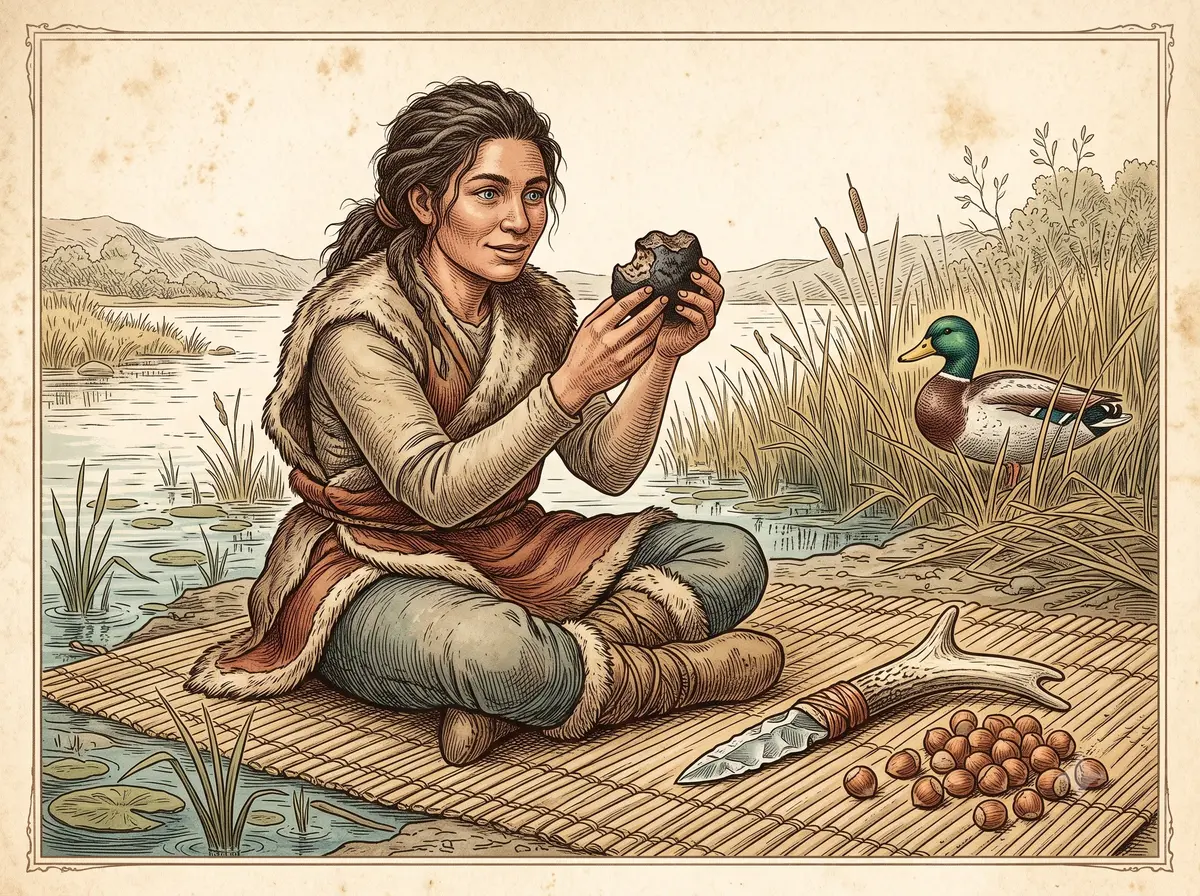
A dig on a muddy Danish island turned up a lump of blackish goo about the size of a thumbnail, dimpled with the imprints of teeth. No skeleton, no skull, no bone of any kind was ever found nearby. And yet, tucked inside that chewed-up wad, scientists recovered a complete human genome — enough to say the person who had spat it out roughly 5,700 years ago was a woman with dark skin, dark hair, and startlingly blue eyes.
By the Curiosities Desk · · 5 min read · Filed under Archaeology · Today’s round
What happened: The 5,700-Year-Old Chewing Gum That Held an Entire Human Genome
The lump came from Syltholm, on the southern Danish island of Lolland — the site of Denmark’s largest Stone Age excavation, uncovered ahead of a tunnel construction project. Its waterlogged, oxygen-poor mud turned out to be an extraordinary preservative, sealing away organic material that would have rotted almost anywhere else.
Among the finds was a piece of birch pitch: a black-brown tar made by heating birch bark until it oozes a sticky resin. Stone Age people used birch pitch as a kind of all-purpose glue, most often to fix stone blades into wooden or antler handles. The pitch hardens as it cools, so to soften it again before use, people chewed it — which is why so many of these lumps carry tooth marks. Some may also have been chewed as a primitive medicine, since one of the pitch’s main ingredients, a compound called betulin, has mild antiseptic properties.
A team led by researchers at the University of Copenhagen, publishing in Nature Communications in 2019, decided to see whether the chewed pitch had trapped any DNA from the mouth that chewed it. It had — spectacularly. More than 30 percent of the DNA they pulled out was human, a preservation level they compared to a well-kept tooth or the dense petrous bone of the inner ear, the two richest sources of ancient DNA archaeologists know. From roughly 390 million DNA fragments, the team reconstructed a full genome.
The genome told a small biography. The chewer was female. She carried gene variants linked to dark skin, dark brown hair, and blue eyes — a combination now known to have been common among Europe’s hunter-gatherers. She could not digest milk as an adult, which fits the era: the ability to tolerate lactose spread through Europe only later, alongside dairy farming. Genetically she belonged with western hunter-gatherers of mainland Europe, and carried no ancestry from the incoming Neolithic farmers, even though she lived right at the moment Denmark was tipping from foraging toward farming. Researchers gave her the nickname “Lola,” after the island of Lolland where she was found — a name from the scientists and press, not something the woman herself would have recognized.
The pitch held more than her own DNA. It preserved a snapshot of the microbes living in her mouth that day, including bacteria associated with gum disease and the pathogen Streptococcus pneumoniae. It even carried 593 fragments of Epstein-Barr virus, the extremely common virus that can cause glandular fever, or mononucleosis. And there was DNA that hadn’t come from her at all: traces of hazelnut and mallard duck, which the researchers suggest — carefully, as a possibility rather than a certainty — may have been the remains of a recent meal.
Why it was strange: The 5,700-Year-Old Chewing Gum That Held an Entire Human Genome
Ancient DNA almost always comes from bone or teeth. The whole discipline is built on the idea that you need a physical piece of the person. Here, there was no person to sample. The individual’s actual body has never been found and may be gone forever. Her entire genome survived instead in something she threw away — a piece of literal Stone Age trash, spat into the mud and forgotten.
It’s an inversion of how we usually imagine leaving a mark on history. We picture monuments, graves, written names. This woman left a full genetic portrait of herself by doing the most mundane thing imaginable: chewing on something and tossing it aside.
Another ordinary thing with a strange past: The 3,000-Year-Old Pants That Were Invented for Horseback Riding.
What scientists learned: The 5,700-Year-Old Chewing Gum That Held an Entire Human Genome
The headline lesson was practical: chewed birch pitch is a genuine archive of the deep past. Because the pitch is antiseptic and seals quickly, it can lock away DNA in a way that resists the decay that destroys most biological material. That makes these humble lumps — common at Scandinavian sites and long treated as unremarkable — a new source of ancient genomes, especially at sites where no human bones survive.
Because the pitch captures a moment rather than a lifetime, it also offers something bone can’t: a same-day glimpse of a person’s oral microbiome and, possibly, a recent meal. And “Lola’s” lack of farmer ancestry added a data point to a long-running debate, hinting that in southern Scandinavia, farming may have spread more by the exchange of ideas than by a wholesale replacement of the local hunter-gatherer population — though the authors are careful to note this rests on a single genome.
The same thread — ancient DNA — continues in The King Found Six Hours Into the Dig, Under a Parking Space Marked ‘R’.
How it reaches us today: The 5,700-Year-Old Chewing Gum That Held an Entire Human Genome
The technique has cracked open a new category of evidence. Since the Syltholm study, researchers have gone back to boxes of chewed pitch sitting in museum drawers, reading the genetics of people who left no bones at all. It expands the reach of ancient-DNA research to sites and populations that were, until now, genetically invisible.
There’s a public-health angle, too. Recovering a 5,700-year-old sample of S. pneumoniae and Epstein-Barr virus lets scientists trace how such microbes have changed over thousands of years — the same long-view approach that helps researchers understand how today’s pathogens evolve, spread, and resist our defenses.
Elsewhere in archaeology: Göbekli Tepe: The Temple Built Before Farming, Writing, or the Wheel.
Fun fact: The 5,700-Year-Old Chewing Gum That Held an Entire Human Genome
The chewer’s DNA survived better in a wad of spit-out tar than most royal skeletons survive in their tombs: over 30 percent of the recovered DNA was human, rivaling the best-preserved ancient teeth. Her body vanished; her chewing gum outlasted it.
Sources: The 5,700-Year-Old Chewing Gum That Held an Entire Human Genome
- Jensen, T.Z.T., Niemann, J., Iversen, K.H., et al. “A 5700 year-old human genome and oral microbiome from chewed birch pitch.” Nature Communications 10, 5520 (2019). https://www.nature.com/articles/s41467-019-13549-9 (primary source)
- Smithsonian Magazine, “Human Genome Recovered From 5,700-Year-Old Chewing Gum” (2019). https://www.smithsonianmag.com/science-nature/human-genome-recovered-5700-year-old-chewing-gum-180973801/
- Sci-News, “Researchers Extract and Sequence Human DNA from 5,700-Year-Old ‘Chewing Gum’” (2019). https://www.sci.news/archaeology/syltholm-human-dna-07925.html
- CBS News, “Scientists discover DNA of ancient woman on 5,700-year-old ‘chewing gum’” (2019). https://www.cbsnews.com/news/scientists-discover-dna-of-ancient-woman-on-5700-year-old-chewing-gum/
Related stories: The 5,700-Year-Old Chewing Gum That Held an Entire Human Genome
- The 5,300-Year-Old Iceman Whose Tattoos May Have Been Medicine — A 5,300-year-old murder victim whose tattoos may have been treatment
- The Runaway Goat That Led to the Dead Sea Scrolls — A goat wandered into a cave and led to the Dead Sea Scrolls
- From Mendel’s Peas to CRISPR: A Short History of Genetics — Pea plants to gene editing in one long thread