Everyday Objects · Archaeology
The 3,000-Year-Old Pants That Were Invented for Horseback Riding
At the Yanghai cemetery in western China, archaeologists opened two Bronze Age tombs from the 13th to 10th century BC and found something almost embarrassingly familiar staring back at them: two middle-aged men, dead for three millennia, still dressed in their pants. Straight legs, a wide seat, a drawstring waist — trousers any modern rider would recognize. They just happened to be the oldest pants ever found.
By the Curiosities Desk · · 5 min read · Filed under Archaeology · Today’s round
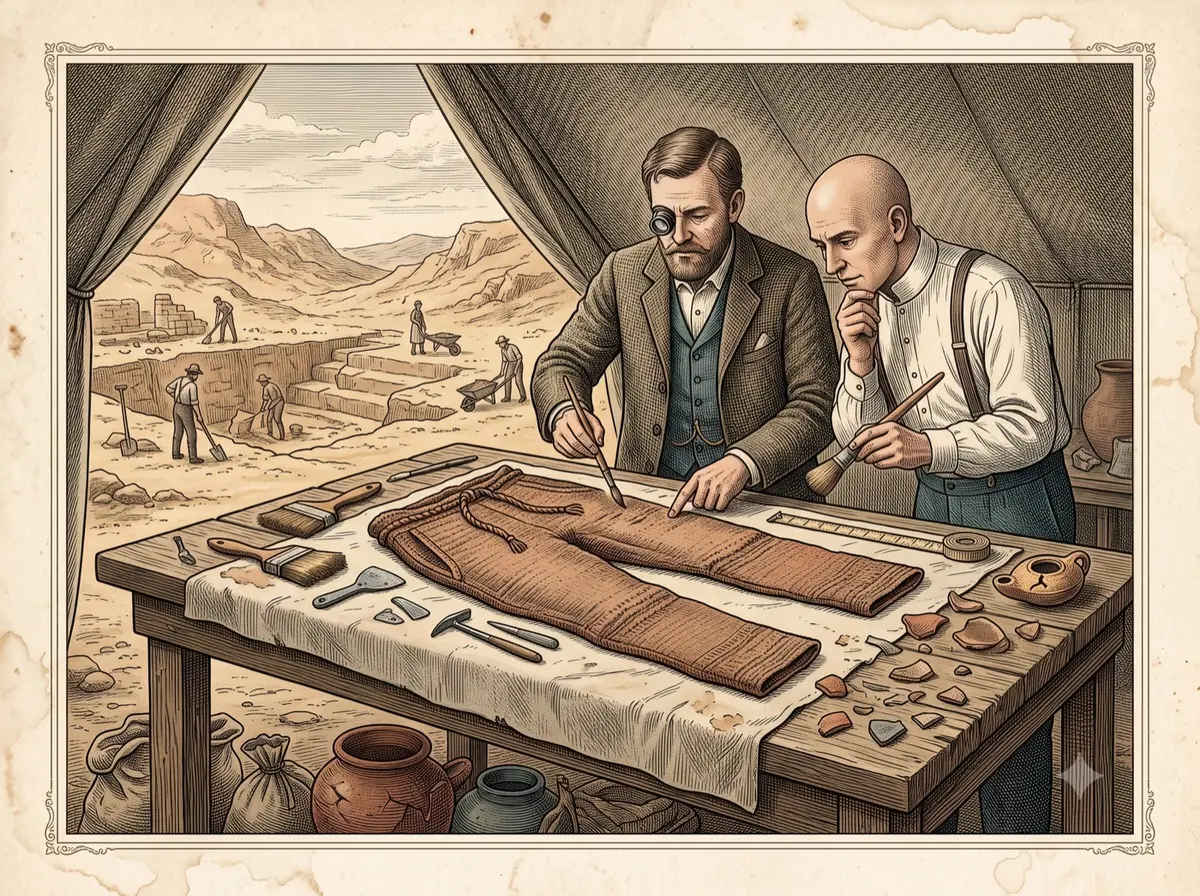
What happened: The 3,000-Year-Old Pants That Were Invented for Horseback Riding
The find came from the Yanghai cemetery, a sprawling burial ground near the Turfan oasis in China’s Tarim Basin, where the region’s brutally dry climate has preserved bodies, wood, and cloth since the early 1970s. More than 500 tombs have been excavated there. In 2014, archaeologists Ulrike Beck and Mayke Wagner of the German Archaeological Institute in Berlin published a detailed study, in the journal Quaternary International, of woolen trousers recovered from two of those tombs, labeled M21 and M157.
Radiocarbon dating placed the trousers between the 13th and 10th century BC — roughly 3,300 to 3,000 years old. Both belonged to men who died around age 40 and were likely herders and warriors. One was buried with a decorated leather bridle, a wooden horse bit, a battle-ax, and a leather arm guard. The other was laid to rest with a whip, a decorated horse tail, a bow, and a bow sheath. The gear left little doubt about how these men spent their lives: on horseback.
The trousers themselves were a small feat of engineering. Each pair was assembled from just three pieces of brown wool cloth — one rectangular panel for each leg, plus a stepped, cross-shaped insert for the crotch — sewn together with decorative braid covering the seams. Crucially, none of the fabric had been cut. The weaver had shaped each piece directly on the loom, at the exact size needed, then stitched the pieces to fit one specific person. Side slits and waist strings, rather than a fitted waistband, held the finished garment on. Beck and Wagner called it “a ground-breaking achievement in the history of cloth making.”
Why it was strange: The 3,000-Year-Old Pants That Were Invented for Horseback Riding
For most of clothing history up to that point, people across Europe and Asia dressed in a wrap: tunics, robes, togas, kilts, one continuous piece of fabric draped or belted around the body. Even Ötzi the Iceman, the roughly 5,300-year-old mummy found frozen in the Alps, wore a loincloth paired with separate leg coverings rather than a single stitched garment enclosing both legs at once.
A true pair of trousers — a “bifurcated” garment, split into two independent legs joined at the crotch — is a different kind of object. It requires imagining the body in two separable parts before a single thread is woven, then building cloth that follows that shape. It’s the kind of everyday item so ordinary that it seems like it must have always existed. It didn’t. Somewhere, someone had to invent it, solve the tailoring problem it posed, and decide it was worth the effort. The Yanghai finds are the oldest direct physical evidence of that moment.
Another object that did not start out as itself: The 22-Pound Lump of 2,000-Year-Old Butter Turf Cutters Dug Out of a Bog.
What scientists learned: The 3,000-Year-Old Pants That Were Invented for Horseback Riding
Beck and Wagner’s team noticed the trousers’ distinctive shape — straight, close-fitting legs and an unusually wide, low crotch piece — closely resembled modern riding pants. To test the idea, they had a replica sewn to the same pattern and tried it out. Worn for walking, the wide crotch felt awkward and impractical. Worn on horseback, it let the rider grip the animal’s sides with the legs while sitting comfortably, exactly the design compromise you’d expect from someone spending long days in the saddle rather than on foot.
That evidence, combined with the horse gear and weapons buried alongside both men, supports what researchers had already suspected: trousers were invented specifically to make horseback riding and mounted combat easier, not as a fashion choice. Victor Mair, a University of Pennsylvania linguist and longtime researcher of the region’s mummies, called the study strong support for the idea that “trousers were invented for horse riding by mobile pastoralists” and then carried outward from Central Asia by horse-riding peoples. It’s worth noting that the exact origins of horseback riding itself are still debated among archaeologists, with estimates ranging from roughly 4,000 to 5,500 years ago, so the precise gap between “humans first rode horses” and “humans first wore pants for it” isn’t nailed down. But the Yanghai trousers predate the famous Scythian nomad trousers, from around 2,500 years ago, making them the earliest known examples by a wide margin, and roughly 400 years older than the wool trousers found on Cherchen Man, another mummy from the same region.
Another ordinary thing with a strange past: The First Roman Letter Found Near Hadrian’s Wall Was About Socks and Underpants.
How it reaches us today: The 3,000-Year-Old Pants That Were Invented for Horseback Riding
Nearly every pair of pants worn today, from jeans to ski pants to riding breeches, is a distant descendant of the same basic solution the Yanghai tailor arrived at: two independent legs joined by a crotch piece, built to let a body move the way a specific activity demands. It’s a pattern that keeps repeating in the history of clothing. Cycling shorts, wetsuits, and spacesuits all exist because someone needed the human body to interface with a machine, an animal, or an environment it wasn’t naturally built for, and cloth had to be re-engineered to make that possible. The Bronze Age herders of the Tarim Basin were the first people known to have solved that problem for the horse.
A close cousin: The Tube of Paint That Got a Funeral in an English Garden.
FAQ
Where were the oldest pants found?
The oldest known trousers were found in the Yanghai cemetery, near the Turfan oasis in China’s Tarim Basin. They belonged to two men buried between the 13th and 10th century BC, and they were published in detail in 2014 by Ulrike Beck and Mayke Wagner.
Why were pants invented?
The Yanghai men were buried with horse bridles, bits, whips, and weapons. The trousers — two leg panels and a crotch piece, woven to shape — are the oldest physical evidence that pants were made for riding, not as a fashion. They are older than the famous Scythian riding trousers by several centuries.
Fun fact: The 3,000-Year-Old Pants That Were Invented for Horseback Riding
Nothing about these trousers was cut from a larger sheet of cloth. The weaver planned the finished, tapered shape of each leg and the crotch insert in advance and wove them directly into that form on the loom, meaning the garment’s pattern existed in someone’s head before it existed in wool.
Sources: The 3,000-Year-Old Pants That Were Invented for Horseback Riding
- Beck, U., Wagner, M., et al. “The invention of trousers and its likely affiliation with horseback riding and mobility: A case study of late 2nd millennium BC finds from Turfan in eastern Central Asia.” Quaternary International, published online May 22, 2014. (Primary source)
- Bower, Bruce. “First pants worn by horse riders 3,000 years ago.” Science News, May 30, 2014.
- “3,000-year-old trousers discovered in Chinese grave, oldest ever found.” Phys.org, June 3, 2014.
- “World’s Oldest Pants Unearthed in China.” Archaeology Magazine, Archaeological Institute of America, June 2, 2014.
Related stories: The 3,000-Year-Old Pants That Were Invented for Horseback Riding
- The 5,700-Year-Old Chewing Gum That Held an Entire Human Genome — Birch tar chewed 5,700 years ago preserved an entire human genome
- The 5,300-Year-Old Iceman Whose Tattoos May Have Been Medicine — A 5,300-year-old murder victim whose tattoos may have been treatment
- From a Sponge on a Stick to the Flush Toilet: A Short History of the Toilet — Two thousand years of sanitation, from shared sponges to the S-bend