Everyday Objects · Archaeology
The Tube of Paint That Got a Funeral in an English Garden
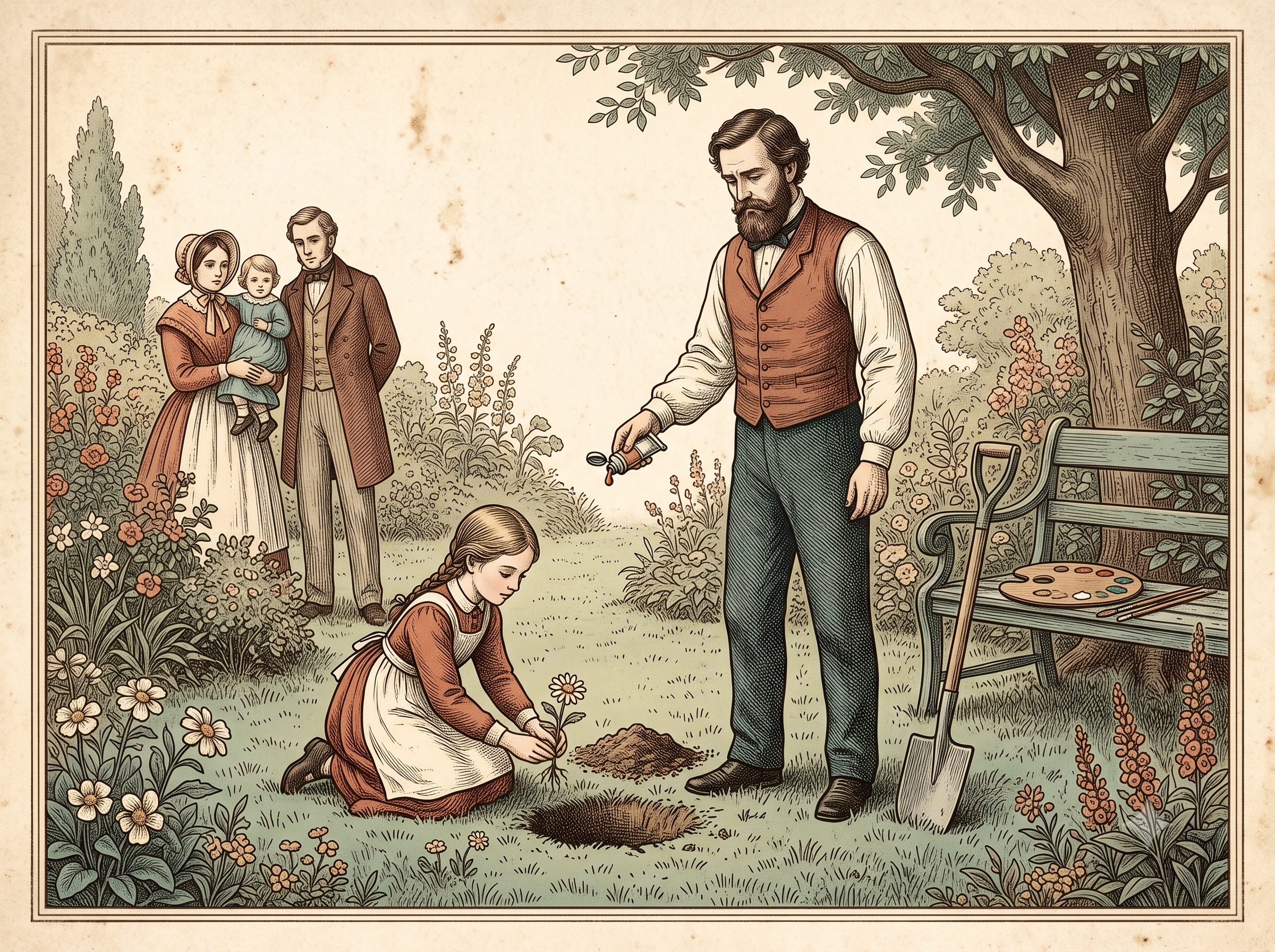
One afternoon in 1881, the painter Edward Burne-Jones came downstairs into his garden holding a tube of oil paint the way you might hold something that had just bitten you. He had learned, minutes earlier, what "mummy brown" was actually made of. A hole was dug in the lawn. The family gathered. Someone planted a daisy on top.
By the Curiosities Desk · · 5 read · Filed under Archaeology · Today’s round
What happened?
The paint had a long and awkward history behind it.
It starts with a translation problem. The 10th-century Persian physician al-Razi used the word mumia — from mum, Persian for wax — for a sticky black medicinal substance. By the next century Avicenna was using mumia to mean bitumen, the natural asphalt that seeps out of the ground in parts of Persia. It was expensive, scarce, and believed to cure nearly everything. When Gerard of Cremona translated Arabic medical texts into Latin in the 12th century, the meaning slid: mumia became something found where bodies were buried.
European travellers who then saw Egyptian mummies — blackened, resinous, unmistakably tarry-looking — concluded that the good stuff was inside the corpses. Apothecaries across Europe began selling powdered mummy as medicine. You can still find 18th-century apothecary jars labelled MUMIA in museum collections.
Somewhere along the way, someone noticed that ground mummy made a very nice brown.
The pigment that resulted was called mummy brown, Egyptian brown, or caput mortuum — “dead head.” It was mummy tissue ground up and mixed with white pitch and myrrh, and it sat in tint between raw and burnt umber, with unusually good transparency. That transparency is what artists actually wanted: it was excellent for glazes, shadows, and flesh tones. A Paris colour shop trading in 1712 called itself À la Momie. A London Compendium of Colours from 1797 claimed the finest brown used by Benjamin West, president of the Royal Academy, “is the flesh of mummy, the most fleshy are the best parts.”
The chemist George Field kept notes. In 1809 he recorded a delivery of mummy sent to him by the portrait painter Sir William Beechey, describing it as arriving “in a mass, containing and permeating rib-bone etc.—of a strong smell resembling Garlic and Ammonia—grinds easily—works rather pasty.”
By the Victorian era the colour was a Pre-Raphaelite favourite. And, crucially, not every artist buying it had thought hard about the name. Burne-Jones apparently assumed it was a shade description, like “flesh tint” or “Naples yellow.” His wife Georgiana later wrote that “Edward scouted the idea of the pigment having anything to do with a mummy — said the name must be only borrowed to describe a particular shade of brown.” Then the painter Lawrence Alma-Tadema, over lunch, mentioned that he had seen a mummy at his colourman’s workshop before it was ground up.
Burne-Jones went and got his only tube and insisted on giving it a “decent burial there and then.” Among the people who trooped out onto the grass was his teenaged nephew, Rudyard Kipling, who never forgot it. Kipling’s version: his uncle “descended in broad daylight with a tube of ‘Mummy Brown’ in his hand, saying that he had discovered it was made of dead Pharaohs and we must bury it accordingly. So we all went out and helped — according to the rites of Mizraim and Memphis, I hope — and to this day I could drive a spade within a foot of where that tube lies.”
Why was it strange?
The strangest part isn’t the funeral. It’s that the funeral was so late.
Mummy brown had been sold openly, under that name, for well over a century by the time Burne-Jones held his ceremony. It appeared in catalogues. It was advertised. And it kept going after him: in 1904 the London firm C. Roberson placed a notice in the Daily Mail reading, “We require [a] mummy for making colour. Surely a 2,000-year-old mummy of an Egyptian monarch may be used for adorning a noble fresco… without giving offence to the ghost of the departed gentlemen or his descendants.”
Roberson finally stopped making it in 1964 — not on principle, but on inventory. The managing director told Time magazine: “We might have a few odd limbs lying around somewhere, but not enough to make any more paint.”
Another object that did not start out as itself: The 3,000-Year-Old Pants That Were Invented for Horseback Riding.
What did scientists learn?
Two things, and both undercut the paint’s whole premise.
First, the bitumen assumption was shakier than anyone in a 17th-century apothecary knew. When chemists ran gas chromatography–mass spectrometry — a technique that separates a mixture and identifies its components by molecular weight — on samples from dozens of Egyptian mummies, they found no detectable petroleum bitumen at all before the New Kingdom. It shows up in roughly half of New Kingdom to Late Period mummies and about 87% of Ptolemaic and Roman ones. Much of the black, tarry look of a mummy comes instead from heated and aged mixtures of fats, resins, and beeswax.
Second, it was a bad pigment. Field himself warned that “little reliance” should be placed on it. It faded, it cracked when used alone, and because it carried fat and ammonia it could interfere with the colours next to it. The conservator Sally Woodcock has argued that mummy brown deserves part of the blame for the disrupted, crazed paint surfaces on many 18th- and 19th-century British pictures.
Another ordinary thing with a strange past: The First Roman Letter Found Near Hadrian’s Wall Was About Socks and Underpants.
How does it affect us today?
We mostly can’t tell which paintings contain it, and that’s the honest answer. Confirming the pigment in a canvas means taking a physical sample, so almost no work has been tested. Delacroix’s Liberty Leading the People and Drolling’s Interior of a Kitchen are frequently named, but on the basis of colour and circumstance — mummy brown appears on a list of Delacroix’s palette from 1854 — not analysis. Treat “this painting is made of mummies” as an open question, not a fact.
What survives clearly is the object lesson. A tube sold under the label “mummy brown” now sits in the Forbes Pigment Collection at the Harvard Art Museums. The paint you can buy today under that name is kaolin, quartz, goethite, and hematite — ordinary minerals doing the same job. And the story is a fixture in the ongoing conversation about human remains in museums, which is worth remembering here: the people in those tubes were people, and they didn’t consent to any of it. Burne-Jones, standing in his garden with a spade, got there about 140 years early.
A close cousin: The 22-Pound Lump of 2,000-Year-Old Butter Turf Cutters Dug Out of a Bog.
Fun fact
Bolton Library and Museum Services owns a tube of mummy brown that its curators laid to rest in an ancient Egyptian animal coffin — one probably made, originally, for an eel or a snake.
Sources
- Georgiana Burne-Jones, Memorials of Edward Burne-Jones (Macmillan, 1906) — the primary eyewitness account of the burial.
- R. Leopoldina Torres, “A Pigment from the Depths”, Index Magazine, Harvard Art Museums — on the Forbes Collection tube, the 1904 Daily Mail notice, and George Field’s 1809 delivery note.
- Lauren R. Bruce, “The corpse on the canvas: the story of ‘mummy brown’ paint”, Art UK.
- K. A. Clark, S. Ikram and R. P. Evershed, “The significance of petroleum bitumen in ancient Egyptian mummies”, Philosophical Transactions of the Royal Society A 374 (2016).
- Philip McCouat, “The life and death of Mummy Brown”, Journal of Art in Society.