Everyday Objects · Archaeology
The 22-Pound Lump of 2,000-Year-Old Butter Turf Cutters Dug Out of a Bog
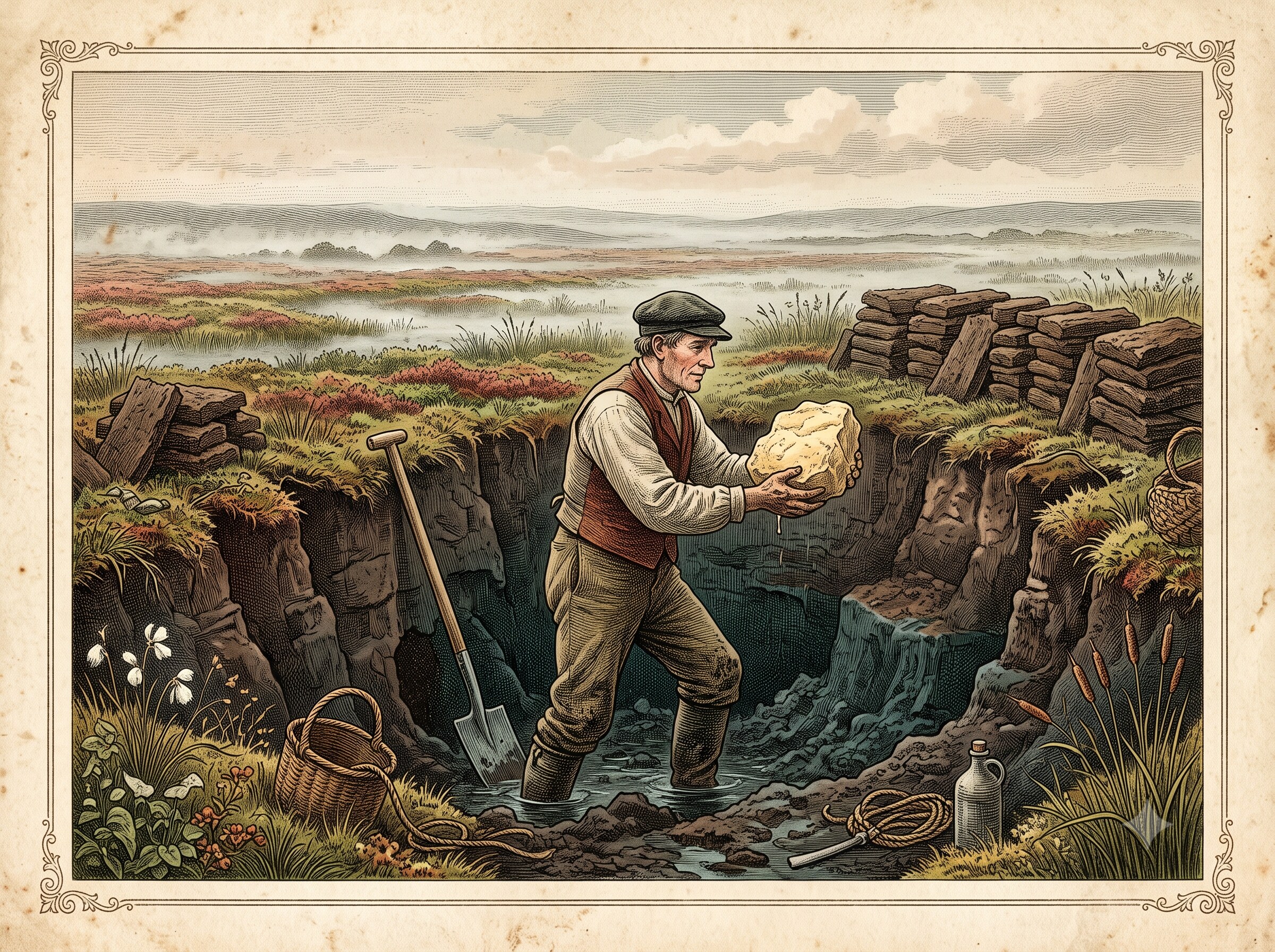
In June 2016, a turf cutter named Jack Conway was working Emlagh bog in County Meath when his tools hit something pale and waxy about twelve feet down. It was creamy white, it weighed roughly ten kilograms — about twenty-two pounds — and it smelled powerfully of strong cheese. It was butter. Nobody had touched it in about two thousand years.
By the Curiosities Desk · · 5 read · Filed under Archaeology · Today’s round
What happened?
Conway reported the find to Cavan County Museum, which passed it to the National Museum of Ireland, and the story travelled around the world under headlines noting that the thing was, technically, still food.
What surprised archaeologists was not that butter had turned up in a bog. It was that this butter had turned up there. Andy Halpin, assistant keeper in the museum’s Irish Antiquities Division, pointed out that the Drakerath find spot sits where eleven townlands and the boundaries of three ancient baronies meet — a political no-man’s-land between kingdoms. “These bogs in those times were inaccessible, mysterious places,” he told the Irish Times. And crucially, there was no cover over it. Butter buried for later retrieval usually gets a container: a wooden keg, a bark wrapping, an animal bladder. This lump had none. Halpin’s read was that whoever put it down there may never have intended to come back for it.
Which points at the second explanation for bog butter, and the reason it keeps archaeologists arguing: some of it looks like a deposit, not a pantry. Bronze Age and Iron Age communities across Ireland and Britain routinely sank valuable metalwork into wetlands, apparently as offerings. Butter was genuinely valuable — early medieval Irish law tracts list it among the goods payable as food rent. Dropping twenty-two pounds of it into a bog you can’t easily walk back into is either very careful storage or a very expensive gift.
Bog butter is not rare. Roughly five hundred specimens have been recorded from Ireland and Scotland, the first documented back in the seventeenth century, with recorded weights running up to twenty-three kilograms and some finds likely larger. A 2019 study led by Jessica Smyth and colleagues, published in Scientific Reports, put a firm timeline on the practice: radiocarbon dates on Irish bog butters span from about 1700 BC, in the Early Bronze Age, all the way to the seventeenth century AD. That is at least three and a half thousand years of people burying dairy in wet ground. Folk accounts have Donegal families still doing it in the 1850s.
The same study settled a question that had nagged at researchers for a century. Long burial scrambles fat chemistry badly enough that earlier analyses couldn’t tell what the stuff had originally been — some suspected it was closer to adipocere, the waxy substance that forms when body fat breaks down in cold wet conditions. Smyth’s team used compound-specific stable isotope analysis, which measures carbon isotope ratios in individual fatty acid molecules rather than in the sample as a whole, and got a clean answer for the Irish material: dairy fat. Butter, as advertised. (Scottish bog “butters” are a mixed bag — a 2004 analysis found several were actually rendered animal tallow.)
Why was it strange?
The reflex on hearing “2,000-year-old butter” is that it must be a fossil — mineralised, inert, butter-shaped rock. It isn’t. It’s still fat. It has changed: the triglycerides have slowly hydrolysed into free fatty acids, mostly palmitic and stearic, which is why the texture goes crumbly and waxy and the smell goes cheesy. But chemically it’s the same family of molecules that came out of the cow.
There’s a stranger wrinkle. Fresh butter left in a modern refrigerator will go rancid in a matter of months. Butter left in a bog for two millennia does not, particularly. The bog isn’t merely failing to destroy the butter — it’s actively doing a better preservation job than the appliance in your kitchen.
It shares a shelf with The Basement Wall That Opened Onto a City for 20,000 People, in The Finds That Started on the Wrong Errand.
What did scientists learn?
Peat bogs are a rare combination of conditions that microbes hate. They are cold, waterlogged, and almost entirely anoxic — the built-up plant matter blocks oxygen circulation. They are also acidic; the Nordic Food Lab measured a pH of 3.5 at the Swedish bog where they ran their own experiment. Sphagnum moss adds a chemical dimension: work by Terence Painter identified sphagnan, a reactive pectin-like polysaccharide released as moss decays, which sequesters metal ions and interferes with microbial enzymes. Painter’s research focused on how bogs preserve bodies rather than butter, so it’s the general antimicrobial environment, not a butter-specific mechanism, but the effect on both is the same — bacteria simply can’t get going.
The most enjoyable test of all this was not done by an archaeologist. In 2012, chef Ben Reade of the Nordic Food Lab made butter using only pre-industrial methods with Swedish butter maker Patrik Johansson, wrapped it in hypnum moss and birch bark in imitation of a late Iron Age find from Rosmoylan, County Roscommon, and buried it in a Swedish bog. Three months later they dug some up and tasted it, first in Copenhagen and then in front of an audience at the Oxford Symposium on Food and Cookery. It had not gone rancid. It had, however, absorbed the bog: tasters reached for the words “animal,” “gamey,” “moss,” “funky,” “pungent,” and “salami.” Reade recorded that the result caused “disgust in some and enjoyment in others.”
He was not the first to try. In 1892, the Reverend James O’Laverty buried butter in a bog bank for eight months for exactly the same reason — to find out. His verdict was gracious: he preferred butter cured the modern way, “but I have no doubt that usage would confer an acquired taste.”
Also in The Finds That Started on the Wrong Errand: The Buried Army Found by Farmers Digging a Well.
How does it affect us today?
Bog butters are, per the 2019 study, the largest deposits of fat found anywhere in nature, which makes them an unusually good archive. Fat locks in a chemical signature of the animal that produced it, so a lump of bog butter is a dated sample of an ancient dairy economy — evidence of when Irish farmers had enough surplus milk to bury some of it and walk away.
The underlying trick never really went away. Burying food to change it is a global habit: Italian formaggio di fossa is cheese aged in pits, Moroccan smen is buried clarified butter, Icelandic hákarl is fermented shark. Modern refrigeration is roughly a century and a half old. Cold, dark, low-oxygen ground is considerably older, and it works.
Another from The Finds That Started on the Wrong Errand: The Lost Hammer That Led to 14,865 Roman Coins — and Got Its Own Museum Number.
Fun fact
A 1904 report by Angus Grant describes a find of bog butter that was melted down and made into candles. The candles “spluttered and crackled, sending sparks of boiling tallow all round,” were “voted uncanny,” and were promptly thrown out.
Sources
- Smyth, J. et al. — Four millennia of dairy surplus and deposition revealed through compound-specific stable isotope analysis and radiocarbon dating of Irish bog butters, Scientific Reports 9, 4559 (2019). (Primary source: dating range, dairy-fat confirmation, ~500 specimens, weights.)
- Reade, B. — Bog butter: a gastronomic perspective, Nordic Food Lab (paper first published in the Oxford Symposium on Food and Cookery Proceedings, 2012). (Primary source: the burial experiment, tasting notes, O’Laverty and Grant accounts.)
- 2,000-year-old bog butter unearthed in Co Meath, The Irish Times, 9 June 2016. (The Emlagh find and Andy Halpin’s comments.)
- Cronin, T. et al. — Composition of ancient Irish bog butter, International Dairy Journal 17, 1011–1020 (2007).
- Painter, T. J. — Lindow Man, Tollund Man and other peat-bog bodies: the preservative and antimicrobial action of Sphagnan, Carbohydrate Polymers 15, 123–142 (1991).
A note on the obvious question: no, please don’t eat a two-thousand-year-old lump of anything. Asked whether the Emlagh butter was still edible, the National Museum’s Andy Halpin gave what may be the finest hedge in the history of archaeology — “Theoretically the stuff is still edible, but we wouldn’t say it’s advisable.”