Accidental Discoveries · Archaeology
The Lost Hammer That Led to 14,865 Roman Coins — and Got Its Own Museum Number
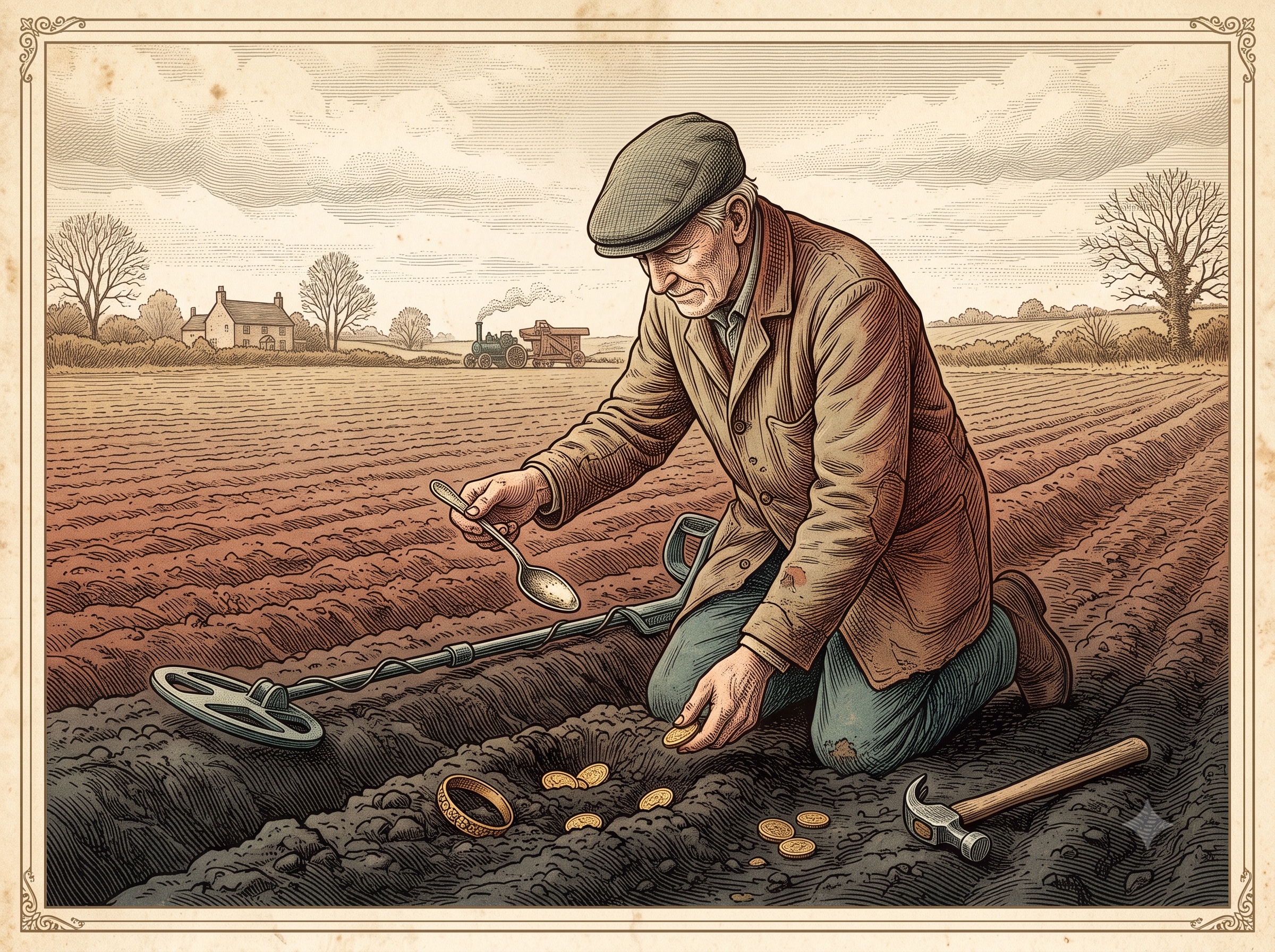
In a Suffolk field on a grey November morning in 1992, a retired gardener swept a metal detector back and forth, hunting for a friend's mislaid hammer. The machine screamed. He knelt, scraped away the soil, and found silver spoons. Then gold jewellery. Then coins — a great many coins. The hammer turned up too, eventually. It is now in the British Museum, catalogued as object 1994,0408.410: "Modern iron hammer, wooden haft."
By the Curiosities Desk · · 5 min read · Filed under Archaeology · Today’s round
What happened?
On 16 November 1992, Peter Whatling, a tenant farmer working a field southwest of the village of Hoxne (pronounced HOK-sən), lost his hammer somewhere in the dirt. Rather than give it up, he asked his friend Eric Lawes — a retired gardener and amateur metal detectorist — to come and sweep the field for it.
Lawes got a signal. He dug and pulled up silver spoons, gold jewellery, and a scatter of gold and silver coins. What he did next is the reason archaeologists still talk about him fondly. He stopped digging. After retrieving a few pieces, he and Whatling called the landowners — Suffolk County Council — and the police, and left the rest in the ground.
The following day, a team from the Suffolk Archaeological Unit arrived for an emergency excavation and lifted the entire hoard in a single day, cutting out several large blocks of undisturbed soil to be excavated later under laboratory conditions. They swept a 30-metre radius around the find spot. And they recovered Peter Whatling’s hammer.
What they had was the largest hoard of late Roman gold and silver ever found in Britain: 14,865 coins, plus roughly 200 items of silver tableware and gold jewellery. The coins break down as 569 gold solidi, 14,272 silver pieces (60 miliarenses and 14,212 siliquae — the standard silver denominations of the era), and 24 bronze nummi. The latest coins date the burial to sometime after AD 407, right as Roman rule in Britain was ending.
The rest of the hoard reads like an inventory of a very good life abruptly packed away: a gold body chain set with an amethyst and garnets, six necklaces, three rings, nineteen bracelets, a silver statuette of a leaping tigress that once served as a handle, four silver pepper pots, 98 silver spoons and ladles. All of it had been carefully sorted by type and packed into a wooden chest, some pieces nested inside smaller boxes, some wrapped in fabric. The chest itself had rotted away, but its hinges and locks survived.
Because Lawes made one phone call instead of one more shovel-stroke, archaeologists could reconstruct exactly how the chest had been packed — information that would have been destroyed forever by an enthusiastic night’s digging.
A coroner’s inquest at Lowestoft declared the find treasure trove on 3 September 1993. That November, the Treasure Trove Reviewing Committee valued it at £1.75 million (roughly £4.5 million in 2023 money), paid to Lawes as finder. He shared it with Whatling.
Why was it strange?
The absurdity is in the arithmetic. A hammer is worth a few pounds. The search for it produced a find valued at £1.75 million and rewrote what we know about the last years of Roman Britain. Had Whatling simply bought a new hammer, the hoard would very likely still be sitting under a Suffolk field, or — worse — been chewed apart by ploughing and quietly dispersed by looters, one coin at a time.
There’s a second oddity. Britain has produced bigger numbers of Roman coins in a single hoard — the Cunetio Hoard held 54,951 — but those were heavily debased third-century pieces with little precious metal in them. Hoxne is the richest, not the biggest: nearly pure gold and high-grade silver, the actual portable wealth of a family, buried in one box.
And nobody knows whose family. Ten of the spoons carry the name Aurelius Ursicinus, and a gold bracelet is inscribed VTERE FELIX DOMINA IVLIANE — “Use this happily, Lady Juliane.” It is tempting to hand the whole treasure to a Roman couple named Aurelius and Juliane, and plenty of retellings do. But several other names appear on other objects, and Ursicinus matches no one in the historical record. The honest answer is that we have their spoons and not their story.
It shares a shelf with The Teenagers Who Found a 20,000-Year-Old Art Gallery, in The Finds That Started on the Wrong Errand.
What did scientists learn?
The hoard turned out to be a precision instrument for studying a collapsing economy. The 569 gold solidi are all close to their theoretical weight of 4.48 grams, and together they weigh almost exactly eight Roman pounds — which suggests the owners counted their gold out by weight, not by coin. Among the silver siliquae, 428 are locally made imitations, mostly good enough to pass, with silver content matching the official issues; a handful are cliché forgeries, base metal wrapped in silver foil. That mix is a snapshot of a province whose coin supply from the continent was drying up and which was improvising its own.
A follow-up excavation in 1994 found a single post hole at the southwest corner of the burial pit — possibly a marker so the owners could come back for it. They never did.
Also in The Finds That Started on the Wrong Errand: The Basement Wall That Opened Onto a City for 20,000 People.
How does it affect us today?
Hoxne changed British law. Under the old treasure trove rules, the finder got the reward and the landowner and tenant got nothing, which gave detectorists every incentive to dig fast and stay quiet. The visible success of Hoxne — a careful finder, an intact excavation, a scientific windfall — fed directly into the Treasure Act 1996, which lets finder, tenant, and landowner share in any reward. It is often credited with thawing a long-frosty relationship between metal detectorists and professional archaeologists, and today thousands of finds a year are reported voluntarily under that framework.
Another from The Finds That Started on the Wrong Errand: The Buried Army Found by Farmers Digging a Well.
Fun fact
The hammer is a museum object in its own right. The British Museum’s record for 1994,0408.410 describes it as a “Modern iron hammer, wooden haft,” 393 millimetres long, donated by Peter Whatling, with a curator’s note explaining that it is “associated with, but not part of” the Hoxne hoard. It has since toured Britain in the exhibition Buried Treasure: Finding Our Past, appearing in London, Cardiff, Manchester, Newcastle, and Norwich — a working farm tool that got a better travel schedule than most people.
Sources
- British Museum collection record: hammer, 1994,0408.410 — the primary museum record, including the curator’s note on how the hoard was found
- British Museum collection record: the Hoxne ‘Empress’ pepper pot, 1994,0408.33
- Smithsonian Magazine — “A Search for a Lost Hammer Led to the Largest Cache of Roman Treasure Ever Found in Britain”
- Current Archaeology — “Hoxne Hoard”
- Wikipedia — Hoxne Hoard (used as an index to the underlying Bland & Johns and Johns 2010 British Museum publications)