Accidental Discoveries · Archaeology
The Teenagers Who Found a 20,000-Year-Old Art Gallery
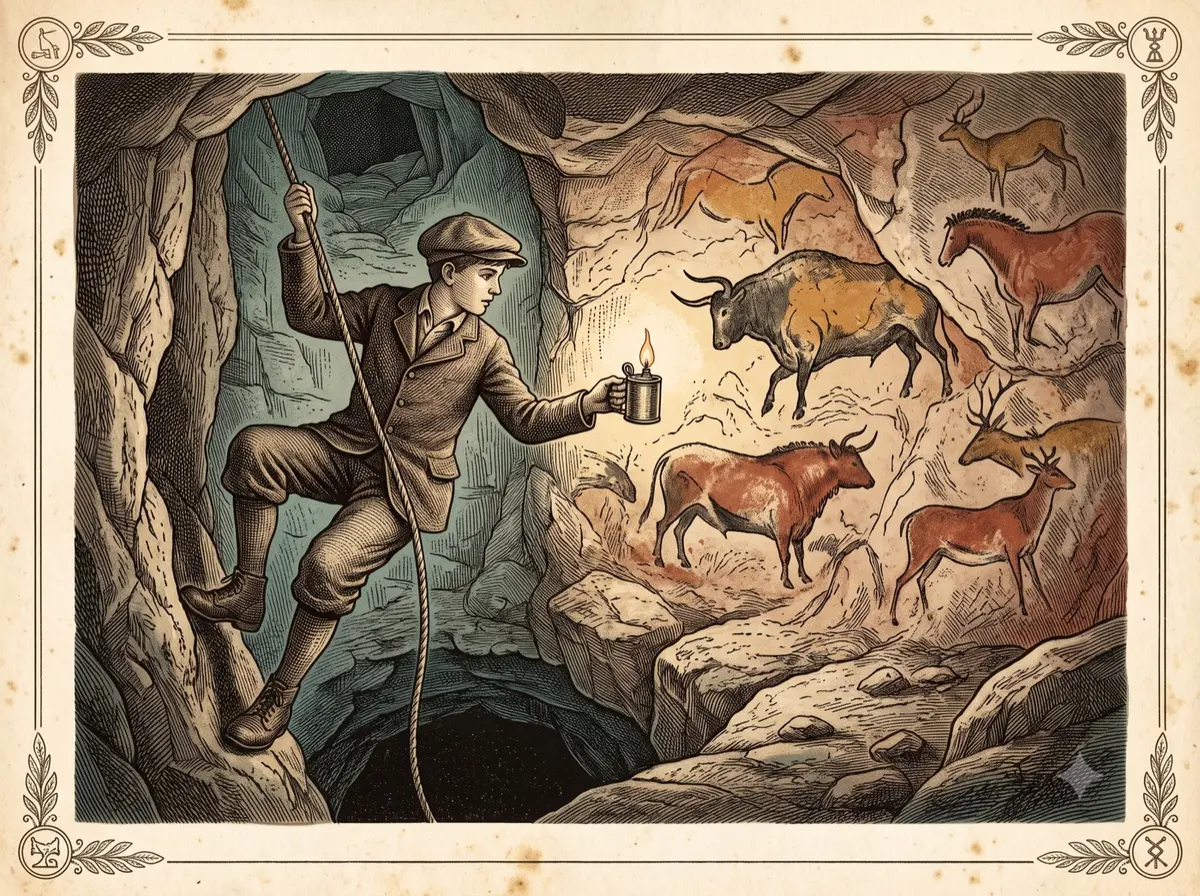
On a September afternoon in 1940, a dog went missing down a hole in the woods above the French village of Montignac. The eighteen-year-old who went in after him lit a makeshift lamp, dropped into the dark, and found himself standing in a chamber where hundreds of painted animals — bulls, horses, deer — seemed to run across the walls in the flickering light. No one had seen them in an estimated seventeen thousand years or more.
By the Curiosities Desk · · 6 min read · Filed under Archaeology · Today’s round
What happened: The Lascaux Cave Paintings
The story, as it’s usually told, starts with a dog. According to the traditional account, eighteen-year-old Marcel Ravidat was out walking near Montignac in the Dordogne region of southwestern France on 12 September 1940 when his dog investigated a hole left by an uprooted tree and didn’t come back out. Whether the dog was chasing a rabbit, and whether it was even the dog Ravidat’s family later named “Robot,” is uncertain — that detail comes down to us as legend more than documented fact. What is well established is that Ravidat found a narrow shaft at the base of the tree, widened it, and lowered himself in to look for his dog.
He returned a few days later with three friends — Jacques Marsal, Georges Agnel, and Simon Coencas — carrying a homemade oil lamp. The boys believed local rumor that the hole might lead to a secret tunnel connecting to the nearby Lascaux manor house, possibly hiding treasure. Instead, dropping some fifteen meters down a narrow shaft, they found themselves inside a large cave whose walls were covered floor to ceiling with painted and engraved animals: aurochs (a now-extinct wild ancestor of cattle) rendered nearly six meters long, along with horses, stags, and ibex, painted in red, black, and yellow pigment.
The teenagers kept the discovery mostly to themselves at first, returning to explore further, before word reached their old schoolteacher, who alerted the prehistorian Abbé Henri Breuil — already one of the world’s leading authorities on cave art. Breuil visited the cave on 21 September 1940 and confirmed what the boys suspected: this was not a hoax or recent graffiti but genuine Paleolithic art, and an exceptionally well-preserved example of it. News spread quickly even amid the German occupation of France, and the cave was opened to the public in 1948, drawing visitors from around the world to see what Breuil reportedly called the “Sistine Chapel of prehistory” — a comparison so widely repeated that it’s now inseparable from the cave’s story, even though it functions more as a memorable nickname than a documented direct quote.
Why it was strange: The Lascaux Cave Paintings
Cave art wasn’t unknown before Lascaux — Spain’s Altamira cave had been discovered decades earlier, in 1879 — but Lascaux’s paintings were startling for their sheer number, scale, and apparent sophistication. Nearly six thousand figures cover the walls: animals, abstract signs, and a small number of human figures, clustered across a series of connected chambers with names like the Hall of the Bulls and the Axial Gallery. The animals are drawn with a fluency and command of form that surprised even specialists — confident outlines, a sense of movement, and in places a technique art historians call “twisted perspective,” where an animal’s body is shown in profile while its horns or antlers face forward.
It was strange, too, precisely because it violated a common assumption: that people living some twenty thousand years ago, hunting and gathering in an Ice Age landscape, wouldn’t have had the means, motive, or organization to produce something this deliberate and skilled. The paintings weren’t scratched out quickly. Postholes found cut into the cave walls suggest the artists built wooden scaffolding to reach high surfaces, and they worked by the light of stone lamps burning animal fat, deep inside a cave with no natural light at all.
It shares a shelf with The Runaway Goat That Led to the Dead Sea Scrolls, in The Finds That Started on the Wrong Errand.
What scientists learned: The Lascaux Cave Paintings
Lascaux became a testing ground for figuring out how, and when, ancient people made art like this — and how hard it is to pin an exact date on paintings that contain no organic material of their own. Pigments like red ochre and black manganese oxide can’t be radiocarbon dated directly, so researchers have instead dated organic material found nearby: charcoal, bone, and antler left on the cave floor by the people who used it.
That indirect method has produced a moving target. The first radiocarbon dates, run in 1951 at the University of Chicago lab of Willard Libby (who developed the technique), suggested Lascaux belonged to the Magdalenian culture, around 17,000 years ago. Later tests in the 1990s, using more sensitive accelerator mass spectrometry on reindeer antler, pushed the estimate older, into the Solutrean period. A more recent research effort, the LAsCO project, re-dated bone fragments from across the cave between 2018 and 2021 and now places the cave’s use at roughly 21,000 to 23,000 years ago, at the transition between the Badegoulian and Magdalenian cultures — according to France’s Ministry of Culture, which oversees the site. Each round of testing has revised the number, a reminder that scientific dates are our best current estimate, not a fixed fact carved in stone.
Beyond dating, researchers studying the pigments, tools, and postholes have pieced together a picture of organized, skilled work: mineral pigments ground and mixed, scaffolding engineered to reach ceilings, and compositions planned across large wall surfaces rather than added at random. It reshaped how prehistorians think about Ice Age humans — not as crude survivalists, but as people capable of sustained artistic and technical projects.
Also in The Finds That Started on the Wrong Errand: The Basement Wall That Opened Onto a City for 20,000 People.
How it reaches us today: The Lascaux Cave Paintings
Lascaux almost didn’t survive being found. After opening to the public in 1948, the cave welcomed over a thousand visitors a day at its peak, and their breath, body heat, and the carbon dioxide they exhaled began altering the cave’s delicate, stable microclimate. By the 1950s, conservators noticed a “green sickness” — algae blooming under the artificial lighting — followed by a “white sickness,” crystals of calcite clouding the paintings. In 1963, France’s culture minister André Malraux ordered the cave closed to the public entirely. Even now, only a handful of scientists are allowed limited access each year, and the cave has battled recurring outbreaks of mold and fungus since, forcing ongoing research into cave microbiology and climate control.
Rather than let the public lose access altogether, France built replicas. Lascaux II, a partial reproduction, opened nearby in 1983; a full-scale facsimile, Lascaux IV, opened in 2016 as part of an International Centre for Cave Art, recreating the entire cave to within a millimeter of the original using 3D scanning, with artists hand-painting the walls using techniques and pigments similar to the originals. Millions of visitors now see a replica so precise that it preserves the experience of the cave while protecting the fragile original — a conservation strategy that has since influenced how other decorated caves, including France’s older Chauvet cave, are managed and shown to the public.
Another from The Finds That Started on the Wrong Errand: The Lost Hammer That Led to 14,865 Roman Coins — and Got Its Own Museum Number.
Fun fact: The Lascaux Cave Paintings
The four teenagers who found the cave didn’t just walk away once the scientists arrived. Jacques Marsal spent decades of his life working at Lascaux, eventually becoming one of its official guardians and living in a house built at the cave’s entrance, watching over the site he’d helped discover as a teenager until his death in 1989.
Sources: The Lascaux Cave Paintings
- Ministry of Culture (France), “Dating the figures at Lascaux,” official Lascaux cave archaeological site: https://archeologie.culture.gouv.fr/lascaux/en/dating-figures-lascaux
- Ministry of Culture (France), “Lascaux IV” and site history pages: https://archeologie.culture.gouv.fr/lascaux/en/lascaux-iv
- Wikipedia, “Lascaux” — overview of discovery, dating history, and closure (cross-referenced against cited sources): https://en.wikipedia.org/wiki/Lascaux
- History Today, “Discovery of the Lascaux Cave Paintings”: https://www.historytoday.com/archive/months-past/discovery-lascaux-cave-paintings
- TIME, “The Battle to Save the Cave” — on the 1963 closure and preservation crisis: https://time.com/archive/6596723/the-battle-to-save-the-cave/
Related stories: The Lascaux Cave Paintings
- Part of The Finds That Started on the Wrong Errand
- The Buried Army Found by Farmers Digging a Well — Farmers digging a well hit an 8,000-strong clay army
- The Runaway Goat That Led to the Dead Sea Scrolls — A goat wandered into a cave and led to the Dead Sea Scrolls
- Göbekli Tepe: The Temple Built Before Farming, Writing, or the Wheel — A temple complex built before farming, writing, or the wheel