Göbekli Tepe: The Temple Built Before Farming, Writing, or the Wheel
Picture a hilltop in southeastern Turkey about eleven thousand years ago. The people standing on it have no pottery. No metal tools. No writing, no wheel, no domesticated crops to speak of. By every rule in the textbook, they are simple hunter-gatherers who should be chasing gazelle, not building anything that lasts. And yet here they are, hauling limestone pillars taller than a person and heavier than a car, standing them in great rings and carving them with foxes, snakes, and vultures. The monument they leave behind is older than Stonehenge by six thousand years — and its existence quietly broke one of archaeology's most confident assumptions.
By the Curiosities Desk · · 5 min read · Filed under Archaeology · Today’s round
Part of The Version Everyone Remembers
What happened: Göbekli Tepe
The site is called Göbekli Tepe, Turkish for “Potbelly Hill,” a rounded mound near the city of Şanlıurfa. A survey team first noted it in 1963, spotted some broken slabs poking out of the dirt, and assumed they were grave markers from a medieval cemetery. For thirty years, almost nobody looked again.
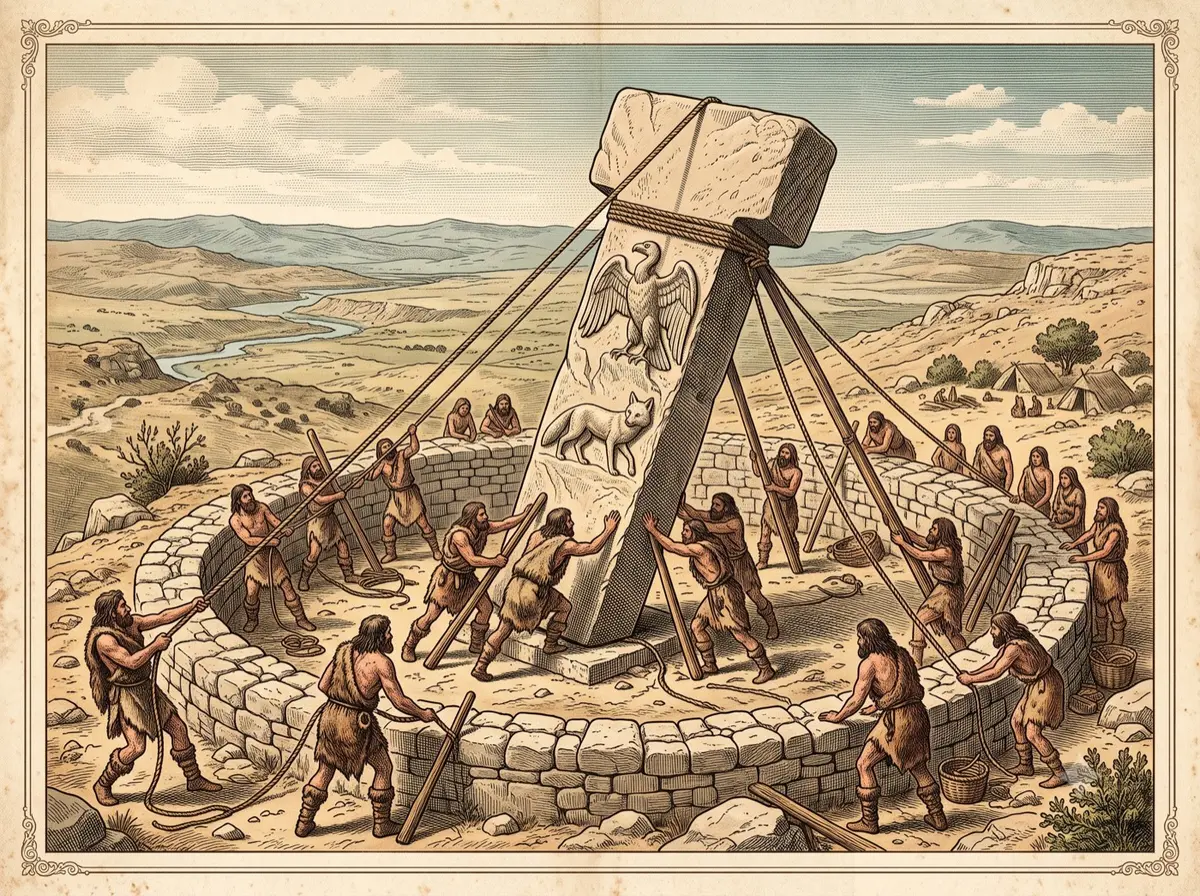
Then in 1994 the German archaeologist Klaus Schmidt visited, recognized that the “grave markers” were the tips of enormous prehistoric pillars, and began excavating the following year. What he uncovered was astonishing: massive T-shaped limestone pillars, the tallest standing around 16 feet (5 metres) high and weighing, by his estimate, between seven and ten tons. They were arranged in circular enclosures ten to thirty metres across, ringed by stone walls and benches, with two especially tall pillars facing each other at the center of each ring.
Radiocarbon dating placed the oldest construction around 9500 BCE, in the period archaeologists call the Pre-Pottery Neolithic — literally the era before ceramics. These are the oldest known monumental megaliths anywhere on Earth. The builders cut the pillars from bedrock quarries roughly 100 metres away using flint tools, then moved and raised them without draft animals, metal, or the wheel. Many pillars are carved in crisp relief with wild animals — foxes, boars, lions, scorpions, snakes, and birds — and some have arms, hands, and belts, suggesting they represent stylized human or supernatural figures.
Schmidt worked the site until his death in 2014; excavation continues today as a joint effort of Istanbul University, the Şanlıurfa Museum, and the German Archaeological Institute, now led by the Turkish prehistorian Necmi Karul. Göbekli Tepe became a UNESCO World Heritage Site in 2018. Remarkably, only about ten percent has been dug; geophysical surveys hint at some twenty enclosures in total and nearly two hundred buried pillars still underground.
Why it was strange: Göbekli Tepe
For most of the twentieth century, the story of civilization had a tidy, agreed-upon order. First, people learned to farm. Farming produced food surpluses. Surpluses let populations settle, specialize, and free up labor. Only then — once you had villages, granaries, and spare time — could humans afford to build temples, organize religion, and raise monuments. Agriculture came first; everything else, including the gods, came after.
Göbekli Tepe arrived in the wrong order. Here was monumental, labor-intensive architecture built by people who, at least in the earliest phases, had not yet domesticated their crops or animals. Coordinating the quarrying, carving, and raising of multi-ton stones would have required dozens or hundreds of workers, plus someone to feed them and a shared reason to bother. That kind of organized effort was supposed to be impossible before farming, not before it. The monument seemed to come first and the farms second — exactly backwards from the textbook.
The same thread — Neolithic — continues in The 5,700-Year-Old Chewing Gum That Held an Entire Human Genome.
What scientists learned: Göbekli Tepe
Schmidt’s bold interpretation was a slogan that gets quoted constantly: in effect, “first the temple, then the city.” He argued that the impulse to gather, worship, and build together may have driven people toward settled life and agriculture, rather than the other way around. The need to feed crowds of monument-builders, in this view, could have been one of the pressures that nudged humans to start cultivating the wild grasses growing all around the site — for Göbekli Tepe sits in the very region of the Fertile Crescent where wild wheat was first domesticated.
But good science keeps digging, and the picture has grown more nuanced. More recent excavations have turned up domestic-looking structures, water cisterns cut into the rock, and abundant grinding stones showing heavy cereal processing. That suggests Göbekli Tepe was not purely a remote sanctuary visited by wandering nomads, as first believed, but a place where people actually lived, at least seasonally — and where monument-building and the earliest experiments with cultivation may have happened side by side. The lesson isn’t that one simple model replaced another. It’s that the line between “hunter-gatherer” and “farmer,” and between “settlement” and “shrine,” was far blurrier than the neat textbook sequence ever allowed.
Elsewhere in archaeology: The Bluestone Bound for Stonehenge That Sank 17 Miles Into a 240-Mile Trip.
How it reaches us today: Göbekli Tepe
Göbekli Tepe reset the clock on human ambition. It pushed the origins of monumental architecture, and possibly organized religion, back thousands of years and showed that complex, cooperative society did not have to wait for the farm. Anthropologists now take seriously the idea that shared belief and the desire to gather may have been engines of the Neolithic Revolution, not just its byproducts.
The discovery also turned a quiet Turkish hillside into one of the most important archaeological landscapes on the planet. It anchors a broader regional project nicknamed Taş Tepeler (“Stone Hills”), as researchers excavate a cluster of related sites — like nearby Karahan Tepe — that together are rewriting the opening chapter of settled human life. Every season, with ninety percent of Göbekli Tepe still buried, the story keeps getting older and stranger.
Another claim that stuck harder than the correction: The Easter Island Statues That ‘Walked’ to Work — and the 18 People Who Took One for a Stroll.
Fun fact: Göbekli Tepe
Göbekli Tepe predates not only Stonehenge (by about 6,000 years) but also the invention of writing and the wheel (by more than 5,000 years). People who could organize a multi-ton building project had not yet figured out how to write their own names — or how to make a cart to move the stones.
Sources: Göbekli Tepe
- Andrew Curry, “Gobekli Tepe: The World’s First Temple?” Smithsonian Magazine (November 2008). smithsonianmag.com
- UNESCO World Heritage Centre, “Göbekli Tepe” (inscribed 2018), Ref. 1572. whc.unesco.org
- German Archaeological Institute, “The Tepe Telegrams” — official Göbekli Tepe research blog. dainst.blog
- O. Dietrich, M. Heun, J. Notroff, K. Schmidt & M. Zarnkow, “The role of cult and feasting in the emergence of Neolithic communities. New evidence from Göbekli Tepe,” Antiquity 86 (2012): 674–695. doi.org
- “Göbekli Tepe,” Wikipedia (used as a starting point and cross-checked against its cited sources). en.wikipedia.org
Related stories: Göbekli Tepe
- The Teenagers Who Found a 20,000-Year-Old Art Gallery — Four teenagers and a dog found a 20,000-year-old painted cave
- Kon-Tiki: The Raft That Crossed an Ocean to Prove a Theory That Was Wrong — A balsa raft crossed the Pacific to prove a theory DNA later demolished
- The Man Who Found Troy — and Dug Straight Through It — The man who found Troy dug straight through it