The Easter Island Statues That 'Walked' to Work — and the 18 People Who Took One for a Stroll
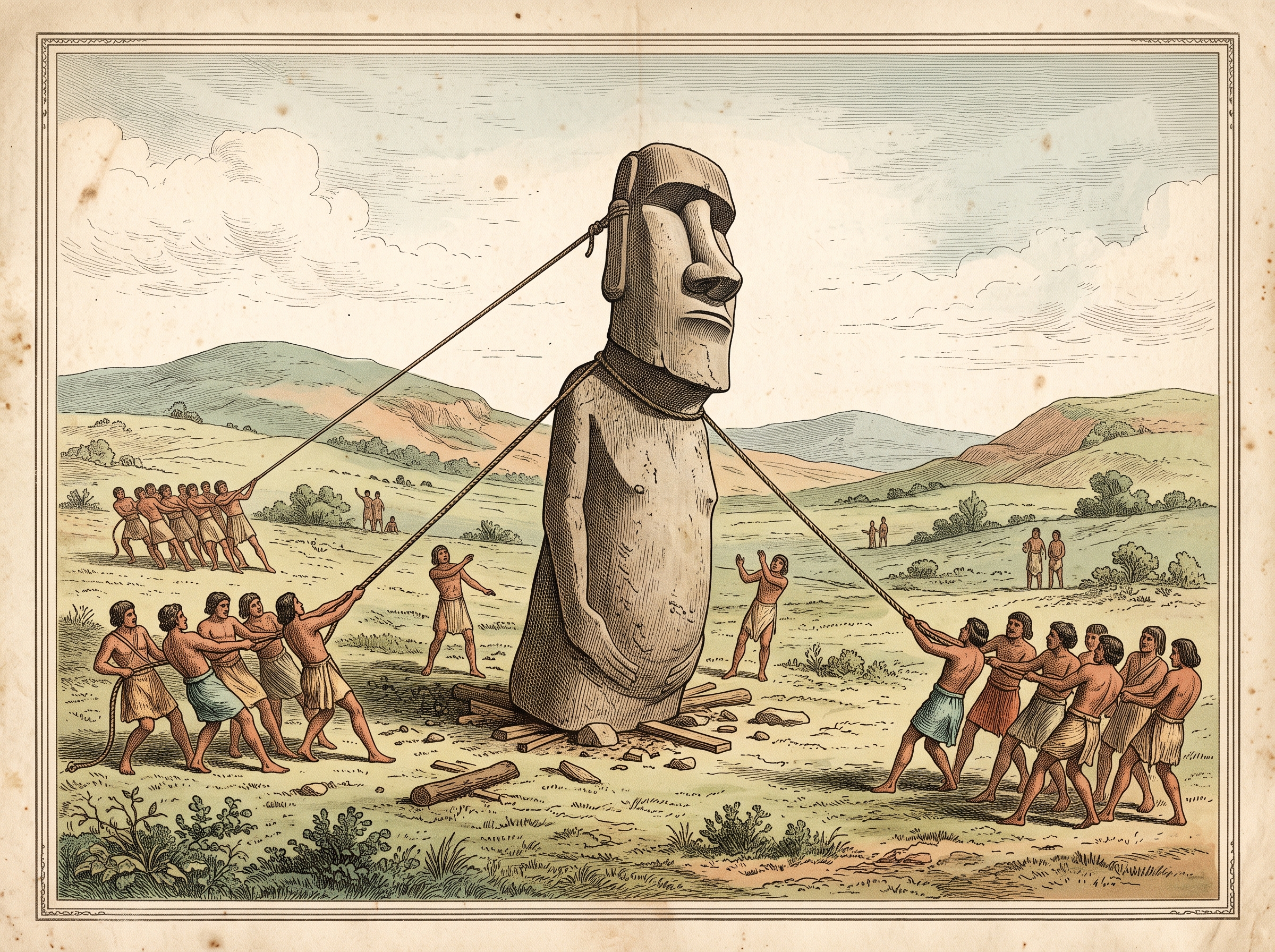
On a ranch in Hawaii, eighteen people stood around a 4.35-ton concrete statue holding three ropes. One team held a rope tied behind its head so it wouldn't fall on its face. Two other teams pulled on its sides, one after the other. The giant rocked onto one corner of its base, swung forward, rocked onto the other corner, and swung forward again. It shuffled down the field like a refrigerator being "walked" across a kitchen. The islanders of Rapa Nui had been saying for centuries that their statues walked. Here was one doing it.
By the Curiosities Desk · · 5 min read · Filed under Archaeology · Today’s round
What happened?
Rapa Nui, also called Easter Island, is a speck of land in the Pacific more than 2,000 kilometers from the nearest inhabited island. Its Polynesian settlers carved nearly 1,000 stone statues called moai, most of them at a volcanic quarry named Rano Raraku. The largest weighs about 74 tonnes and stands more than 10 meters tall. Many were moved kilometers across the island to stone platforms called ahu. How, with no cranes, wheels, or draft animals?
The islanders had an answer. In their oral tradition, the moai walked. Some accounts say statues moved by mana, a sacred power, and some credit a chief or the god Makemake with ordering them to walk. Outsiders long treated this as legend, not engineering.
Instead, visiting researchers tried to drag the statues lying down. In 1955–56, the Norwegian adventurer Thor Heyerdahl had a 10-ton moai tied onto a sledge made from a forked tree and pulled by 180 islanders. In 1998, the archaeologist Jo Anne Van Tilburg proposed hauling statues horizontally on a sledge running over wooden rails, with up to 70 people per statue. She considered upright methods “daunting-to-impossible” on the island’s terrain.
Not everyone gave up on walking. In 1982, the Czech engineer Pavel Pavel built a 12-ton concrete replica in South Bohemia, tilted it back slightly, and rocked it forward side to side with ropes and 17 people. Heyerdahl was intrigued enough to invite him to Rapa Nui. In 1986, Pavel and a team of 16 local residents walked a real 15-ton moai at Anakena beach. It worked, but the twisting ground away at the statue’s ancient stone base, and the test was stopped. A 1980s attempt in Wyoming by Charles Love went worse: his 10-ton replica toppled over after a few hundred feet.
Then the archaeologists Terry Hunt and Carl Lipo, who had spent years mapping the island, took a different approach. Instead of starting with a transport method, they started with the statues that didn’t finish the trip. Dozens of moai lie broken or abandoned along the island’s ancient roads. These “road moai” are shaped differently from the ones standing on platforms. They have wide, D-shaped bases and lean forward, roughly 5 to 15 degrees past vertical. Statues that fell on uphill stretches mostly landed on their backs; those on downhill stretches tended to land on their faces. That is what you would expect if they were upright when they fell.
So Hunt and Lipo built a proportionally scaled concrete replica of a road moai, weighing 4.35 metric tons, and tested it at Kualoa Ranch in Hawaii, in an experiment they reported in 2012. With 18 people and three hemp ropes, they moved it about 100 meters in around 40 minutes. “Each roll caused the statue to take a step,” Lipo told Live Science. They published the results in the Journal of Archaeological Science in 2013.
Why was it strange?
Because the “myth” was the most literal description available. Scientists spent decades treating “the statues walked” as poetic language and designing sledges, rollers, and levers instead. The people who actually lived with the moai had described the motion all along: an upright statue, swaying, moving forward step by step.
The other surprise was in the stone itself. The forward lean and D-shaped base that make road moai look slightly odd are exactly the features that make walking possible. A statue that leans forward wants to tip; a rounded base lets it pivot from corner to corner. In Hunt and Lipo’s reading, the moai were carved to travel.
Another claim that stuck harder than the correction: The Baghdad Battery: The 2,000-Year-Old ‘Battery’ That Probably Never Held a Charge.
What did scientists learn?
The physics comes down to the center of mass, the single point where an object’s weight is balanced. Tilt a tall object so its center of mass sits over one edge of its base, and the rest of the base lifts off the ground. Gravity then pulls it back down as it swings, and a forward lean turns that swing into a small step. Alternate the pulls, and you get a zig-zag shuffle. “The hard part is getting it rocking in the first place,” Lipo said. Once moving, it took far less force than dragging a statue across the ground.
The roads matter too. In a 2025 follow-up paper in the Journal of Archaeological Science, Lipo and Hunt analyzed 962 moai, including 62 along the roads, and argued that the roads themselves were part of the method. They are about 4.5 meters wide with a slightly concave surface that would help keep a rocking statue stable. Some stretches overlap or run in parallel, which Lipo interprets as crews clearing the way, moving a statue, and clearing again.
It’s worth being precise about what this proves. The experiments show that walking works with a small crew and simple tools, and the evidence on the roads fits it well. They don’t prove that every moai was moved this way, and some archaeologists remain unconvinced. Lipo’s challenge to critics is to “find some evidence that shows it couldn’t be walking.”
Another story that outran the evidence: The Mummy’s Curse That Missed Its Main Target.
How does it affect us today?
The walking moai changed a bigger story about Rapa Nui. A popular account held that islanders cut down their forests to drag giant statues, triggering an ecological and social collapse. If the moai could be walked by a couple of dozen people with rope, the statues didn’t require huge amounts of timber or enormous labor forces. That doesn’t settle every debate about the island’s history, but it weakens one popular explanation for its deforestation.
It is also a lesson in listening. Oral traditions can hold real, practical knowledge, even when they’re phrased in a way outsiders find hard to take literally. And it is a showcase for experimental archaeology, the practice of testing ideas about the past by physically rebuilding them.
A close cousin: The Opera Costume Designer Who Put Horns on the Vikings.
Fun fact
Pavel Pavel, the Czech engineer who walked a moai in 1986, later used his skills closer to home. His team returned a “rocking stone” called the Kadov stone, removed by unknown vandals in the 19th century, to its original spot in South Bohemia.
Sources
- Lipo, C. P., Hunt, T. L., & Rapu Haoa, S. (2013). “The ‘walking’ megalithic statues (moai) of Easter Island.” Journal of Archaeological Science, 40(6), 2859–2866: https://doi.org/10.1016/j.jas.2012.09.029
- Lipo, C. P., & Hunt, T. L. (2025). “The walking moai hypothesis: Archaeological evidence, experimental validation, and response to critics.” Journal of Archaeological Science, 183, 106383: https://doi.org/10.1016/j.jas.2025.106383
- Binghamton University News, “Easter Island’s statues actually ‘walked’ – and physics backs it up” (2025): https://www.binghamton.edu/news/story/5830/easter-islands-statues-actually-walked-and-physics-backs-it-up
- NOVA Online (PBS), “Secrets of Easter Island: Moving the Moai — Past Experiments”: https://www.pbs.org/wgbh/nova/easter/move/past.html
- Kon-Tiki Museum, “Easter Island, 1986–1988”: https://www.kon-tiki.no/en/heyerdahls-expeditions/easterisland-jm2ah