The Opera Costume Designer Who Put Horns on the Vikings
In 1875, a German professor sat down to sketch costumes for an opera about gods, dragons, and a cursed ring. He gave some of the warriors helmets with a pair of cow horns sticking out the sides. Twenty years later, those horns were on a cruise ship's dinner menu. A century later, they were on sports logos, cartoons, and party-store costumes. The real Vikings never wore them. The horns came from the theater, not the grave mounds.
By the Curiosities Desk · · 5 min read · Filed under Archaeology · Today’s round
What happened?
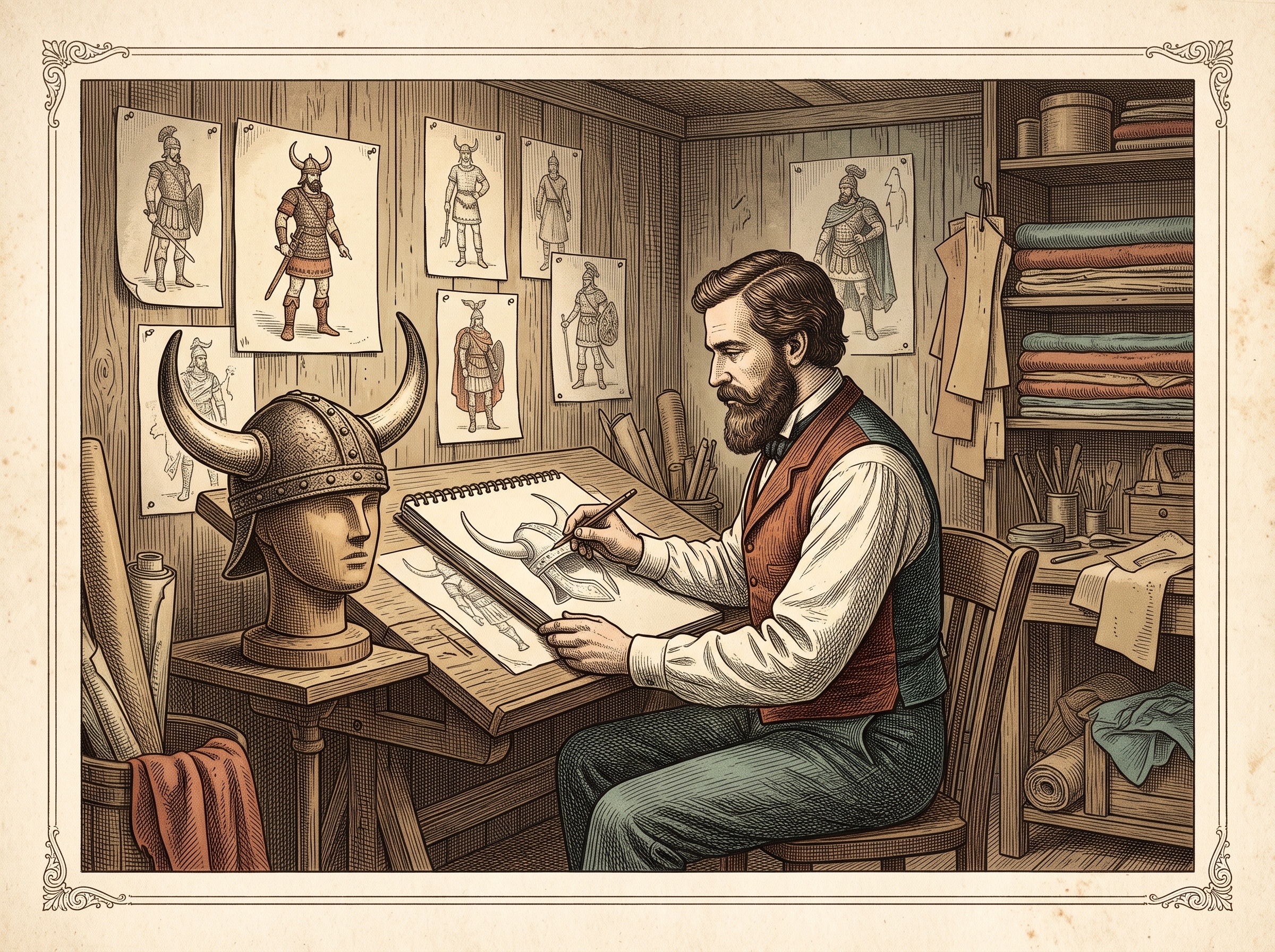
The professor was Carl Emil Doepler, a painter and illustrator hired to design the costumes for the first complete performance of Richard Wagner’s Der Ring des Nibelungen at the new Bayreuth Festival in 1876. Wagner’s four-opera cycle blended Old Norse myths with a medieval German poem, and Doepler needed to dress Valkyries, gods, and a whole cast of ancient warriors.
He did his homework, in a 19th-century way. According to the medievalist Roberta Frank, who traced the history of the image in a 2000 essay, Doepler turned to the scholarly commentaries on Germania, a book about the tribes north of the Roman Empire written by the Roman historian Tacitus in AD 98. For centuries, European scholars had been decorating those tribes with horns. Ancient Greek writers had described horned helmets on Gauls (Celtic peoples of what is now France), and Renaissance scholars had cheerfully decided that Gauls, Celts, and Germans were all more or less the same people. Tacitus himself had actually written the opposite: that hardly any Germans had helmets at all.
Doepler gave cow-horned helmets to several characters in the Ring, including the villain Hunding and the retinue of the Gibichung king Gunther. Not everyone loved the look. Wagner’s wife, Cosima, reportedly complained that the costumes made the singers look like Native American chiefs.
The audience, though, took the image home. Frank found that before this, artists usually gave their Vikings winged helmets, the favored headgear of romantic heroes. R. M. Ballantyne’s 1869 adventure novel Erling the Bold put a pair of hawk’s wings on its hero’s helmet, and all eight illustrated editions printed before 1880 kept them. The ninth edition, in 1890, swapped them for horns. By 1894, Doepler’s own son was drawing horned helmets for a Viking ballad written by Kaiser Wilhelm II, and in 1895 a Hamburg-America cruise liner touring Scandinavia printed horned Vikings on its menu. “Within twenty years,” Frank wrote, the horned helmet spelled “viking” everywhere.
There’s a twist in the timing, too. The phrase “Viking Age” itself was only coined in 1873, in Danish and Swedish articles. The period and its signature hat were invented at almost the same moment.
Meanwhile, archaeologists were looking for actual Viking helmets. It took them until 1943. That year, a farmer named Lars Gjermundbo was removing a burial mound on his land in Ringerike, Norway. Norway was under Nazi occupation, and while Lars was hiding in the woods, his son Gunnar found the treasure, loaded it into a wheelbarrow, and hid it in the barn. Among the swords and axes were the broken fragments of an iron helmet from the late 900s. Restored, it has a rounded cap and a “spectacle” guard around the eyes. It has no horns.
For decades, Oslo’s Museum of Cultural History billed it as the world’s only Viking helmet. A second, the Yarm helmet from northern England, was confirmed as Viking Age in 2020. It has no horns either.
Why was it strange?
The one thing everyone “knows” about Vikings has no support in the evidence. No Viking Age helmet ever found has horns. No saga, poem, or chronicle from the period describes Norse warriors wearing them. Christian monks who wrote about Viking raids were happy to portray the raiders as terrifying pagans, and even they never mentioned horns.
Stranger still, the most famous horned helmets in Scandinavia are real. In 1942, a peat cutter in a bog at Veksø, Denmark, heard a crunch under his spade and uncovered two nearly identical bronze helmets with long curving horns, decorated with the eyes and beak of a bird of prey. For years they were casually linked to Vikings. In 2019, archaeologist Heide Wrobel Nørgaard spotted a trace of birch tar inside one horn while photographing it. Radiocarbon dating of that tar showed the helmets were placed in the bog around 900 BC, roughly 1,700 years before the Viking Age began. “It’s nonsense,” archaeologist Helle Vandkilde told Live Science of the Viking link.
Another claim that stuck harder than the correction: The Petrified Giant That Was a Fake of a Fake.
What did scientists learn?
The Veksø helmets turned out to belong to a completely different story. The 2021 study in Praehistorische Zeitschrift argued they were ceremonial, not battle gear, and were probably decorated with feathers and possibly horsehair. Their design resembles horned-warrior figures from Bronze Age Sardinia and Iberia, which the authors suggest points to long-distance contact along Europe’s Atlantic coast. Not every archaeologist agrees with that trade-route idea, but everyone agrees the helmets have nothing to do with Vikings.
The myth also taught historians something about how images spread. Frank’s research shows that the horned Viking had no single inventor. It was built up over centuries from misread classical texts, Bronze Age rock carvings that a 19th-century writer wrongly dated to the Viking Age, heraldry, and national pride. Doepler’s costumes were the spark that pulled all those pieces together and sent them into mass-produced books and advertising.
Another story that outran the evidence: The Baghdad Battery: The 2,000-Year-Old ‘Battery’ That Probably Never Held a Charge.
How does it affect us today?
The horned helmet is one of the most recognizable costumes in the world, and it is a useful reminder that popular pictures of the past often come from artists rather than excavations. Museums in Scandinavia now routinely address the myth in their galleries, and the Veksø helmets are displayed at the National Museum of Denmark as what they really are: Bronze Age ritual objects.
It’s also a live example of why archaeologists care about dating methods. A speck of birch tar settled a question that had floated around for 80 years.
A close cousin: The Easter Island Statues That ‘Walked’ to Work — and the 18 People Who Took One for a Stroll.
Fun fact
Doepler wasn’t the first artist to go overboard. In 1639, an Utrecht artist illustrating early Danish history for King Christian IV drew an elderly ancient priest (or priestess) presiding over an animal sacrifice, wearing a horned helmet — and a pair of spectacles.
Sources
- Roberta Frank, “The Invention of the Viking Horned Helmet,” in International Scandinavian and Medieval Studies in Memory of Gerd Wolfgang Weber (2000), pp. 199–208.
- National Museum of Denmark, “The Viksø helmets.”
- Helle Vandkilde et al., “Anthropomorphised Warlike Beings With Horned Helmets: Bronze Age Scandinavia, Sardinia, and Iberia Compared,” Praehistorische Zeitschrift 97 (2022): 130–158 (published online December 2021).
- Livia Gershon, “The Horned Helmets Falsely Attributed to Vikings Are Actually Nearly 3,000 Years Old,” Smithsonian Magazine, 10 January 2022.
- Ida Irene Bergstrøm, “Did This Viking Helmet Belong to a Norwegian Warrior Who Served Rulers in the East?” ScienceNorway, 12 January 2022.