The Petrified Giant That Was a Fake of a Fake
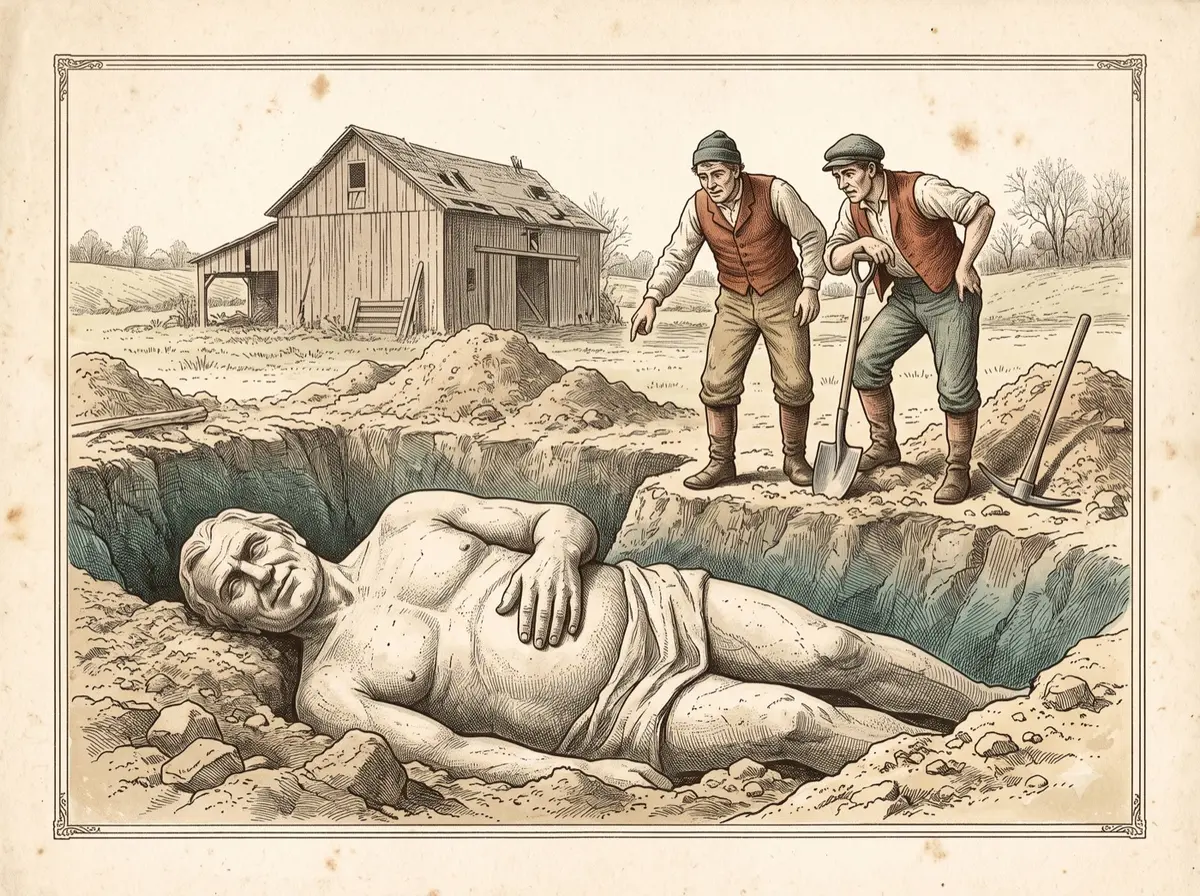
On October 16, 1869, two laborers digging a well behind a barn in Cardiff, New York, hit stone three feet down. Clearing away the dirt, they found the outline of a foot. Minutes later they had uncovered an entire man, ten feet tall, turned to stone, lying on his back with one arm pressed to his stomach and a faint smile on his face. "I declare," one of them reportedly said, "some old Indian has been buried here!" Within days, farmers were charging visitors fifty cents to see it — and the man who'd planted it there the year before was standing in the crowd, watching his lie become a sensation.
By the Curiosities Desk · · 6 min read · Filed under Archaeology · Today’s round
Part of The Version Everyone Remembers
What happened: The Cardiff Giant
The giant was the creation of George Hull, a cigar maker from Binghamton, New York, and a committed atheist. According to Hull’s own later account, the idea came to him around 1867 after a heated argument with a revivalist preacher over a line from Genesis: “There were giants in the earth in those days.” Hull thought the preacher’s literal reading of the Bible was absurd. Lying awake afterward, he wondered whether he could prove his point by giving literal-minded believers exactly the kind of “evidence” they wanted — a giant of their very own, dug out of the ground.
Over the next two years he spent close to $2,600 (roughly $60,000 today) making it real. He paid quarrymen in Fort Dodge, Iowa, to cut an enormous block of gypsum, telling them it was destined for a Lincoln monument, then shipped it to Chicago, where a stonecutter and two sculptors carved it into a reclining man modeled on Hull’s own body — hair and beard removed, since a geologist had told him hair doesn’t fossilize. The surface was scrubbed, pricked all over with needles to fake skin pores, and doused in acid to age it. In November 1868, Hull shipped the finished giant to the farm of his cousin, William “Stub” Newell, and the two buried it near the barn overnight.
Almost a year later, Newell hired two men to dig what they were told would be a well — directly over the buried giant. When they unearthed it on October 16, 1869, word spread fast. Newell pitched a tent, charged admission, and drew as many as 500 visitors a day. Opinions split immediately: some took it, per the Genesis passage, as proof that biblical giants had walked the earth; others thought it looked more like a statue, possibly carved centuries earlier by a Jesuit missionary. New York’s state geologist and a Rochester professor both leaned toward the statue theory but still called it “the most remarkable object yet brought to light in our country” — not yet a fraud, just a puzzle.
The story unraveled once real scrutiny arrived. A mining engineer noted that soft gypsum couldn’t have survived intact in damp soil for centuries. Then, in late November 1869, Yale paleontologist Othniel C. Marsh — later famous for the “Bone Wars” dinosaur rivalry with Edward Drinker Cope — examined the giant and pronounced it “of very recent origin, and a most decided humbug,” pointing to tool marks too fresh to have spent millennia underground.
By then the giant had already been sold: a syndicate led by David Hannum bought a majority stake for tens of thousands of dollars and moved it to Syracuse. That’s when showman P.T. Barnum entered the story. Having failed to buy the original for $50,000, he secretly had his own sculptor cast a plaster replica and exhibited it in New York City as the “real” Cardiff Giant, calling Hannum’s version the fake. Hannum’s group sued Barnum for slander, but the judge ruled that if they wanted an injunction, they’d need the giant itself to swear to its own authenticity — the case was dismissed. On December 10, 1869, Hull confessed to reporters, and on February 2, 1870, a court officially declared both giants fakes: a fake original, and a fake of that fake, touring simultaneously.
Why it was strange: The Cardiff Giant
It wasn’t just that people believed a hoax — it’s that trained observers, state geologists among them, spent weeks debating exactly how real the giant was rather than whether it was real at all. And once exposed, the fraud didn’t end the spectacle; it multiplied it. A forger’s forger cashed in on a forgery, crowds kept paying to see both, and the legal system’s response was essentially to shrug: you can’t slander a hoax by calling it fake.
Another claim that stuck harder than the correction: The Mummy’s Curse That Missed Its Main Target.
What scientists learned: The Cardiff Giant
The Cardiff Giant became an early, widely publicized lesson in why scientific claims about ancient artifacts need physical evidence, not just plausibility. Marsh’s diagnosis worked because he reasoned from known material properties — how quickly gypsum weathers, how tool marks age — rather than the emotional pull of the discovery. That combination of skepticism and testable physical evidence is the same basic method used decades later to unmask other archaeological frauds, including the Piltdown Man skull hoax in England. The Cardiff Giant is now taught in folklore and forensic geology courses as a textbook case of how “wonder” can outrun evidence, and how the burden of proof has to sit with the extraordinary claim.
Another story that outran the evidence: The Opera Costume Designer Who Put Horns on the Vikings.
How it reaches us today: The Cardiff Giant
The giant’s most famous line almost certainly isn’t real, at least not the way most people repeat it. Newspapers of the time attributed “there’s a sucker born every minute” to David Hannum, mocking the crowds who paid to see Barnum’s fake — not to Barnum himself. Over the following century, the quote drifted onto Barnum, whose name has been attached to it ever since, even though no contemporary source has him saying it. The mix-up is itself a small case study in how legends calcify: repeat an attribution often enough, in a good enough story, and it becomes “true” the same way a stone giant briefly became a fossil. The broader habit the Cardiff Giant helped cement — demanding rigorous, material evidence before accepting a sensational archaeological claim — remains the standard practice that separates real discoveries from modern hoaxes and misidentified finds.
A close cousin: Göbekli Tepe: The Temple Built Before Farming, Writing, or the Wheel.
Fun fact: The Cardiff Giant
Barnum’s fake of Hull’s fake still exists. It toured for decades and today one version is displayed at Marvin’s Marvelous Mechanical Museum in Farmington Hills, Michigan — meaning a replica of a hoax that was itself a replica of a hoax is still charging admission, more than 150 years later. The original giant, meanwhile, ended up as a coffee table in an Iowa publisher’s basement rec room before it was donated to the Farmers’ Museum in Cooperstown, New York, where it’s on permanent display today.
Sources: The Cardiff Giant
- Cardiff Giant — Wikipedia (cites Franco, “The Cardiff Giant: A Hundred Year Old Hoax,” New York History 50, no. 4, 1969, and Pettit, “‘The Joy in Believing’: The Cardiff Giant, Commercial Deceptions, and Styles of Observation in Gilded Age America,” Isis 97, no. 4, 2006)
- Evan Andrews, “The Cardiff Giant Fools the Nation, 145 Years Ago,” HISTORY
- Kat Eschner, “The Cardiff Giant Was Just a Big Hoax,” Smithsonian Magazine
- Mark Rose, “When Giants Roamed the Earth,” Archaeology Magazine (Archaeological Institute of America)
Related stories: The Cardiff Giant
- Piltdown Man: The Fake Fossil That Fooled Science for 40 Years — A skull that fooled paleoanthropology for four decades
- The Fake Fossils Carved to Humiliate a Professor — Who Then Published a Book About Them — Students planted fake fossils; the professor published a book on them
- The Chess-Playing Machine That Beat Napoleon (With a Man Hidden Inside) — A chess automaton that beat Napoleon, with an operator folded inside