The Mummy's Curse That Missed Its Main Target
In April 1923, newspapers around the world reported that a 3,300-year-old pharaoh had struck down the British earl who disturbed his tomb. Lights had supposedly flickered out across Cairo at the moment of death. Back in England, the earl's dog was said to have howled once and dropped dead. There was just one inconvenient detail: Howard Carter — the man who actually found the tomb, opened it, and spent a decade handling nearly every object inside — remained stubbornly, visibly alive. He stayed that way for another sixteen years.
By the Curiosities Desk · · 6 min read · Filed under Archaeology · Today’s round
Part of The Version Everyone Remembers
What happened: The Mummy's Curse That Missed Its Main Target
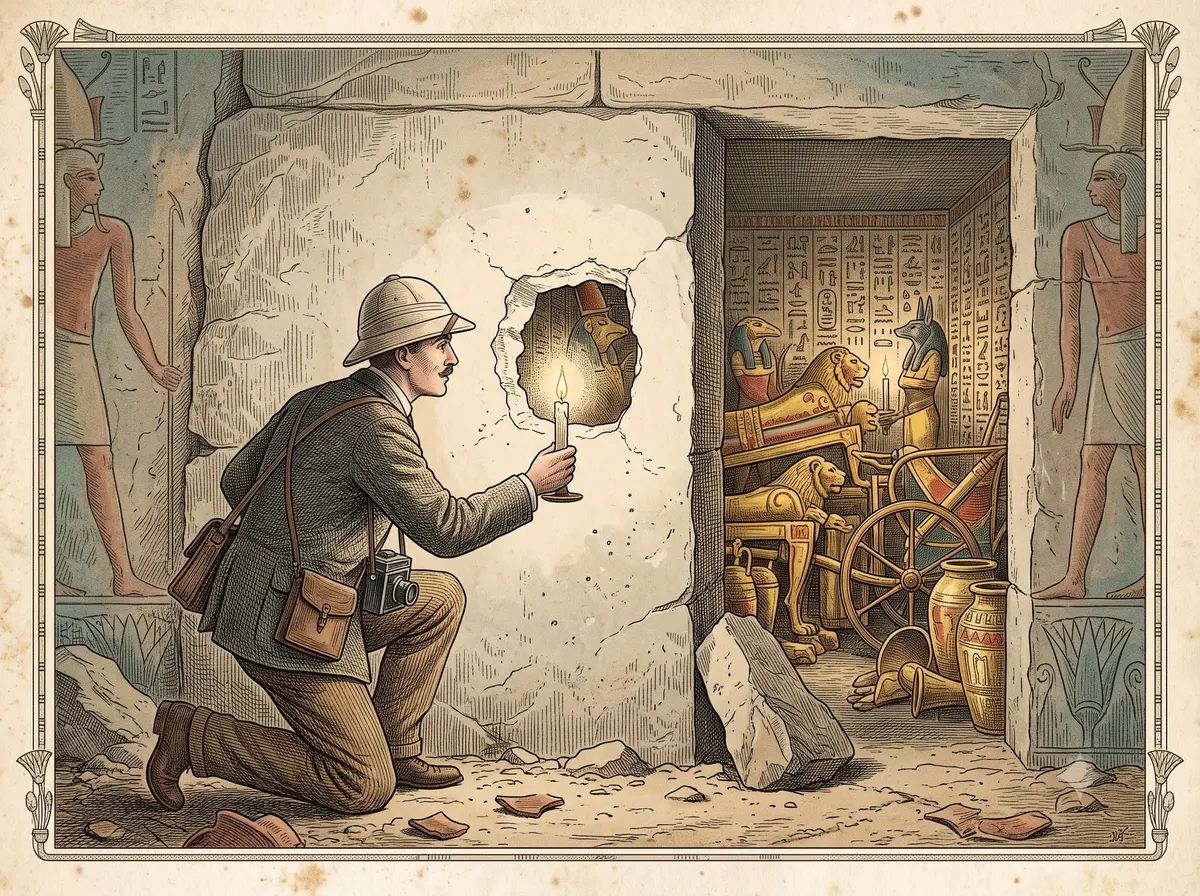
On November 4, 1922, after five mostly fruitless seasons digging in Egypt’s Valley of the Kings, Howard Carter’s workers uncovered a stone step. It led down to the sealed tomb of Tutankhamun, a young pharaoh who died around 1323 BCE. On November 26, with his patron George Herbert, the fifth Earl of Carnarvon, at his shoulder, Carter widened a small hole in the doorway, held up a candle, and peered into a room packed with gilded couches, chariots, and statues. Asked if he could see anything, he gave the reply that became legend: “wonderful things.” The burial chamber itself was formally opened on February 16, 1923. It was the most intact royal tomb ever found in Egypt, and it made front pages everywhere.
Then, in late March, Carnarvon was bitten on the cheek by a mosquito. Shaving, he nicked the bite. The wound became infected, the infection spread to his blood, pneumonia followed, and on April 5, 1923 — less than seven weeks after the burial chamber was opened — he died in a Cairo hotel at age 56. He had been in fragile health for years following a serious motoring accident, which is partly why he had first come to Egypt’s warm climate at all. None of that mattered to the story that took shape.
The press had a problem Carnarvon himself had created: he’d sold exclusive coverage of the tomb to The Times of London, leaving every other newspaper starved for Tutankhamun content. A curse required no access. Weeks before Carnarvon’s death, the novelist Marie Corelli had written to the papers warning that “the most dire punishment follows any rash intruder into a sealed tomb.” When he then actually died, the story exploded. Papers reported an inscription over the tomb’s entrance — “Death shall come on swift wings to whoever toucheth the tomb of Pharaoh.” No such inscription existed; Carter insisted on this, and no firsthand account ever placed it there. Arthur Conan Doyle, creator of the ruthlessly logical Sherlock Holmes, told reporters that “elementals” — spirit guardians created by Tutankhamun’s priests — might be responsible.
The supporting anecdotes grew in the retelling. The Cairo blackout appears to have happened — but power failures were routine in 1920s Cairo. The howling, dying dog Susie rests on a single suspect account. Carter’s canary, famously devoured by a cobra (the pharaoh’s protective serpent!) on the day the tomb was found, had by other accounts simply been handed off to a friend, Minnie Burton, and lived. For years afterward, any death of anyone connected, however loosely, to the excavation was added to the curse’s tally.
Carter himself called the curse talk nonsense and went on cataloguing the tomb’s roughly 5,000 objects for the next decade. He died in London on March 2, 1939 — of lymphoma, at 64, seventeen years after breaching the doorway that supposedly guaranteed swift death.
Why it was strange: The Mummy's Curse That Missed Its Main Target
The curse got the causality exactly backward, and almost nobody cared. The person with the greatest “exposure” — Carter, who worked inside the tomb for ten years — outlived the legend’s launch by a decade and a half. Lady Evelyn Herbert, Carnarvon’s daughter and one of the first people into the tomb, lived until 1980. Meanwhile the story sailed on, powered by a perfect storm: a frustrated press locked out of the real scoop, celebrity mystics happy to comment, and a public primed by decades of mummy fiction. The curse wasn’t ancient Egyptian at all — Egyptian tombs carried warnings against desecration, but nothing resembling the swift-winged death of the headlines. It was a modern media invention wearing ancient costume.
The same thread — Egyptology — continues in The 3,000-Year-Old Pharaoh Who Flew to Paris for a Fungus Treatment — Without a Passport.
What scientists learned: The Mummy's Curse That Missed Its Main Target
The curse eventually received the most fitting rebuttal imaginable: a controlled study. In 2002, epidemiologist Mark Nelson published “The mummy’s curse: historical cohort study” in the British Medical Journal. Using Carter’s own records, he identified 44 Westerners in Egypt at the time of the excavation, 25 of whom were “exposed” — present at the breaching of a sealed door or the opening of the sarcophagus or mummy. The exposed group survived an average of 20.8 years after the event; the unexposed, 28.9 years — a difference that vanished entirely once age was accounted for, with no statistically significant effect on survival. Nelson’s dry conclusion: no evidence for a mummy’s curse. Later researchers also tested a more scientific-sounding variant — that toxic mold like Aspergillus in the sealed tomb killed Carnarvon — and found it wanting, too: mold sickness doesn’t wait months, then strike via a shaving cut.
Another story that outran the evidence: The Easter Island Statues That ‘Walked’ to Work — and the 18 People Who Took One for a Stroll.
How it reaches us today: The Mummy's Curse That Missed Its Main Target
The mummy’s curse became the template for a media pattern we now see constantly: a thrilling explanation outcompeting a boring true one. It also permanently shaped pop culture — Boris Karloff’s The Mummy arrived in 1932, and cursed-tomb stories have anchored horror films, novels, and video games ever since. For scientists, the episode is a teaching classic: it shows survivorship-style counting (tally the deaths, ignore the survivors) and how to defeat it with a proper cohort — count everyone, then compare. Egyptologists still field curse questions a century later, which is its own kind of immortality for a story that was never true.
Another claim that stuck harder than the correction: Göbekli Tepe: The Temple Built Before Farming, Writing, or the Wheel.
Fun fact: The Mummy's Curse That Missed Its Main Target
Nelson’s curse-debunking study ran in the BMJ’s Christmas issue — the journal’s annual tradition of applying rigorous methods to delightfully unserious questions. The mummy’s curse was tested with the same statistical machinery used for drug trials, and the curse lost.
Sources: The Mummy's Curse That Missed Its Main Target
Related stories: The Mummy's Curse That Missed Its Main Target
- The Circus Strongman Who Found Egypt’s Greatest Tomb — A circus strongman who muscled his way into Egyptology
- The Petrified Giant That Was a Fake of a Fake — A fake stone giant, and then a fake of the fake
- Piltdown Man: The Fake Fossil That Fooled Science for 40 Years — A skull that fooled paleoanthropology for four decades