The 3,000-Year-Old Pharaoh Who Flew to Paris for a Fungus Treatment — Without a Passport
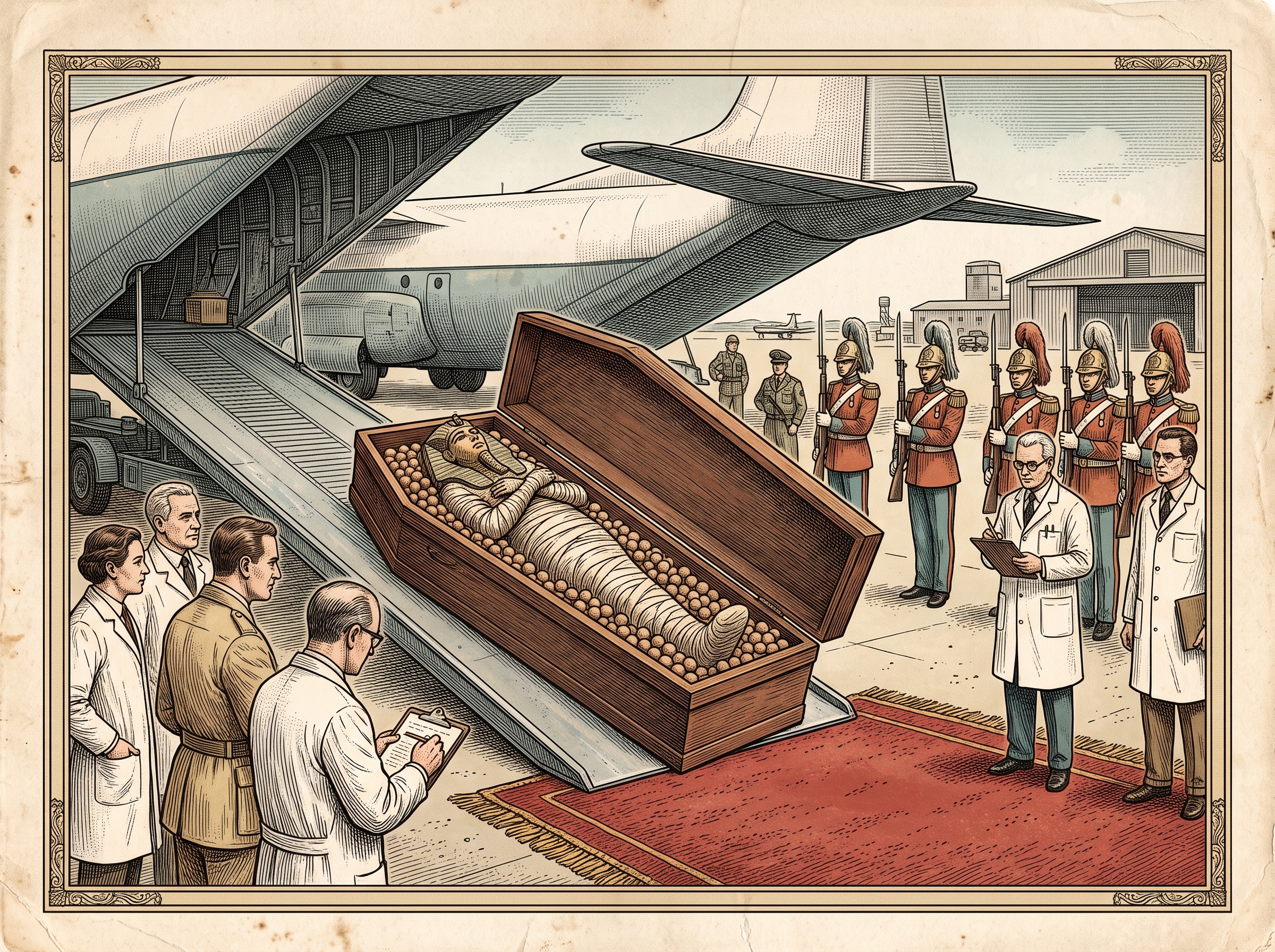
On September 26, 1976, a French Air Force transport plane touched down at Le Bourget airport outside Paris. A red carpet was waiting. So was a government minister, and a line of the Republican Guard standing at attention. The honored guest came off the plane lying down, packed in a cushioning bed of plastic balls. He was Ramesses II, one of the most powerful kings in Egyptian history, dead for roughly 3,200 years, and he had come to Paris because he had a fungus.
By the Curiosities Desk · · 5 min read · Filed under Archaeology · Today’s round
What happened?
Ramesses II ruled Egypt from about 1279 to 1213 BC, a 66-year reign that included the temples at Abu Simbel. In ancient times, priests worried about tomb robbers moved his mummy, along with many other royal mummies, into a hidden group burial at Deir el-Bahari, near Luxor. That cache stayed hidden until 1881, when archaeologists working under the French Egyptologist Gaston Maspero found it, and the mummy eventually went on display in Cairo.
Life in a museum was harder on Ramesses than 3,000 years in a tomb. By the mid-1970s the mummy was clearly getting worse. In 1975, French researchers studying it in Cairo raised the alarm: something was eating the pharaoh.
At the same time, Paris was hosting a major exhibition about Ramesses II at the Grand Palais. French president Valéry Giscard d’Estaing persuaded Egyptian president Anwar Sadat to let the mummy travel to France for treatment, promising that the pharaoh would be received like a visiting head of state. France kept its word. The arrival was carried live on national television.
The rescue was organized by Christiane Desroches Noblecourt, chief curator of Egyptian antiquities at the Louvre, who flew to Cairo to escort the mummy, and by Lionel Balout, director of the Musée de l’Homme, the anthropology museum across the Seine from the Eiffel Tower. There, in a dedicated sterile lab, close to 100 scientists and technicians spent months examining their famous patient with X-rays, endoscopes (thin cameras slipped inside the body), and chemical and biological tests.
They found the culprit, a wood-decaying fungus called Daedalea biennis, among roughly sixty kinds of fungi growing on the body. Swings in temperature and humidity in the Cairo museum had helped it thrive.
The fix was dramatic. On May 9, 1977, the mummy was taken to the French Atomic Energy Commission’s center at Saclay and exposed to gamma rays. Two days later, on May 11, a cured Ramesses was on his way home to the Egyptian Museum in Cairo.
And the passport? According to a story you have probably seen on social media, French law required every traveler, living or dead, to carry a passport, so Egypt issued one to Ramesses, listing his occupation as “King (deceased).” It’s a great line, and there is no good evidence it happened.
Why was it strange?
Start with the obvious: a nation rolled out full military honors for a patient who had been dead since the Bronze Age, and the patient’s problem was mold.
But the passport legend is strange in its own way, because it keeps coming back despite being checked. In 2020, a picture of the “passport,” complete with the pharaoh’s shriveled face, was shared tens of thousands of times. The news agency AFP traced it to Heritage Daily, an archaeology blog, whose own caption called it “an artist’s creation” and said the actual passport was not publicly available. The blog’s owner told AFP he had made the illustration in 2018.
AFP also checked with experts. Élisabeth David of the Louvre’s Department of Egyptian Antiquities said the claim had no basis. She suggested it may come from a 1985 scientific report on the mummy in which Desroches Noblecourt wrote that a “passport” was needed to get Ramesses out of Egypt. She meant it as a figure of speech for the enormous paperwork involved. “Of course the French government does not ask a deceased king to present a passport,” David said. A French law professor added that French law has no passport requirement for the dead; mummies travel under property rules, like other artifacts. Egyptologist Toby Wilkinson, a Ramesses biographer, calls the passport an urban myth.
In other words, the weird true story (a pharaoh with a state welcome and a radiation cure) got upstaged by a weirder invented one.
The same thread — Egyptology — continues in The Mummy’s Curse That Missed Its Main Target.
What did scientists learn?
The team faced a real puzzle: how do you kill a fungus without harming a fragile 3,000-year-old body? Heat or harsh chemicals could damage the tissue. The answer came from the Nucléart project, a group at France’s Atomic Energy Commission that used radiation to preserve cultural heritage.
Gamma rays are high-energy light, the same kind used to sterilize medical equipment. They pass straight through an object and wreck the DNA of living things inside, such as fungi and insects, so they can’t grow or reproduce. Crucially, this kind of exposure doesn’t make the object itself radioactive. The team chose a dose of 18 kilograys (a unit measuring how much radiation energy is absorbed).
Researchers were nervous. Some worried the rays could bleach or damage Ramesses’ hair. So before touching the pharaoh, the team spent months running test samples through an irradiator in Grenoble. Only then did they treat the king.
The examination also turned the mummy into a medical record. Studies of the X-rays reported that the old king had bad teeth, gum disease, hardened arteries, and a spine so stiffened, likely by an inflammatory arthritis, that in his last years he probably could not lift his head upright.
Another story that outran the evidence: The Petrified Giant That Was a Fake of a Fake.
How does it affect us today?
The Ramesses rescue put gamma irradiation on the map for museums. The Nucléart team became ARC-Nucléart, a conservation lab in Grenoble that still uses gamma rays to kill insects and fungi in wooden statues, textiles, and archaeological finds.
The mummy itself is doing well. In April 2021, Ramesses II rode through Cairo in the Pharaohs’ Golden Parade, a televised procession of 22 royal mummies, to his new home at the National Museum of Egyptian Civilization. He is now considered too fragile to travel; when his cedar coffin went to Paris in 2023 for a new exhibition, the king stayed home.
The passport lives on as a handy reminder to check the source before you share.
Another claim that stuck harder than the correction: The Baghdad Battery: The 2,000-Year-Old ‘Battery’ That Probably Never Held a Charge.
Fun fact
Ramesses II had a stunt double. Before anyone aimed gamma rays at the great king, the French team tested the treatment on a lesser-known Egyptian mummy from the Grenoble Museum of Fine Arts.
Sources
- AFP Fact Check. “No Evidence Of A Passport Being Issued To Mummy Of Pharaoh Ramesses II.” Republished by BOOM, October 20, 2020.
- ARC-Nucléart. “La momie du pharaon Ramsès II” (the irradiation team’s own account of the 1977 treatment).
- “Paris Mounts Honor Guard for a Mummy.” The New York Times, September 28, 1976.
- AFP. “1976: when Ramses came to Paris for a mummy makeover.” France 24, April 6, 2023.
- “Ramsès II : le patient égyptien.” The Conversation (France), 2023.