The Scientist Behind It · Archaeology
The Circus Strongman Who Found Egypt's Greatest Tomb
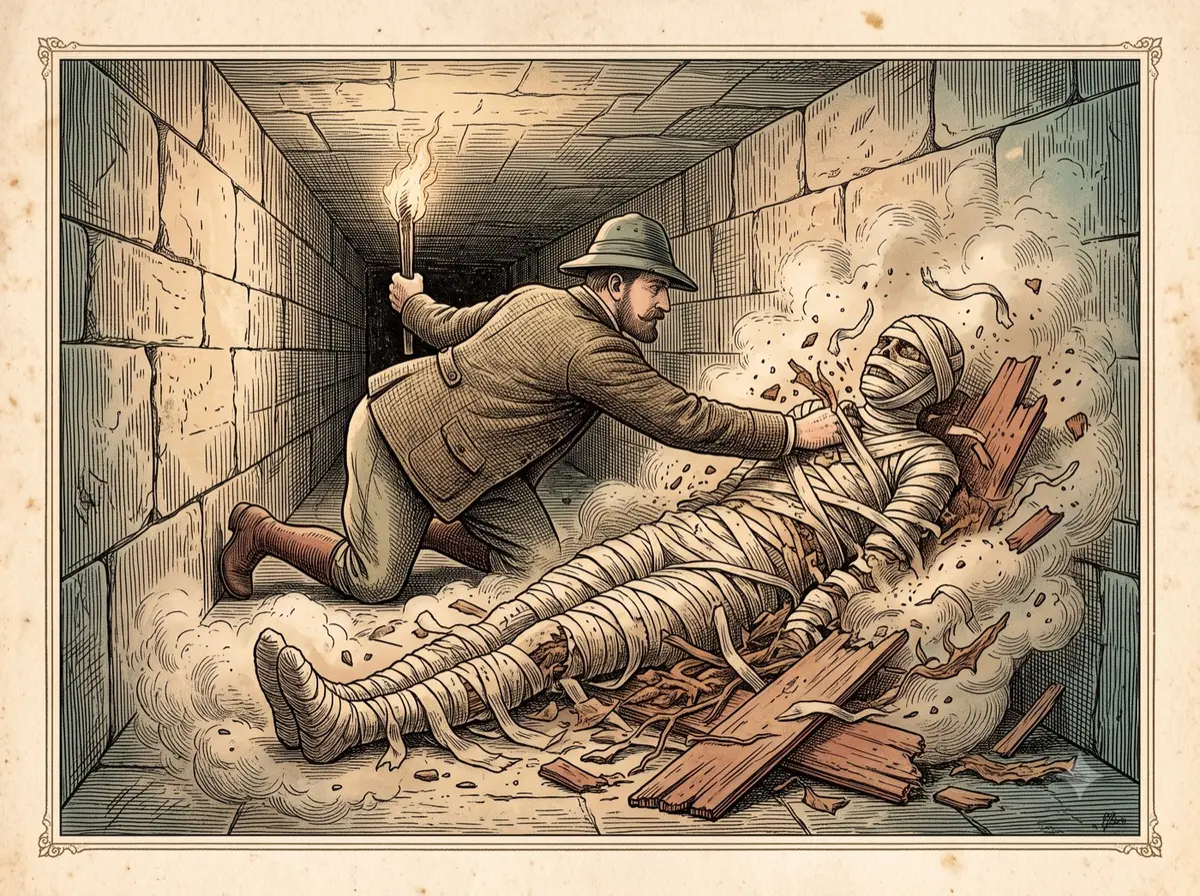
Crawling on his stomach through a pitch-black corridor deep in an Egyptian burial ground, a six-foot-seven Italian former circus performer put his weight down on what he thought was solid rock. It was a mummy. It "crushed like a band-box" beneath him, and he sank into a pile of broken bones, wrappings, and splintered wooden coffin cases, kicking up a cloud of ancient dust so thick he had to sit motionless for fifteen minutes, he later wrote, waiting for it to clear enough to breathe.
By the Curiosities Desk · · 7 min read · Filed under Archaeology · Today’s round
Part of The Person Who Would Not Drop It
What happened: The Strongman in Egypt's Tombs
Giovanni Battista Belzoni was born in Padua, Italy, in 1778, one of fourteen children of a barber. He briefly trained for the priesthood in Rome, but when French troops occupied the city in 1798 he fled north, eventually landing in England in 1803 as a penniless immigrant. Standing roughly six feet seven inches tall, he found the one line of work his size guaranteed: the circus. Billed as “The Great Belzoni,” he became a strongman at Sadler’s Wells Theatre, performing a “Human Pyramid” act in which he strapped on a 58-kilogram iron frame and carried a dozen fellow performers across the stage at once.
By 1815, Belzoni had traded the stage for the wider world, touring Europe before sailing to Egypt with an idea he thought would make his fortune: a hydraulic water wheel of his own design, which he hoped to sell to Muhammad Ali, the pasha ruling Egypt, for irrigating farmland along the Nile. The demonstration went badly. An accident injured a worker during the trial run, the pasha’s ministers declared it a bad omen, and the project was shelved.
Out of a job in Cairo, Belzoni fell in with a very different crowd: European consuls and scholars competing to ship Egyptian antiquities home for their national museums. Henry Salt, the British consul general, hired Belzoni for an unusual task — hauling a 7.25-ton red granite bust of Ramesses II, known as the “Younger Memnon,” out of the pharaoh’s ruined mortuary temple at Thebes and down to the Nile. Napoleon’s own engineers had tried and failed to move it. Belzoni, drawing on the same rigging, leverage, and rollers he’d used to move stage sets and human towers, got it done: over seventeen days in the summer of 1816, using ropes, timber rollers, and roughly 130 hired laborers, he dragged the statue to the riverbank, breaking the bases of two ancient columns in the process to widen his path. The removal was carried out under a firman — an official permit — from Muhammad Ali himself, the standard authorization for antiquities work at the time.
That success launched an improbable second career. Over the following two years, Belzoni excavated across the Valley of the Kings, clearing decades of drifted sand from the entrance to the great temple at Abu Simbel and becoming, by his own account, the first person in the modern era to step inside it. He also broke into a tomb using, in his words, a pole “not unlike a battering ram,” and it was in his search for papyri among the burial pits at Qurna that he suffered the now-infamous encounter with the crumbling mummies. His most celebrated find came on October 18, 1817: the tomb of Seti I, father of Ramesses II, still sometimes called “Belzoni’s Tomb.” It remains one of the largest and most elaborately painted tombs in the Valley of the Kings, its ceilings covered in astronomical scenes and its corridors stretching more than 130 meters into the hillside. Inside, Belzoni found an empty sarcophagus carved from a single block of translucent alabaster.
In 1818, Belzoni became the first person in modern times known to enter the burial chamber of the Pyramid of Khafre at Giza, the second-largest pyramid on the plateau. He returned to England in 1819, published an illustrated account of his travels in 1820, and — ever the showman — opened a full-scale replica of Seti I’s tomb as a paying exhibition in Piccadilly, London, where crowds paid to walk through a burial chamber that had lain sealed for three thousand years. He died of dysentery in 1823 in what is now Nigeria, while attempting an expedition to find the source of the Niger River.
Why it was strange: The Strongman in Egypt's Tombs
Belzoni had no formal training in archaeology, history, or ancient languages — the discipline of Egyptology barely existed yet. What he had was a showman’s engineering intuition, honed by years of rigging pulleys, weights, and human pyramids for paying crowds. It turned out that moving a seven-ton stone pharaoh required exactly the same physics as moving twelve acrobats: leverage, distributed weight, and a lot of rope. The skills that once got him booed off a stage in a bad performance instead moved monuments that had defeated Napoleon’s army engineers.
Another scientist, told from the human side: The King Found Six Hours Into the Dig, Under a Parking Space Marked ‘R’.
What scientists learned: The Strongman in Egypt's Tombs
Belzoni’s era predates modern archaeological method by decades; there was no standardized practice for excavation, and much of what he and his contemporaries did — prying open sealed tombs, hauling statues abroad, breaking column bases to clear a path — would be considered destructive by today’s standards. Even Belzoni admitted that his crawl through the mummy pits at Qurna left human remains “crushed” and reduced to breathable dust. But he also did something many contemporaries did not: he measured. At Seti I’s tomb, Belzoni and the artist Alessandro Ricci spent weeks mapping the layout, recording wall paintings, and making wax and paper casts of the reliefs. Archaeologist Don Ryan, a modern Valley of the Kings specialist, has called Belzoni a “proto-archaeologist” for exactly this reason — his documentation, however crude by later standards, gave future researchers something to work from. Howard Carter, who discovered Tutankhamun’s tomb a century later, praised the “manner in which” Belzoni’s excavations were carried out and called him “one of the most remarkable men in the entire history of archaeology.”
The same thread — Egyptology — continues in The 3,000-Year-Old Pharaoh Who Flew to Paris for a Fungus Treatment — Without a Passport.
How it reaches us today: The Strongman in Egypt's Tombs
The Younger Memnon bust still stands in the British Museum’s Egyptian sculpture gallery, and its arrival in London directly inspired Percy Bysshe Shelley’s 1818 poem “Ozymandias.” Seti I’s alabaster sarcophagus was later purchased by the architect Sir John Soane and remains on display in the basement of Sir John Soane’s Museum in London. More broadly, Belzoni’s career sits at an uncomfortable but instructive point in the history of archaeology: a bridge between outright treasure hunting and the systematic, careful documentation that the field would eventually adopt as its standard. Modern Egyptologists remain divided on how to judge him — some call him a plunderer, others a pioneer — and that unresolved debate is itself part of a much larger, ongoing conversation about how objects like the Younger Memnon left Egypt in the first place, and what museums that hold them owe in return. Belzoni is also frequently cited as a real-life inspiration for the fictional archaeologist-adventurer Indiana Jones.
Another person who would not drop the question: The Man Who Found Troy — and Dug Straight Through It.
Fun fact: The Strongman in Egypt's Tombs
On his first visit to the Great Pyramid at Giza — as a tourist, before he’d ever excavated anything — Belzoni’s oversized frame got wedged in the pyramid’s narrow descending corridor, and he had to be worked free.
Sources: The Strongman in Egypt's Tombs
- Giovanni Belzoni — Wikipedia (citing Belzoni’s own 1820 Narrative of the Operations and Recent Discoveries within the Pyramids, Temples, Tombs, and Excavations in Egypt and Nubia)
- Egyptology’s Pioneering Giant, AramcoWorld
- Giovanni Battista Belzoni — Encyclopaedia Britannica
- Ramesses II statue (“Younger Memnon”) — The British Museum
- Sarcophagus of Seti I — Sir John Soane’s Museum
Related stories: The Strongman in Egypt's Tombs
- The Man Who Found Troy — and Dug Straight Through It — The man who found Troy dug straight through it
- The Copper Tools That Scraped History Off the Parthenon Marbles — Museum staff scrubbed the Parthenon marbles with copper tools
- The Mummy’s Curse That Missed Its Main Target — The Tutankhamun curse skipped the man who actually opened the tomb