The Scientist Behind It · Archaeology
The Man Who Found Troy — and Dug Straight Through It
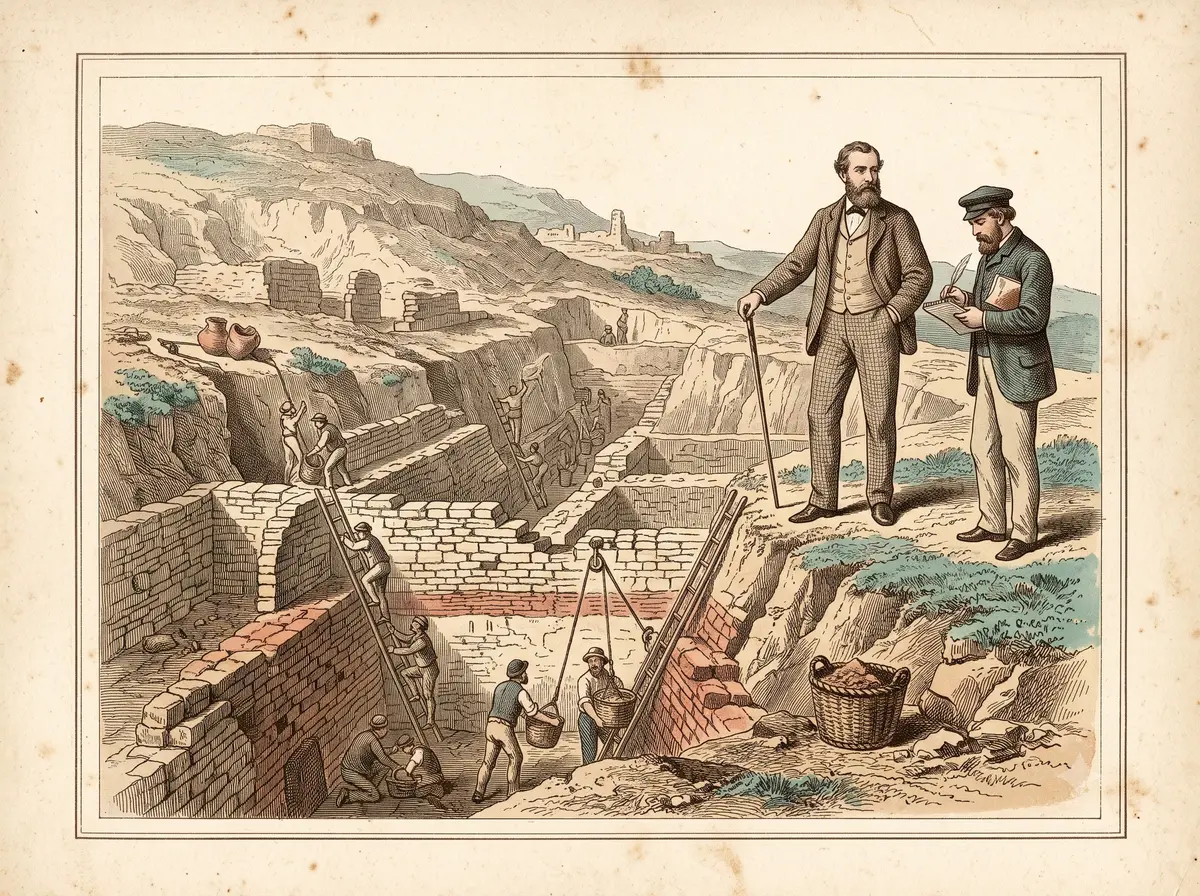
On a Turkish hillside in the early 1870s, a retired businessman stood at the edge of a trench forty metres wide that he had ordered gouged through the middle of a hill, and looked down at a wall of stacked cities. He was hunting for Homer's Troy. He was standing in it. He had already dug through it, and kept going.
By the Curiosities Desk · · 5 read · Filed under Archaeology · Today’s round
Part of The Person Who Would Not Drop It
What happened: The Man Who Found Troy — and Dug Straight Through It
Heinrich Schliemann was not, by training, an archaeologist. He was a merchant — indigo, gold dust, military supplies during the Crimean War — who made enough money to retire in his thirties and then went looking for something grander to do with the rest of his life. What he chose was the Iliad. He wanted to prove that Homer’s Troy had been a real place.
He did not find the site on his own. In 1868 he met Frank Calvert, an English expatriate and consular official whose family owned part of a mound called Hisarlik near the Dardanelles. Calvert had been digging test trenches there for years and was convinced Troy lay underneath. He was short of money. Schliemann was not. Calvert pointed him at the mound, and Schliemann began excavating in 1870 — without a permit from the Ottoman authorities.
Hisarlik is a tell: an artificial hill built up from the rubble of settlement after settlement, each new town raised on the flattened remains of the last. Later work at the site identified nine major levels, spanning the Bronze Age to Roman times. Reading a tell means peeling it, layer by layer, keeping careful track of what came out of which stratum. Schliemann did the opposite. Reasoning that Homer’s city must be old, and that old meant deep, he set his workmen to cutting an enormous north–south trench straight through the mound — roughly 40 metres across, driven down in places all the way to bedrock, more than a dozen metres below the surface.
He got to the bottom fast. The levels he tore through on the way got very little of his attention and almost none of his record-keeping. Archaeologists Jill Rubalcaba and Eric Cline describe his methods as “savage and brutal” even by the standards of the 1870s: “He plowed through layers of soil and everything in them without proper record keeping — no mapping of finds, few descriptions of discoveries.”
Then, in late May 1873, came the gold: diadems of woven wire, thousands of tiny gold rings and buttons, bracelets, goblets, silver vessels, copper weapons. Schliemann announced it as Priam’s Treasure, the personal hoard of Homer’s Trojan king. He photographed his young wife Sophia wearing the diadem and earrings, an image that went around the world and is still the picture most people carry of the discovery of Troy.
Nearly every part of that announcement has since come apart. Schliemann’s published account has Sophia at his side, carrying the gold away in her shawl; he later admitted he invented that detail, and that she was in Athens at the time, following her father’s death. Scholars now generally treat the “treasure” as a composite — objects found at different moments across the site, gathered into one dramatic hoard. And the layer it came from, Troy II, dates to roughly 2400 BCE. If a historical Trojan War happened at all, it belongs somewhere around 1180 BCE, in the levels called Troy VI and VII.
Which is to say: the city Schliemann was looking for was sitting several layers above the one he stopped at. He had already cut through it.
Why it was strange: The Man Who Found Troy — and Dug Straight Through It
The usual failure in archaeology is not finding the thing. Schliemann’s failure was rarer and stranger: he found the thing, correctly, and then removed a large part of it before anyone could tell him what it was.
His hunch about the location has largely held up — Hisarlik really is the best candidate for Homer’s Troy, and that was not the consensus view when he started. But the same certainty that made him dig there made him dig through. He knew what he was looking for so precisely that everything on the way down registered as overburden. Excavation maps of the site still carry a note where the trench cut: palace removed by Schliemann. As Cline put it, “He found Troy, but he also destroyed Troy.”
Another scientist, told from the human side: The King Found Six Hours Into the Dig, Under a Parking Space Marked ‘R’.
What scientists learned: The Man Who Found Troy — and Dug Straight Through It
The lesson Schliemann’s trench taught the field is now its founding rule: stratigraphy, the principle that layers of deposit sit in the order they were laid down, and that the relationship between layers carries as much information as the objects themselves. A gold cup with no recorded context is a nice gold cup. The same cup, logged to a specific floor, beside a specific hearth, under a specific burn layer, is a date, a household, and possibly a war.
The correction came from inside Schliemann’s own dig. In 1882 he hired Wilhelm Dörpfeld, a trained architect from the German excavations at Olympia, who brought systematic recording to Hisarlik. Dörpfeld eventually sorted the mound into its nine principal cities and argued that the Homeric level was higher up than his employer believed. Schliemann, to his credit, had begun to come around; he died in December 1890, shortly after Dörpfeld persuaded him. Dörpfeld carried on at the widow’s request, and Carl Blegen’s later excavations firmed up the sequence further.
Excavation is destruction — you only get to dig a given square metre once. That is why modern practice is so obsessive about documentation, and why “dig less, record more” is a real professional value rather than caution for its own sake.
Another person who would not drop the question: The Doctor Who Discovered Handwashing — and Was Locked Away for It.
How it reaches us today: The Man Who Found Troy — and Dug Straight Through It
Every trowel-by-trowel excavation, every context sheet and section drawing, every deliberately unexcavated reserve left for future archaeologists with better tools, descends in part from the reaction against digs like this one. Ground-penetrating radar and other survey methods exist precisely so that a site can be read before it is opened.
The objects are still unsettled too. Some of Priam’s Treasure went to the Istanbul Archaeology Museum after the Ottoman government sued Schliemann for smuggling it out; the rest reached Berlin in 1881, was taken to Moscow by Soviet trophy brigades at the end of the Second World War, and was denied to exist for decades. The Pushkin Museum finally acknowledged holding it in 1994. Three countries have a claim on it, and it is not resolved.
A close cousin: The Scientist Who Weighed the Earth but Couldn’t Speak to His Housekeeper.
Fun fact: The Man Who Found Troy — and Dug Straight Through It
Ottoman officials reportedly learned that the gold had left the country the simplest way imaginable: Sophia Schliemann wore it in public. The Ottoman inspector assigned to watch the dig was sentenced to prison, and Schliemann’s permit was revoked. He later traded part of the hoard back to the Ottoman government in exchange for permission to return and dig some more.
Sources: The Man Who Found Troy — and Dug Straight Through It
- Heinrich Schliemann, Troy and Its Remains (London: John Murray, 1875) — Schliemann’s own narrative of the excavation, including his account of the treasure’s discovery.
- Meilan Solly, “The Many Myths of the Man Who ‘Discovered’—and Nearly Destroyed—Troy,” Smithsonian magazine, 17 May 2022.
- D. F. Easton, “Heinrich Schliemann: Hero or Fraud?” The Classical World 91, no. 5 (1998): 335–343.
- David A. Traill, “‘Priam’s Treasure’: Clearly a Composite,” Anatolian Studies 50 (2000): 17–35.
- Alexandra Villing and Lesley Fitton, “The Search for the Lost City of Troy,” British Museum blog, 2019.
Related stories: The Man Who Found Troy — and Dug Straight Through It
- The Circus Strongman Who Found Egypt’s Greatest Tomb — A circus strongman who muscled his way into Egyptology
- The Buried Army Found by Farmers Digging a Well — Farmers digging a well hit an 8,000-strong clay army
- Kon-Tiki: The Raft That Crossed an Ocean to Prove a Theory That Was Wrong — A balsa raft crossed the Pacific to prove a theory DNA later demolished