The Scientist Behind It · Archaeology
The General Who Buried Medals at the Bottom of His Trenches — So Future Archaeologists Would Know He'd Been There
Under the turf of Cranborne Chase, in the chalk downland where Dorset meets Wiltshire, small copper discs were left lying at the bottom of old holes. One side shows a pick, a skull, and a surveying instrument. The other reads "Opened by A. Pitt Rivers FRS," with a date punched in by hand. They were buried on purpose in the 1880s and 1890s by a Victorian army general who wanted any archaeologist who dug there after him to know, in his own words, "that I have been there."
By the Curiosities Desk · · 5 min read · Filed under Archaeology · Today’s round
Part of The Person Who Would Not Drop It
What happened: Augustus Pitt Rivers
Augustus Henry Lane Fox was born in Yorkshire in 1827 and spent most of his working life as a soldier. He joined the Grenadier Guards in 1845, saw front-line combat once, at the Battle of Alma in the Crimean War in 1854, and made his name not in battle but in the classroom. He tested the army’s muskets, taught soldiers to use the new Minié rifle, and helped run the School of Musketry at Hythe in Kent. It was methodical work: comparing designs, sorting them into types, and recording how each performed.
From the 1850s that habit spilled into a hobby: collecting tools and everyday objects from around the world, and digging into ancient sites.
Then, in 1880, his life changed overnight. His cousin Horace Pitt-Rivers, the 6th Baron Rivers, died and left him an enormous estate in Cranborne Chase, on one condition: he had to take the surname Pitt-Rivers. The land was thick with burial mounds, Roman-era villages, and ancient earthworks. Pitt-Rivers later wrote that it almost seemed “as if some unseen hand had trained me up to be the possessor of such a property.”
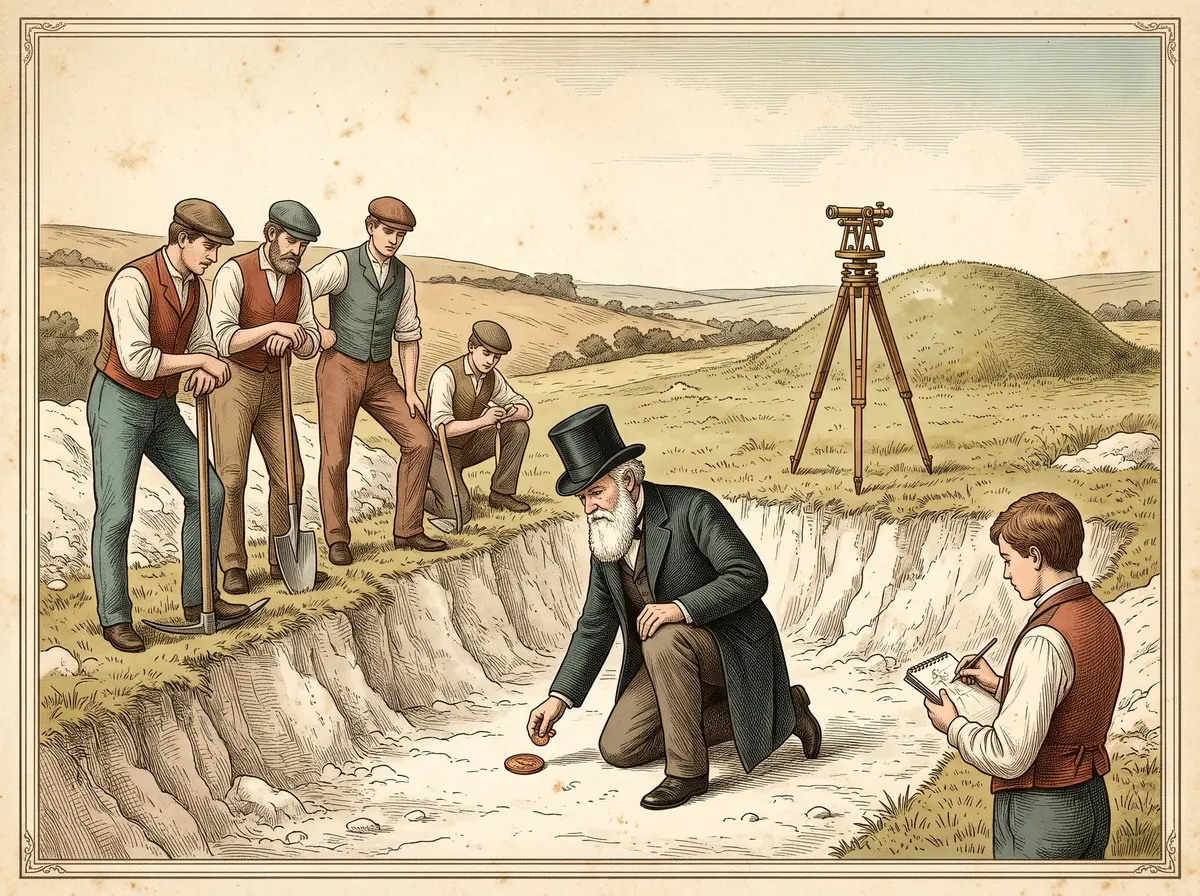
He treated the estate like a military campaign. Over the next two decades he excavated dozens of sites, from the Romano-British village at Rotherley to Wor Barrow, a Neolithic burial mound he dug out almost completely in 1893 and 1894. His crews were estate laborers, between about eight and thirty men at a time, and digging was scheduled around the farming year. Trained assistants directed the diggers, drew every find, and surveyed the trenches. The estate carpenter built wooden scale models of the sites so they could be studied in three dimensions. The general himself visited the digs at least three times a day and wrote that he “never allowed it to be carried on in my absence.”
When a dig was finished, the site was refilled and turfed over. But first, near the bottom of most of his excavations, he placed one of his medalets: a small copper-alloy disc, about 38 millimeters across, designed for him by the antiquarian John Evans. He usually added a few coins and other objects, and stamped the date on the disc with a punch. He explained the practice in the preface to the first of his four privately printed volumes, Excavations in Cranborne Chase, published in 1887. The medal was there “to show future explorers that I have been there.”
Why it was strange: Augustus Pitt Rivers
Many diggers of his era were treasure hunters. They tunneled into burial mounds for urns and gold and left behind a jumble that no one could ever read again. Pitt-Rivers did something that seemed almost eccentric: he assumed his own work would one day be checked.
The medal is a calling card for someone not yet born, and it admits something archaeologists still wrestle with. Digging a site destroys it. The soil layers, the exact positions of objects, the relationships between them: once a trench is emptied, all of that exists only in the excavator’s notes. By marking his holes, Pitt-Rivers made sure no one would mistake his backfill for untouched ancient ground, and he invited later scientists to judge his records against what they found. A very different nineteenth-century approach is the subject of The Man Who Found Troy — and Dug Straight Through It.
What scientists learned: Augustus Pitt Rivers
Pitt-Rivers’ central idea was that you can’t know in advance which details will matter. “Excavators, as a rule, record, only those things which appear to them important at the time,” he wrote, but new questions keep coming up that need evidence nobody thought to save. His answer: “Every detail should, therefore, be recorded.”
So his teams kept the broken pottery, animal bones, and nails along with the showpieces. They noted the depth and position of finds, so the layers of a site could be read like pages, with deeper usually meaning older. He also wrote that an excavator’s chief aim should be “to reduce his own personal equation to a minimum,” borrowing an astronomers’ term for the errors an individual observer brings to a measurement. In other words: keep your own assumptions out of the record.
That was the test his medals set up. When John Barrett, Richard Bradley, and colleagues went back to two of his sites, the South Lodge Camp enclosure and the nearby barrow cemetery, between 1977 and 1981, they were able to reassess his methods against fresh digging. Their report in the journal Antiquity became part of a long debate about how well his famous records hold up. A modern dig that had its own surprise waiting under the surface is The King Found Six Hours Into the Dig, Under a Parking Space Marked ‘R’.
How it reaches us today: Augustus Pitt Rivers
Pitt-Rivers is often called the father of scientific archaeology. Total recording, careful section drawings, and publishing everything, including the dull finds, are now standard practice. Mortimer Wheeler, one of the most influential British archaeologists of the twentieth century, was among those inspired by his methods.
His collections still shape museums. More than 20,000 objects he gave to the University of Oxford founded the Pitt Rivers Museum in 1884. His finds and site models from Cranborne Chase, once shown in his own museum at Farnham in Dorset, are now at the Salisbury Museum.
The spirit of the medals lives on, too. In 1960, British researchers built an experimental earthwork on Overton Down in Wiltshire, buried materials like wood, leather, and cloth inside it, and scheduled re-excavations at 2, 4, 8, 16, 32, and 64 years, with the experiment planned to run for 128. Like the general’s trenches, it is a message to future archaeologists. For another way the field learned to read time underground, see From Baltimore Sewer Gas to the Shroud of Turin: A Short History of Radiocarbon Dating.
A general who labeled his own trenches for strangers he would never meet sits with The Person Who Would Not Drop It.
Fun fact: Augustus Pitt Rivers
Pitt-Rivers didn’t waste the dirt either. When he dug out Wor Barrow, he piled the excavated earth into a terraced bank and planned for the site to become an amphitheater “for games or other amusements and exhibitions.”
Sources: Augustus Pitt Rivers
- A. H. L. F. Pitt-Rivers, Excavations in Cranborne Chase, near Rushmore, Vol. I (1887), via the Internet Archive — the primary source for the medalet, the “future explorers” line, his daily site visits, and his views on recording every detail.
- Pitt Rivers Museum, University of Oxford, catalog record for one of 23 copper-alloy excavation medallions — the medal’s size, design, and “Opened by A. Pitt Rivers FRS” inscription.
- Pitt Rivers Museum, “Pitt-Rivers estate excavations 1880–1900” — dates of each dig, crew sizes, and the role of his assistants.
- John Barrett, Richard Bradley, Mark Bowden, and Barry Mead, “South Lodge after Pitt Rivers”, Antiquity 57 (1983) — the 1977–81 re-excavation of two of his sites.
- “Augustus Pitt Rivers” and “Wor Barrow”, Wikipedia — used as a guide to his military career, inheritance, and the Wor Barrow amphitheater, following citations to Mark Bowden’s 1991 biography.