Science Through Time · Archaeology
From Baltimore Sewer Gas to the Shroud of Turin: A Short History of Radiocarbon Dating
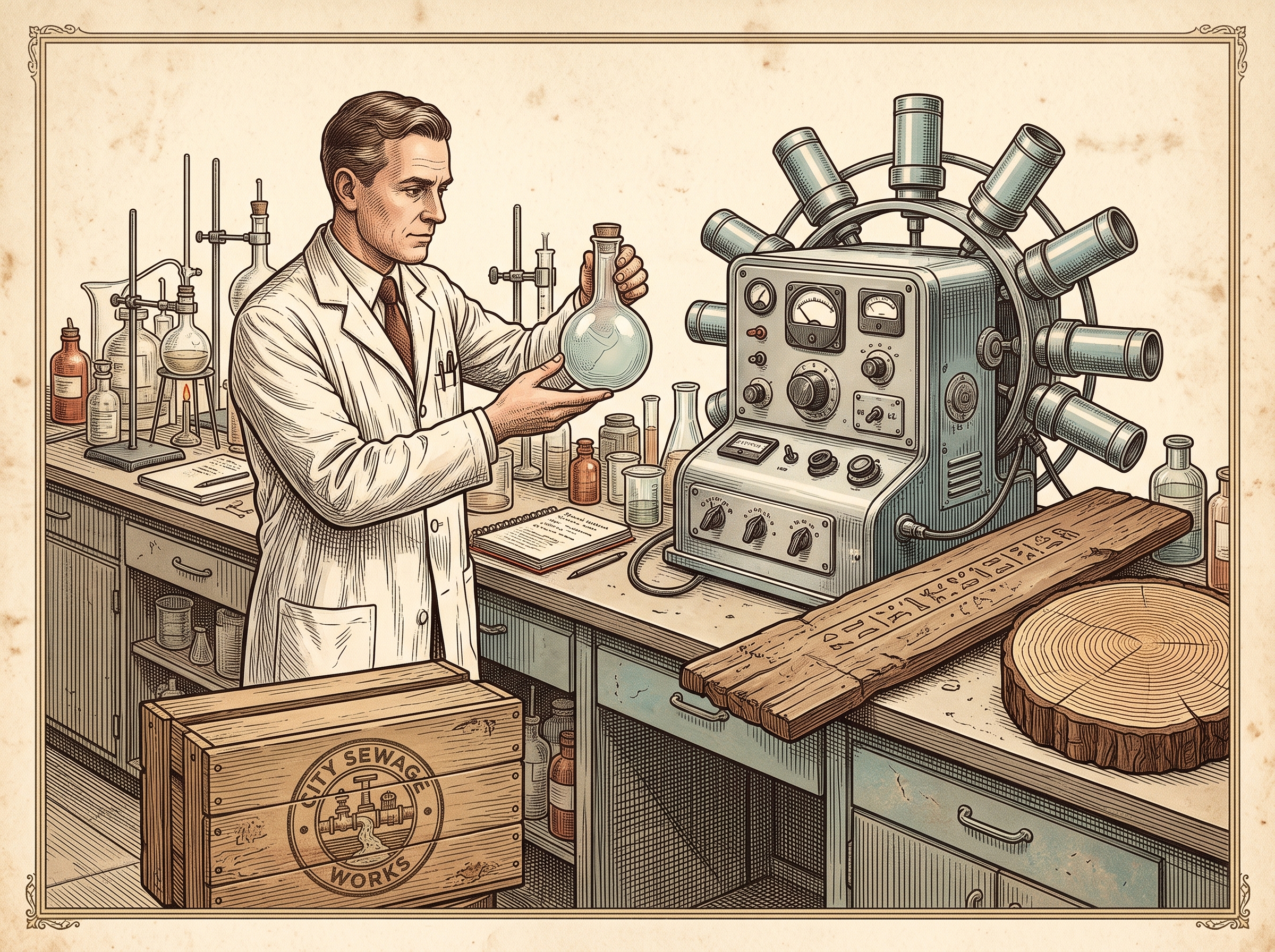
In 1947, a sample of gas bubbled up from the Baltimore City sewage plant, was concentrated, and was shipped to a chemistry lab in Chicago, where a professor named Willard Libby held it up to his radiation counters. He was hoping it would be faintly radioactive. It was. That flicker of activity in a jar of sewer methane was the first real evidence for an idea Libby had been keeping half-secret because, as he later put it, it sounded "too crazy": that cosmic rays could write down human history.
By the Curiosities Desk · · 5 min read · Filed under Archaeology · Today’s round
What happened?
Before the late 1940s, archaeologists could usually tell you what was older than what. Deeper layers in a dig were generally older than shallower ones; one style of pottery came before another. But putting an actual number of years on a hearth or a skeleton was mostly educated guesswork, especially anywhere without written records.
The pieces of a solution were scattered across physics. In 1939, the New York University physicist Serge Korff found that cosmic rays — high-energy particles from space — knock neutrons loose in the upper atmosphere, and he predicted those neutrons would turn ordinary nitrogen into carbon-14, a radioactive form of carbon. In 1940, Martin Kamen and Samuel Ruben at Berkeley made carbon-14 in a particle accelerator. Nobody had yet found it in nature.
Willard Libby, a University of Chicago chemist who had spent the war helping enrich uranium for the atomic bomb project, connected the dots in 1946. If cosmic rays kept making carbon-14 in the air, it would end up in carbon dioxide, then in plants, then in everything that eats plants. Every living thing would carry a tiny, steady dose of it. When the organism died, it would stop taking in new carbon, and the carbon-14 already inside would begin to decay at a fixed rate. Measure how much was left, and you could read the time since death like a clock.
The trouble was that the amount would be minuscule — Libby estimated roughly one carbon-14 atom for every trillion ordinary carbon atoms — and no counter of the day could reliably pick it out of background radiation. So Libby’s team, including graduate student Ernest Anderson, teamed up with the chemist Aristid von Grosse, who had a way to enrich the rare isotope. They needed methane from something recently alive. Grosse obtained it from the Baltimore sewage works, which was rich in fresh organic matter, and for comparison the team tested methane made from petroleum, whose carbon has been underground for millions of years.
The result, published in Science in 1947: the sewage methane was radioactive at about the predicted level, and the petroleum methane was not. Living things carried the clock. Fossil fuels had run theirs down to nothing.
Next the team built a counter sensitive enough to work without the expensive enrichment step. They surrounded the sample with a ring of Geiger counters that cancelled out stray radiation passing through from outside — an “anti-coincidence counter” — inside heavy shielding. Then came the real test: objects whose ages were already known. Wood from tree trunks dated by counting rings. A timber from the funerary boat of the Egyptian pharaoh Senusret III. Acacia wood from the tomb of King Djoser, builder of the Step Pyramid, which Libby’s method put at 4,650 years old, give or take 75.
In 1949, Libby and James Arnold published the “Curve of Knowns” in Science: a graph plotting the radiocarbon ages of these samples against their historically known ages. The points fell along the expected line. Ancient Egypt had graded the method, and it passed.
Why was it strange?
The clock that dates a pharaoh is wound by outer space. Particles from deep space strike the upper atmosphere, and the result ends up ticking inside a coffin board in Egypt. And the proof that the idea worked came not from a museum treasure, but from a city’s sewage.
It also overturned confident claims. The Nobel Prize’s own history of the method notes that a skeleton found in a Welsh cave in 1823 was declared by the geologist William Buckland to be no more than about 2,000 years old. Radiocarbon dating eventually placed it at roughly 33,000 to 34,000 years — the oldest known buried human remains in the UK.
The same thread — Radiocarbon Dating — continues in The Runaway Goat That Led to the Dead Sea Scrolls.
What did scientists learn?
Radiocarbon dating rests on half-life: the time it takes for half of a radioactive sample to decay. For carbon-14, that’s about 5,730 years (Libby’s original figure was 5,568). After one half-life, half the carbon-14 is gone; after two, three-quarters; and so on. Past roughly 50,000 years, too little remains to measure.
Libby assumed the amount of carbon-14 in the air had been constant through time. That turned out to be only approximately true. Measurements on precisely counted tree rings, including very old bristlecone pines, showed the atmospheric level has wobbled over the millennia. So today a raw radiocarbon age is “calibrated” — converted to calendar years using curves built from tree rings and other records. The method didn’t break; it grew up.
Libby himself was struck by how shaky earlier chronologies had been. In his 1960 Nobel lecture he said the profession “learned rather abruptly” that many confidently quoted ancient ages “are not known accurately.”
Another thread pulled across centuries: From a Sponge on a Stick to the Flush Toilet: A Short History of the Toilet.
How does it affect us today?
Modern labs use accelerator mass spectrometry, which counts carbon-14 atoms directly instead of waiting for them to decay, so they can work with samples as small as a milligram. That’s what made it possible, in 1988, for labs in Arizona, Oxford, and Zurich to each test a postage-stamp-sized strip of the Shroud of Turin. Their joint 1989 paper in Nature dated the linen to AD 1260–1390, with at least 95 percent confidence.
Humanity has also tampered with the clock. Above-ground nuclear tests in the 1950s and '60s nearly doubled the carbon-14 in the air, and it has been falling ever since. That “bomb pulse” lets forensic scientists date recent remains, and lets investigators tell whether ivory came from elephants killed before or after the 1989 trade ban. Meanwhile, burning fossil fuels pumps out carbon with no carbon-14 at all, diluting the atmosphere. A 2015 study by Heather Graven projected that, under high emissions, fresh material could look about 1,000 years old by 2050.
Another idea followed the long way: The Angry Customer Complaint That Survived 3,750 Years.
Fun fact
Libby kept the project quiet at first because he feared it sounded absurd. “You can’t tell anybody cosmic rays can write down human history,” he recalled. “So we kept it secret.” In 1960, it earned him the Nobel Prize in Chemistry.
Sources
- E. C. Anderson, W. F. Libby, S. Weinhouse, A. F. Reid, A. D. Kirshenbaum and A. V. Grosse, “Radiocarbon from Cosmic Radiation”, Science 105:576, 1947 — the sewage-methane experiment.
- American Chemical Society, Discovery of Radiocarbon Dating — National Historic Chemical Landmark — history of Libby’s work, the “Curve of Knowns,” and the Nobel lecture quote.
- Willard F. Libby, “Radiocarbon Dating” — Nobel Lecture, 12 December 1960.
- NobelPrize.org / BBC, “The clock that starts ticking when something dies” — Baltimore sewage, Libby’s “too crazy” quote, Buckland’s skeleton, and the bomb pulse.
- P. E. Damon et al., “Radiocarbon dating of the Shroud of Turin”, Nature 337:611–615, 1989.