Science Through Time · Archaeology
The Angry Customer Complaint That Survived 3,750 Years
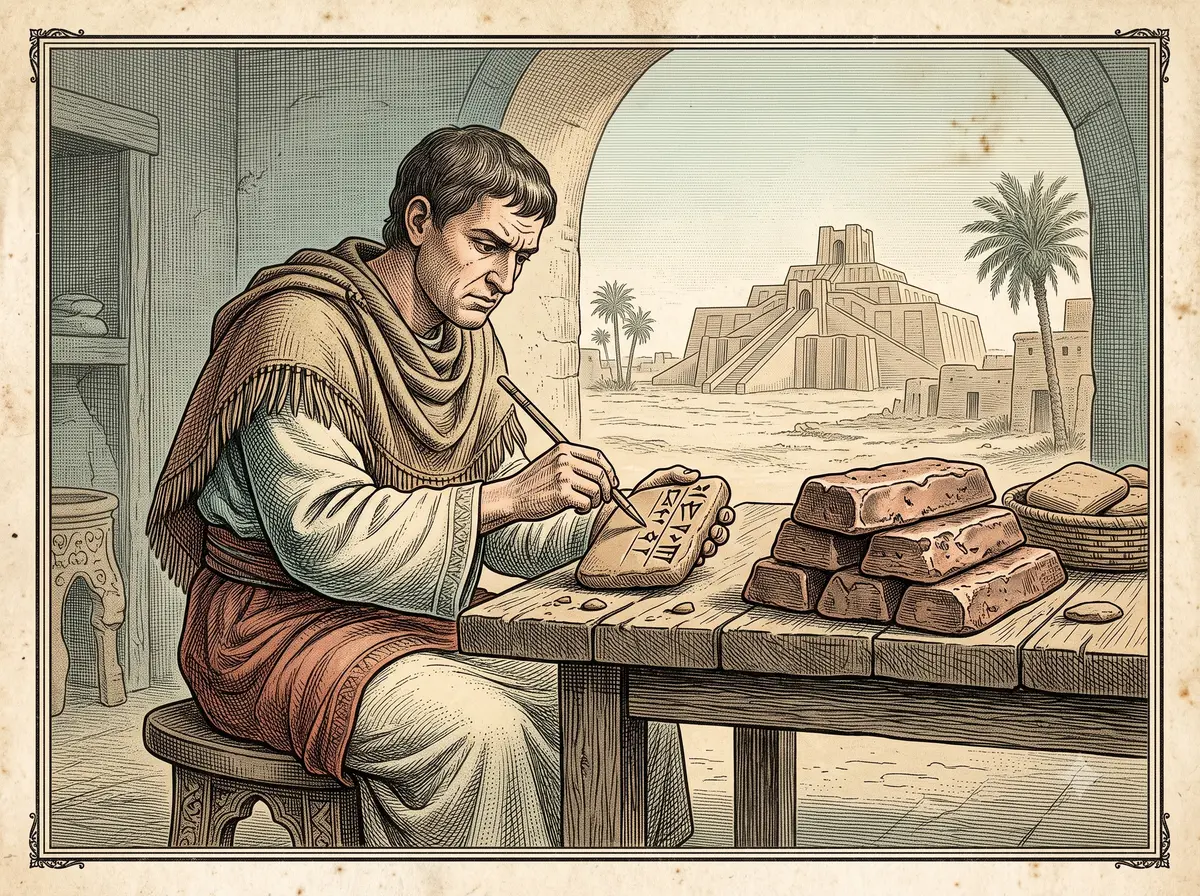
Around 1750 BCE, in the city of Ur, a furious customer named Nanni pressed a reed stylus into wet clay and composed one of the angriest product reviews ever written. His copper was bad. His messenger had been insulted. His money was being held hostage. "What do you take me for," he demanded, "that you treat somebody like me with such contempt?" Then the letter was baked, delivered — and kept. Thirty-seven centuries later, it sits in the British Museum with a Guinness World Record: the oldest written customer complaint on Earth.
By the Curiosities Desk · · 5 min read · Filed under Archaeology · Today’s round
What happened: The Oldest Customer Complaint
The target of Nanni’s fury was a merchant named Ea-nāṣir, one of Ur’s alik Tilmun — “Dilmun traders” — who sailed the Persian Gulf to buy copper from Dilmun, a trading kingdom centered on the island of modern Bahrain, roughly 600 miles from Ur. Copper was the industrial metal of the Bronze Age, needed for tools, vessels, and (alloyed with tin) bronze itself, and southern Mesopotamia had essentially none. So merchants pooled capital — silver, sesame oil, other goods — to finance the voyages, then split the proceeds and paid their cut to the palace.
According to Nanni’s letter, Ea-nāṣir had promised “fine quality copper ingots.” What actually turned up, when Nanni’s messenger came to collect, was copper Nanni considered substandard. Ea-nāṣir’s recorded response to the complaint has become legend in its own right: “If you want to take them, take them; if you do not want to take them, go away!”
Nanni’s reply is 51 lines of cuneiform grievance, written in Akkadian on a clay tablet about the size of a modern smartphone — 11.6 centimeters tall and 5 wide. He complains that his messengers were sent back “empty-handed several times, and that through enemy territory.” He points out, witheringly, that this treatment is over “that one (trifling) mina of silver” he owed, while he had paid out over a thousand pounds of copper to the palace on Ea-nāṣir’s behalf. He closes by announcing that from now on he will inspect every single ingot in his own yard, one by one, and exercise his “right of rejection.” It reads, in short, exactly like a one-star review with the caps lock on — except it took a scribe, a stylus, and a courier willing to cross hostile territory to post it.
The tablet resurfaced in the 1920s, when Sir Leonard Woolley led a joint British Museum–University of Pennsylvania expedition that excavated Ur between 1922 and 1934. In a residential quarter of the city, Woolley’s team dug out a house — plausibly, though not provably, Ea-nāṣir’s own — that contained a stash of business records. Among them were more complaints. A man named Arbituram wrote wanting to know where his copper was. Another correspondent, Imgur-Sin, urged Ea-nāṣir to hand over good copper “so that I will not become upset,” adding wearily, “Do you not know that I am weary?” The worst copper salesman of the eighteenth century BCE had, for whatever reason, kept his hate mail — and the clay preserved every word.
Why it was strange: The Oldest Customer Complaint
Archaeology usually hands us the grand and the official: kings’ inscriptions, temple hymns, law codes. What almost never survives is ordinary annoyance. Nanni’s tablet is a 3,750-year-old bad mood, preserved verbatim — and it’s instantly recognizable. The broken promise, the useless product, the rude staff, the demand for a refund: every element of a modern customer-service dispute was already fully formed before iron tools existed. The strangeness cuts both ways. It’s strange that something so mundane survived at all, and stranger still how little the experience of being a disappointed customer has changed in nearly four millennia.
The same thread — Mesopotamia — continues in The 3,900-Year-Old Fart Joke Scribes Copied in School.
What scientists learned: The Oldest Customer Complaint
Tablets like Nanni’s are how scholars reconstructed the Bronze Age economy. Assyriologist A. Leo Oppenheim, who published the full translation in his 1967 book Letters from Mesopotamia, used the Ur letters to describe the “seafaring merchants of Ur” — private traders running joint-financed ventures down the Gulf, complete with investors, contracts sealed and stored in temples, taxes to the palace, and quality disputes. Historians of trade call this one of the earliest economies with recognizable long-distance commerce; some describe Bronze Age Eurasia as the first era where anything like globalization can be studied. The letters also show why we know any of this: cuneiform was written on clay, and clay — unlike paper, parchment, or hard drives — survives being dropped, buried, and even burned. Fire, which destroys most archives, often just bakes clay tablets harder.
Another idea followed the long way: From Baltimore Sewer Gas to the Shroud of Turin: A Short History of Radiocarbon Dating.
How it reaches us today: The Oldest Customer Complaint
The tablet became an internet celebrity. Starting around 2015, Nanni’s complaint spread as a meme across Reddit and Tumblr, spawning comics, merchandise, and an entire subreddit (r/ReallyShittyCopper) dedicated to dunking on Ea-nāṣir’s copper. Guinness World Records certified it the oldest written customer complaint. In 2025 the British Museum loaned the tablet to the Zayed National Museum in Abu Dhabi — back to the Gulf waters, more or less, that the disputed copper once sailed. And for archaeologists, the affection is useful: a palm-sized clay grudge has probably taught more people that ancient Mesopotamians were recognizably human — petty, weary, litigious, hopeful — than any ziggurat ever has.
Another thread pulled across centuries: The Roman Concrete That Heals Its Own Cracks.
Fun fact: The Oldest Customer Complaint
One letter written by Ea-nāṣir himself survives. In it, he advises two colleagues not to panic when men come looking for some missing metal: “Do not be critical. Do not fear!” History’s most complained-about merchant, it turns out, was also an early adopter of “please remain calm.”
Sources: The Oldest Customer Complaint
- British Museum — Collection record for the complaint tablet (BM 131236)
- A. Leo Oppenheim, Letters from Mesopotamia, University of Chicago Press / Oriental Institute, 1967 (full translation, pp. 82–83)
- Guinness World Records — Oldest written customer complaint
- National Geographic — “Meet Ea-Nasir, a shady ancient merchant—and modern meme”
- Cuneiform Digital Library Initiative — UET 5, 0081 (P414985)
Related stories: The Oldest Customer Complaint
- From a Sponge on a Stick to the Flush Toilet: A Short History of the Toilet — Two thousand years of sanitation, from shared sponges to the S-bend
- The 3,000-Year-Old Pants That Were Invented for Horseback Riding — The world’s oldest trousers, cut for life on horseback
- The Library Burned by Vesuvius That AI Is Finally Reading — Carbonized scrolls from Vesuvius, now being read by AI