Science Through Time · Archaeology
The 3,900-Year-Old Fart Joke Scribes Copied in School
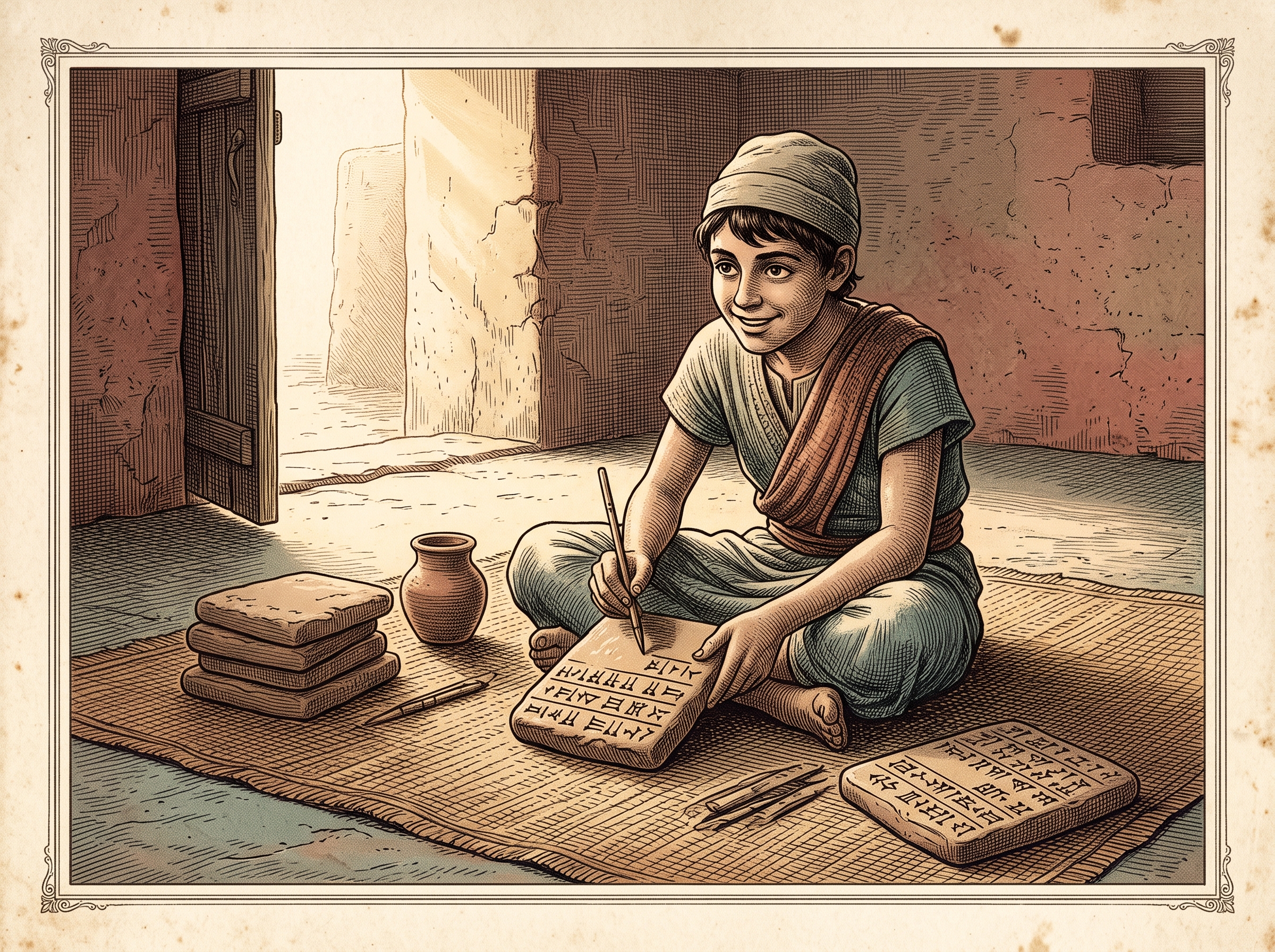
Picture a student in ancient Mesopotamia, nearly 4,000 years ago, hunched over a damp clay tablet with a reed stylus. The lesson today is wisdom literature — the great sayings of the ancestors. Line one: "Something which has never occurred since time immemorial." Line two: "a young woman did not fart in her husband's lap." In 2008, a university research team ranked that line first on its list of the oldest recorded jokes on Earth — and it survived because someone had to copy it out for school.
By the Curiosities Desk · · 5 min read · Filed under Archaeology · Today’s round
What happened?
The joke belongs to a body of texts that scholars call the Sumerian proverb collections. Sumerian was the language of southern Mesopotamia, in what is now Iraq, and it was written in cuneiform — wedge-shaped marks pressed into clay. By the Old Babylonian period (roughly 1900–1600 BC), Sumerian was probably no longer anyone’s everyday language. It had become something like Latin in medieval Europe: the prestigious, classical tongue every educated scribe had to master.
To learn it, students copied. They started with signs and word lists, then moved up to short sentences — and proverbs were ideal practice material. Most of the surviving proverb tablets come from the city of Nippur, and most date to the 1700s BC. One Nippur building, known to archaeologists as House F, was excavated by a joint University of Chicago and University of Pennsylvania expedition in 1951–52. It turned up nearly 1,500 tablet fragments, so many school exercises that historian Eleanor Robson argued the house doubled as a scribal school in the 1740s BC.
For most of the 20th century, these proverbs were a specialist’s puzzle. Edmund Gordon of the University of Pennsylvania published a pioneering edition in 1959, Sumerian Proverbs: Glimpses of Everyday Life in Ancient Mesopotamia. In 1997, Danish Assyriologist Bendt Alster pulled together all the known Old Babylonian Sumerian proverbs into a two-volume edition. Later reviews counted more than 600 manuscripts carrying over 2,000 proverbs, organized into some two dozen collections. Oxford’s Electronic Text Corpus of Sumerian Literature then put English translations online for free.
Sitting in Collection 1, proverb number 1.12, is our line. Oxford’s translation reads: “Something which has never occurred since time immemorial: a young woman did not fart in her husband’s embrace.” Other translators render the last word as “lap.”
Then, in July 2008, the British TV channel Dave commissioned Dr. Paul McDonald, a senior lecturer at the University of Wolverhampton, to find the oldest jokes in history. His team spent two months on it, defining a joke as anything with “a clear set-up and punch line structure.” The Sumerian fart proverb came out on top, ahead of an Egyptian story about entertaining a bored pharaoh. Newspapers around the world ran the headline, and Guinness World Records now lists it as the oldest joke.
Why was it strange?
We tend to picture ancient wisdom as solemn: carved commandments, noble kings, deep thoughts about the gods. And much of Collection 1 does sound like that — “Who can compete with righteousness? It creates life.” But tucked between the lofty lines is a gag built exactly like a modern one. The setup promises something cosmic, a thing that has “never occurred since time immemorial.” The punchline swerves into the bedroom.
The Sumerian is even sharper than the English. University of Pennsylvania Sumerologist Philip Jones notes that the first line uses a negative form, roughly “a thing that has not existed since those primordial days,” and the second line negates the fart, too. That is a double negative, and it leaves modern readers arguing about what exactly is being claimed. Is it teasing brides who pretend to be dainty? Mocking the very idea that anyone has never done it? Or simply a rude line for students to giggle at?
Here is where we need to separate the headline from the evidence. “World’s oldest joke” came from a study commissioned by a comedy TV channel, not from a peer-reviewed paper, and it depends on how you define a joke. We cannot interview the scribes, so nobody can prove they laughed. Older humor may well exist in texts we haven’t recognized as funny. What is solid is that the line was written down, copied in schools, and has the shape of a joke.
The same thread — Mesopotamia — continues in The Angry Customer Complaint That Survived 3,750 Years.
What did scientists learn?
The proverbs are a rare window into ordinary Mesopotamian life. Royal inscriptions tell you about wars and temples. Proverbs tell you about bread, debt, in-laws, and bad neighbors. Collection 1 alone includes “To be sick is acceptable; to be pregnant is painful; but to be pregnant and sick is just too much,” and a man who “wiped his hands and belched” after a meal.
Assyriologists — scholars of ancient Mesopotamian languages and cultures — have also used these tablets to reconstruct how teaching worked. Researchers such as Niek Veldhuis argue that proverbs sat at a specific step in the curriculum: after lists of signs and words, before long literary compositions. Short, punchy sentences taught grammar and vocabulary in bite-size pieces. A memorable bit of rudeness may simply have been good teaching. Then as now, students remember what makes them smirk.
Another thread pulled across centuries: The Library Burned by Vesuvius That AI Is Finally Reading.
How does it affect us today?
Digitized cuneiform has turned specialist archives into something anyone can read. The Oxford corpus, built between 1997 and 2006, lets you click from a translation straight to the Sumerian transliteration. That’s how a linguist in 2025 could pull up the fart joke, line by line, and have a Penn expert explain its grammar on a public blog.
The joke has also become a favorite of teachers and historians trying to make the ancient world feel human. Moudhy Al-Rashid quotes it in her 2025 book Between Two Rivers, a history of Mesopotamia built from tablets that were often tossed aside as building rubble. A line about a bride’s digestion turns out to be a quick way to persuade a modern reader that the people of Nippur were people.
Another idea followed the long way: The Roman Concrete That Heals Its Own Cracks.
Fun fact
The same collection includes what may be one of history’s oldest digs at translators: “Who will listen to your translations?” Scholars have been reading it, and translating it, ever since.
Sources
- Electronic Text Corpus of Sumerian Literature (University of Oxford) — Proverbs: collection 1, translation (proverb 1.12)
- Guinness World Records — Oldest joke (Dave Historical Humour Study, University of Wolverhampton, 2008)
- Eleanor Robson, “The Tablet House: A Scribal School in Old Babylonian Nippur,” Revue d’Assyriologie 93 (2001)
- Language Log (University of Pennsylvania) — “Sumerian double negative (and fart joke),” with grammatical analysis by Philip Jones
- Penn Museum — Edmund I. Gordon, Sumerian Proverbs: Glimpses of Everyday Life in Ancient Mesopotamia (1959)