Science Through Time · Archaeology
The Roman Concrete That Heals Its Own Cracks
A harbor wall built by Roman engineers two thousand years ago has been pounded by salt water every single day since — and instead of crumbling like the highway overpass near your house, it has quietly grown *stronger*. Modern concrete starts to fail in decades. Some Roman seawalls are still intact after twenty centuries in the surf. For a long time, nobody could explain why. The answer turned out to be hiding in tiny white specks that engineers had spent years dismissing as sloppy mixing.
By the Curiosities Desk · · 5 min read · Filed under Archaeology · Today’s round
What happened: The Roman Concrete That Heals Its Own Cracks
Around the first century BC, Roman builders perfected a material they called opus caementicium — a mix of lime, chunks of rock and rubble, and, crucially, volcanic ash. The best ash came from the region around the Bay of Naples, near a town the Romans called Puteoli (modern Pozzuoli), which is why we still call the active ingredient pozzolana today.
This concrete let the Romans build on a scale nobody had managed before. They poured it into aqueducts, bathhouses, piers, breakwaters, and domes. The most jaw-dropping survivor is the Pantheon in Rome, completed under the emperor Hadrian around 126 AD. Its unreinforced concrete dome spans about 43 meters (142 feet) and remains, nearly nineteen centuries later, the largest unreinforced concrete dome on Earth. The Roman engineers even graded their mix, using heavy aggregate at the base and lighter volcanic pumice near the top so the dome wouldn’t collapse under its own weight.
The Romans understood that something special happened when their concrete met the sea. The architect Vitruvius, writing in the first century BC, described mixing lime with volcanic ash to make structures that would set hard underwater. The naturalist Pliny the Elder, writing a few decades later, marveled that concrete piers in the waves became “a single stone mass, impregnable to the waves and every day stronger.” They had the recipe and they had the result. What they didn’t have was any idea why it worked.
Why it was strange: The Roman Concrete That Heals Its Own Cracks
Here is the part that bothered modern engineers: by every rule we teach, this should be backwards. Salt water is concrete’s enemy. Chloride from seawater attacks the steel rebar inside modern reinforced concrete, rusts it, and cracks the structure apart from within. Coastal infrastructure is some of the first to crumble. We design it to last maybe fifty to a hundred years and then expect to tear it down.
Roman marine concrete did the opposite. The very seawater that should have destroyed it was making it tougher over time. And the Romans pulled this off with no steel reinforcement at all, no electric kilns, and no chemistry beyond what they could observe with their eyes. For centuries the prevailing assumption was simply that the recipe had been lost — a piece of ancient know-how we’d never recover. The truth is stranger: the recipe wasn’t lost so much as misunderstood, including by the people studying the leftovers.
Another idea followed the long way: The Library Burned by Vesuvius That AI Is Finally Reading.
What scientists learned: The Roman Concrete That Heals Its Own Cracks
The breakthroughs came when geologists started treating ancient concrete the way they treat rock — by drilling cores and examining the crystals inside.
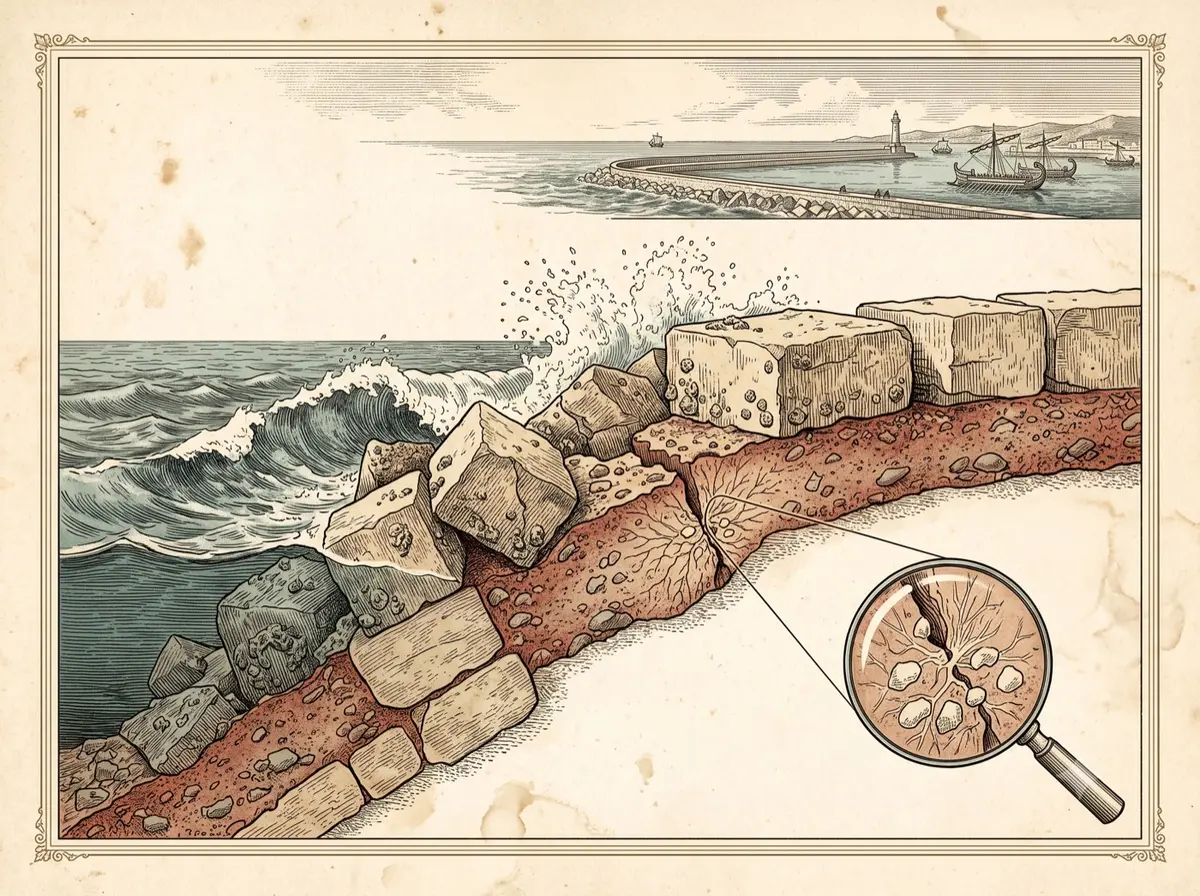
In 2017, a team led by geologist Marie Jackson published an analysis of cores drilled from Roman marine structures. Using the volcanic ash as a clue, they found that seawater slowly percolating through the concrete didn’t wash it away. Instead, it dissolved components of the volcanic material and triggered the growth of rare interlocking minerals — including a form of aluminous tobermorite and a zeolite called phillipsite — right inside the cracks and pores. The concrete was, in effect, mineralizing itself. The seawater wasn’t an attacker; it was an ingredient.
Then, in 2023, a team at MIT led by Admir Masic zeroed in on a different mystery: the little white lumps, called “lime clasts,” scattered through almost all Roman concrete. Researchers had long assumed these were just evidence of low-quality lime or careless mixing. Masic’s group argued the opposite. They concluded the Romans were “hot mixing” — adding highly reactive quicklime (calcium oxide) directly, rather than the gentler slaked lime — which produces those clasts. And the clasts function as tiny built-in repair kits. When a crack forms and water seeps in, it reacts with the leftover lime to deposit fresh calcium carbonate, sealing the gap. In lab tests, cracked Roman-style samples knitted themselves back together; ordinary modern samples did not. Self-healing concrete, it turns out, may have been a Roman feature, not a Roman accident.
Another thread pulled across centuries: The Angry Customer Complaint That Survived 3,750 Years.
How it reaches us today: The Roman Concrete That Heals Its Own Cracks
This isn’t just a charming story about clever ancestors. Concrete is the most-used building material on the planet, and making its key ingredient — Portland cement — is responsible for roughly 8 percent of global carbon dioxide emissions. Every ton we don’t have to pour or replace is a climate win.
So researchers are now reverse-engineering Roman chemistry for the modern world. The appeal is concrete that lasts centuries instead of decades, repairs its own micro-cracks before they spread, and can be made with less energy and less cement. The MIT team behind the 2023 study has been working to commercialize hot-mixed, self-healing formulations. Pozzolanic materials and other volcanic-style additives are already used to make greener, more durable concrete. A material we thought we’d outgrown is quietly helping redesign the bridges, seawalls, and buildings of the future.
A close cousin: From a Sponge on a Stick to the Flush Toilet: A Short History of the Toilet.
Fun fact: The Roman Concrete That Heals Its Own Cracks
The Pantheon’s dome has a 9-meter-wide hole at its very top — the oculus — that is completely open to the sky. Rain really does fall straight into the building. The Romans built the floor with a subtle slope and a ring of drains so the water runs off, a 2,000-year-old drainage system still doing its job under one of the most-visited interiors on Earth.
Sources: The Roman Concrete That Heals Its Own Cracks
- Vitruvius, De Architectura (On Architecture), Book II — ancient account of mixing lime with volcanic pozzolana. Perseus Digital Library
- M. D. Jackson et al., “Phillipsite and Al-tobermorite mineral cements produced through low-temperature water-rock reactions in Roman marine concrete,” American Mineralogist (2017). Publisher page
- L. M. Seymour, A. Masic et al., “Hot mixing: Mechanistic insights into the durability of ancient Roman concrete,” Science Advances (2023). Open-access article
- MIT News, “Riddle solved: Why was Roman concrete so durable?” (January 6, 2023). news.mit.edu
- Smithsonian Magazine, “The Secrets of Ancient Roman Concrete.” smithsonianmag.com
Related stories: The Roman Concrete That Heals Its Own Cracks
- The Roman Cup That Was Accidentally Nanotechnology — A Roman cup that changes color thanks to gold nanoparticles
- The 2,000-Year-Old Computer Found in a Shipwreck — A corroded bronze lump that turned out to be an ancient computer
- Greek Fire: The Byzantine Weapon That Burned on Water — and Whose Recipe Died With the Empire — A Byzantine weapon that burned on water, its recipe lost forever