Impossible Inventions · Engineering
Greek Fire: The Byzantine Weapon That Burned on Water — and Whose Recipe Died With the Empire
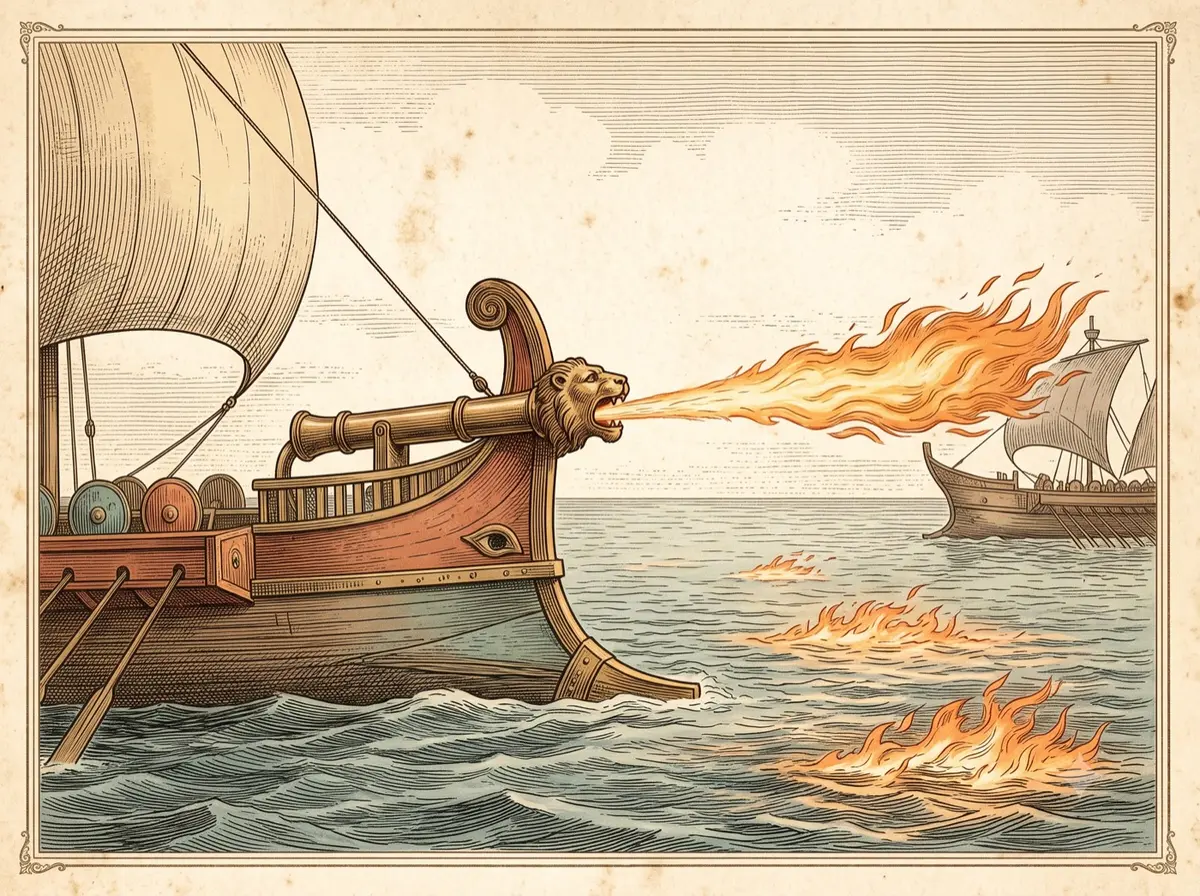
In 678 CE, an Arab war fleet closed in on Constantinople, confident the city was theirs. Then Byzantine ships rowed out to meet them with bronze tubes mounted on their bows, shaped like the open mouths of lions. Flame roared out across the water — and kept burning. Sailors who leapt overboard to escape the fire found that the sea itself seemed to be on fire around them. The Arab fleet broke and fled. The weapon that saved the city would go on to protect the Byzantine Empire for centuries. Today, nobody alive knows exactly how to make it.
By the Curiosities Desk · · 5 min read · Filed under Engineering · Today’s round
Part of Built to Do the Impossible
What happened: Greek Fire
The chronicler Theophanes the Confessor credits the weapon’s invention to a man named Kallinikos (Latinized as Callinicus), described as an architect or engineer from Heliopolis, in Syria, who fled to Constantinople around 672 CE as Arab armies overran his homeland. According to Theophanes, Kallinikos brought with him a “sea fire” that the Byzantines used to devastating effect. It’s worth noting, though, that Theophanes’ own chronology is inconsistent — he describes Byzantine ships already equipped with fire-projecting tubes a couple of years before Kallinikos supposedly arrived. The historian James Partington has suggested the weapon may not have been the work of one inventor at all, but the product of chemists working in Constantinople who inherited older techniques from Alexandria’s chemical tradition. Either way, something new and far more effective appeared in Byzantine hands right around the time the empire needed it most, during the Arab siege of Constantinople from 674 to 678.
What made it new wasn’t just the ingredients — incendiary mixtures of sulfur, pitch, and petroleum had been used in warfare for centuries before this. It was the delivery system. Byzantine dromons (fast war galleys) were fitted with a furnace, a pressurized bronze tank, and a swiveling bronze tube called a siphōn. Crews heated the liquid fuel, pressurized it, and forced it out through the tube, where it ignited as it left the nozzle — producing, by multiple accounts, a “thunder” and a cloud of smoke as it discharged. A smaller handheld version, the cheirosiphōn, worked like an early flamethrower and was used against siege towers and infantry on land.
Greek fire helped break not just the 678 siege but the second major Arab siege of Constantinople in 718. It was used again and again over the following centuries: against rebel fleets in Byzantine civil wars, against Rus’ raiders on the Bosphorus in 941 and 1043, and to blockade the Danube during a war with Bulgaria in the 970s. Its last clearly documented uses trail off by the 12th century. When crusaders sacked Constantinople in 1203–1204, no reliable account describes Greek fire being used to defend the city — a striking absence, given how central it had been to Byzantine survival for five centuries.
Why it was strange: Greek Fire
Most lost ancient technologies get solved eventually. Historians and engineers have reconstructed Roman concrete, Damascus steel, and the Antikythera mechanism well enough to explain how they worked. Greek fire is different: the Byzantines guarded it so effectively that they may have eventually lost track of it themselves.
The 10th-century emperor Constantine VII Porphyrogenitus wrote a private guide for his son and heir, Romanos II, warning him never to reveal the fire’s composition to foreigners under any circumstances. Constantine claimed the formula had been delivered by an angel to the empire’s first Christian emperor, Constantine the Great — almost certainly a legend built to sanctify the secret, not a literal historical event, and Constantine VII’s account should be read as propaganda meant to deter defectors rather than as fact. He also wrote that an official who once tried to sell the secret to Byzantium’s enemies was struck down by “a flame from heaven” before he could reach a church — again, a cautionary story, not a verified incident.
What does look to be true is that the knowledge was deliberately compartmentalized: the fuel formula, the pressurized siphon mechanism, and the specialized dromon design were apparently known to different specialists, with no single person holding the whole system in their head. That explains a genuinely strange fact — when Bulgarian forces captured 36 siphons and a supply of the fuel itself in 814, they still couldn’t reproduce the weapon. Byzantium’s enemies spent centuries trying to steal or copy Greek fire and never fully succeeded, not because the empire had one unbreakable vault, but because there was no single vault to break into.
The same thread — Military Engineering — continues in The Nuclear Landmine Britain Planned to Keep Warm With Live Chickens.
What scientists learned: Greek Fire
Modern historians and chemists have spent well over a century testing theories about what Greek fire actually was, largely by trying to make versions of it and see what failed. An early theory, popular with 19th-century chemist Marcellin Berthelot, held that the fire was an early gunpowder based on saltpeter (potassium nitrate). That theory is now largely rejected, since saltpeter doesn’t appear reliably in Middle Eastern or European warfare until centuries later. A second theory proposed that quicklime reacting with seawater produced the fire and its resistance to dousing; test batches showed the reaction was too weak at sea to match the descriptions. A related idea — that Kallinikos had discovered calcium phosphide, made by boiling bones in urine, which ignites on contact with water — also failed to reproduce the intensity described in Byzantine and Arab sources.
The current consensus, built from these dead ends, is that Greek fire was petroleum-based — refined or crude oil the Byzantines could draw from natural seeps around the Black Sea — thickened with pine or cedar resin into something with handling and burning properties broadly similar to napalm. In 2002, historians John Haldon and Maurice Byrne built a full-scale reconstruction of the pressurized siphon system for the documentary series “Machines Time Forgot,” using crude oil and wood resin. It produced flame temperatures above 1,000°C (1,830°F) and a range of roughly 15 meters. The experiment couldn’t prove the exact original recipe, but it confirmed the mechanical design was entirely workable with Byzantine-era metalworking. The deeper scientific lesson isn’t really about petrochemistry — it’s about how thoroughly a well-compartmentalized secret can outlast the civilization that kept it, leaving only educated reconstruction behind.
Another invention that refused to stay on paper: The 3,000 Letters the Post Office Fired at Florida Inside a Cruise Missile.
How it reaches us today: Greek Fire
Greek fire is a distant conceptual ancestor of napalm, the petroleum-and-gelling-agent incendiary developed by American chemists in 1942 and used widely, and controversially, in the decades since — a reminder that “thickened burning fuel that clings to its target” is a solution militaries have reinvented more than once across history. The cheirosiphōn is often cited as the earliest known device functionally similar to a modern flamethrower. And the Byzantine approach to guarding it — splitting sensitive knowledge among specialists so no single capture or defection compromises the whole system — is a real precursor to the “need to know” compartmentalization still used in modern military and intelligence security today.
Another machine that should not have worked: The Aircraft Carrier Britain Tried to Build Out of Ice.
Fun fact: Greek Fire
Constantine VII’s advice to his son named exactly three things that must never fall into foreign hands: the Byzantine imperial regalia, a Byzantine princess given in marriage, and Greek fire. Weapons technology, in other words, ranked alongside the crown jewels and the royal family as a matter of state survival.
Sources: Greek Fire
- Theophanes the Confessor, as translated and discussed in John Haldon, “‘Greek fire’ revisited: recent and current research”, in Byzantine Style, Religion and Civilization (Cambridge University Press, 2006) — the leading modern academic survey of the evidence and reconstruction attempts.
- Constantine VII Porphyrogenitus, De Administrando Imperio, chapter 13, Dumbarton Oaks edition, ed. Gyula Moravcsik, trans. Romilly Jenkins (archive.org) — the primary source for the imperial secrecy instructions and the “angel” legend.
- “Greek fire”, Encyclopaedia Britannica.
- “Greek Fire”, World History Encyclopedia.
- “Greek fire”, Wikipedia (cross-referenced against its cited primary and academic sources above).
Related stories: Greek Fire
- Starlite: The Fireproof Plastic a Hairdresser Invented and Took to His Grave — A hairdresser’s fireproof plastic that died with him
- The Chemical That Sets Fire to Sand — and the Rocket Chemist Who Recommended Running Shoes — A chemical that sets sand, asbestos, and test engineers on fire
- The Roman Cup That Was Accidentally Nanotechnology — A Roman cup that changes color thanks to gold nanoparticles