Impossible Inventions · Engineering
The 3,000 Letters the Post Office Fired at Florida Inside a Cruise Missile
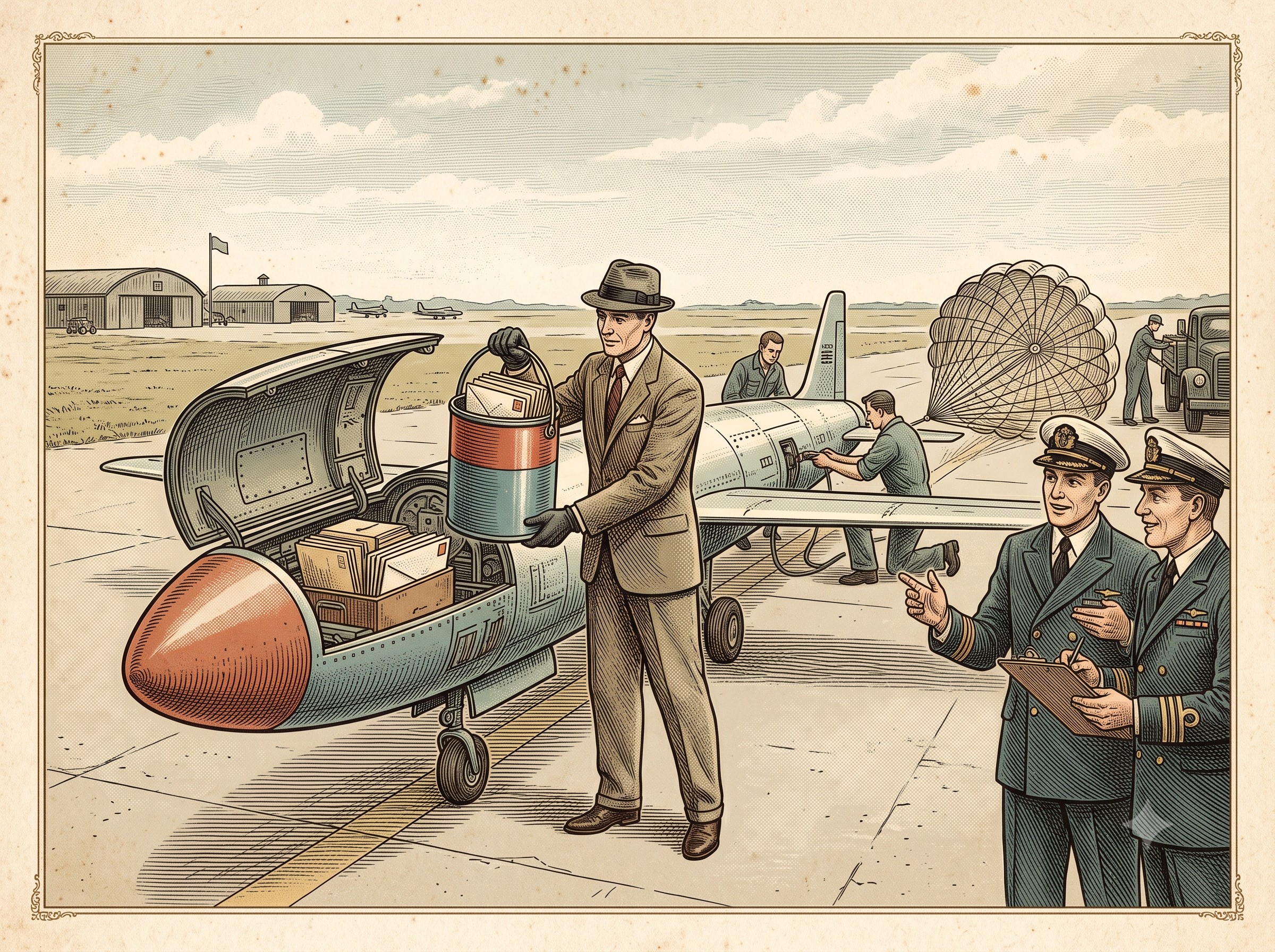
Shortly before noon on June 8, 1959, a submarine surfaced off the coast of Florida, rolled a nuclear-capable cruise missile onto its back deck, and lit it. Twenty-two minutes later the missile came down on a runway at a naval air station near Jacksonville, and the Postmaster General of the United States walked up to it, opened a hatch in the nose — the compartment built to hold a thermonuclear warhead — and pulled out the mail.
By the Curiosities Desk · · 5 min read · Filed under Engineering · Today’s round
What happened?
The missile was a Regulus I, a stubby, subsonic cruise missile about 32 feet long that the U.S. Navy had been firing since the mid-1950s. It was designed to carry a nuclear warhead roughly 500 nautical miles and put it somewhere very specific. Its launch platform that day was USS Barbero, a World War II diesel submarine that had sunk four Japanese ships in the Pacific before being hauled out of mothballs, cut open at Mare Island, and rebuilt in 1955 into a guided-missile submarine with a hangar and a launching rail bolted to her afterdeck.
The idea to put letters in one belonged to Postmaster General Arthur E. Summerfield, and it was, on paper, entirely serious. While Barbero was docked at Norfolk, Virginia, Summerfield posed for photographers as he helped load two metal canisters into the missile’s nose. The canisters were painted red and blue — the colors of American mailboxes at the time — and stenciled “U.S. Mail.” Between them they held 3,000 letters.
All 3,000 were the same letter. Summerfield had written a short, delighted announcement of the experiment and addressed copies to President Eisenhower, Vice President Nixon, the cabinet, every member of Congress, the Supreme Court, the state governors, postmasters general around the world, and the officers and crew of Barbero herself. Nobody outside the operation knew it was coming; the launch had not been announced in advance.
Barbero took station about a hundred miles off Florida. Regulus had to be fired from the surface, so the boat came up, the crew rolled the missile out of its hangar onto the rail, and fired. Cruising at roughly 600 miles per hour under radio guidance, it covered the distance to Naval Auxiliary Air Station Mayport in twenty-two minutes and landed — the test and training versions of Regulus had retractable landing gear so they could be flown back and reused, and photographs from that day show the missile rolling out on a runway with a drag chute streaming behind it.
Summerfield was waiting. He called it “of historic significance to the peoples of the entire world,” and then made the prediction that has followed him ever since: “Before man reaches the moon, mail will be delivered within hours from New York to California, to Britain, to India or Australia by guided missiles.”
Man reached the moon ten years later. No mail has been delivered by guided missile since.
Why was it strange?
The strangest thing about missile mail is not that it failed. It’s that it worked perfectly, and was still useless.
The flight did exactly what it promised. Three thousand letters crossed a hundred miles of ocean in twenty-two minutes, intact. Then the mail was trucked to the post office in Jacksonville and put into the ordinary system — because the recipients were not standing on a runway in Florida. They were in Washington, in state capitals, in embassies abroad. By the time most of those letters reached the people whose names were on them, roughly eight days had passed.
The bottleneck was never the middle of the journey. It was the beginning and the end.
The same thread — Cold War — continues in The Airplane That Carried a Nuclear Reactor.
What did scientists learn?
Engineers already knew what the flight demonstrated about hardware, and that was rather the point. The Postal Service was the friendly public face of a much sharper message: in 1959, in the middle of the Cold War, the United States could put an object through a specific set of coordinates 500 miles away accurately enough to be trusted with the afternoon post. The compartment that held the mail was the warhead bay. The demonstration doubled as an advertisement.
What the experiment actually taught was a logistics lesson, and it’s one that gets rediscovered in every generation of transport engineering. In a delivery network, total time is dominated by the slowest link and by every handoff between links — loading, sorting, addressing, the last few miles to a front door. Making the fast part faster buys almost nothing if the rest of the chain is unchanged. A 600-mph trunk route feeding an eight-day system produces an eight-day system.
There’s a cost lesson too. Each Regulus was an expensive piece of military hardware carrying, at most, a few thousand envelopes. Airliners already crossed the country carrying tons of mail for a tiny fraction of the price per letter.
Another invention that refused to stay on paper: The Flying Saucer the Air Force Built That Maxed Out at 35 MPH.
How does it affect us today?
Summerfield’s successor, J. Edward Day, ended any thought of continuing. “We are not using ICBM’s to carry mail,” he said. “Our predecessors in the Department actually shot some mail up in a missile here in Florida a few years ago. But the press releases about this incident moved much faster than the missile mail. I understand that the letters took eight days to get to their destination.”
The June 1959 launch remains the only time the United States has ever delivered mail by missile. But the underlying question — can you shorten the trunk route enough to change the whole system? — never went away. It’s the same arithmetic behind supersonic freight proposals, behind rocket-delivery concepts pitched every few years, and behind the drone-delivery experiments now running in a dozen countries. Each of them lives or dies on the same test missile mail failed: whether the fast leg is actually where the time is going. Modern logistics answered by attacking the slow parts instead, with regional distribution hubs, barcoded automated sorting, and ZIP codes — which Day’s Post Office Department introduced in 1963, four years after the missile, and which did far more for delivery speed than any rocket.
Another machine that should not have worked: The Bomb Full of Sleeping Bats That Burned Down Its Own Air Base.
Fun fact
President Eisenhower did get his copy, the day after the launch. It was handed to him in his office by a Washington, D.C. letter carrier named Noble Upperman, on foot. Meanwhile, stamp collectors who found out afterward wrote to Summerfield’s office to complain that nobody had offered them the chance to put covers aboard — a reasonable grievance, since surviving Regulus letters were changing hands for more than $100 apiece within the year.
Sources
- National Postal Museum, “Regulus Missile Mail Letter” (Object Spotlight) — includes Summerfield’s letter, launch and landing photographs, and the full quotation
- U.S. Postal Service Historian, “Missile Mail” (2008)
- National Postal Museum, “Cruise Missile Mail,” Oddly Interesting
- Naval History and Heritage Command, DANFS: Barbero (SS-317)
- Rebecca Maksel, “When Missiles Delivered the Mail,” Air & Space/Smithsonian (2011) — source of the J. Edward Day quotation