Impossible Inventions · Engineering
The Bomb Full of Sleeping Bats That Burned Down Its Own Air Base
On a May afternoon in 1943, a group of very sleepy bats woke up earlier than anyone expected. Each one had a tiny napalm capsule glued to its chest and a timer already running. They did what bats do: they looked for somewhere dark and quiet to hang. They found the underside of a fuel tank, some outbuildings, and — according to every account of the day — a general's car. The United States Army had just firebombed its own airfield with a weapon it was still trying to invent.
· 5 min read · Filed under Engineering
What happened?
The idea started with a dentist. Lytle S. Adams, a dental surgeon from Irwin, Pennsylvania, was driving home from Carlsbad Caverns in December 1941 — having just watched millions of Mexican free-tailed bats pour out of the cave mouth at dusk — when he heard about the attack on Pearl Harbor. Those two facts collided in his head, and in January 1942 he mailed the result to the White House.
His pitch: Japanese cities were built largely of wood and paper. Bats roost before dawn, in eaves and attics, in exactly the cracks a bomb can’t reach. Attach a time-delayed incendiary to each bat, drop a canister of them over a city at night, and thousands of fires would start at once — in places no fire watcher would think to look.
Adams knew Eleanor Roosevelt. The letter reached the President, who forwarded it to William Donovan, soon to run the Office of Strategic Services, with a cover note that has outlived everything else about the project: “This man is not a nut. It sounds like a perfectly wild idea but is worth your time looking into.”
It got looked into. Harvard zoologist Donald Griffin, who had recently proven how bats navigate in the dark, assessed the plan and advised that it could work. With his endorsement the project was approved and handed to the Army Air Forces and the Chemical Warfare Service.
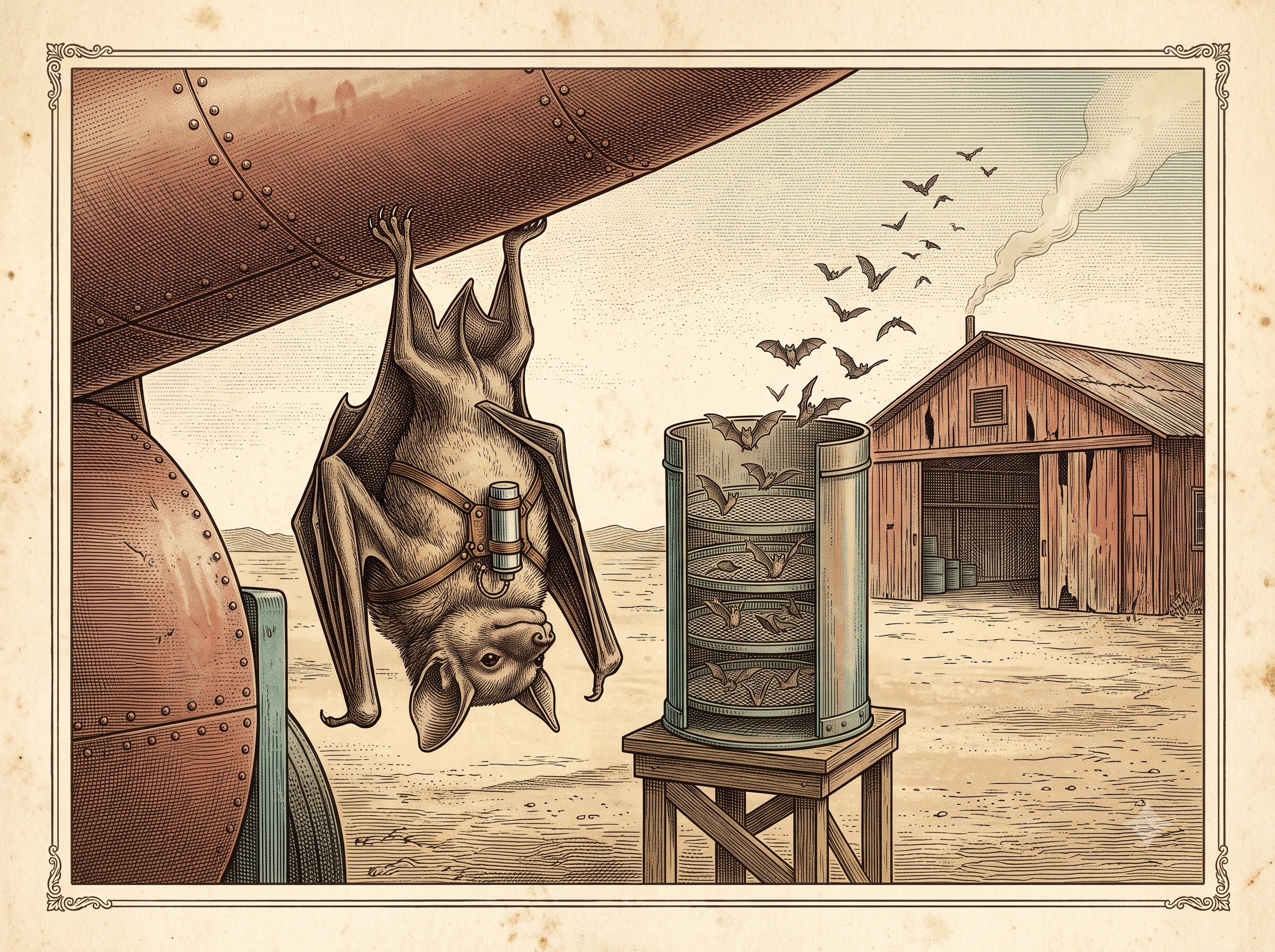
The engineering that followed was, by any measure, real engineering. Adams’ team — which at various points included a mammalogist, the Western film actor Tim Holt, and a young naturalist named Jack Couffer who later wrote the definitive account — settled on the Mexican free-tailed bat, a roughly 14-gram animal that could carry 15 to 18 grams of payload. Chemist Louis Fieser, who had just invented napalm, built a celluloid capsule two and a half inches long, filled it with napalm gel, and fitted it with a delay fuse. To make the bats manageable, the team chilled them into hibernation — sometimes, early on, in ice cube trays. The delivery device was a five-foot sheet-metal tube stacked with twenty-six circular trays holding 1,040 bats, designed to fall from a bomber, deploy a parachute, and split open at altitude.
Then came the field tests. On 15 May 1943, armed bats got loose on the ground. Accounts differ on the setting — most place it at the Carlsbad Army Airfield Auxiliary Air Base in New Mexico, while the 1982 American Heritage account describes the accident at the California test site, and the U.S. Army’s own retelling says the loose bats were part of a display being filmed for a training reel. Every version agrees on the ending. The bats roosted. The timers ran out. Hangars and outbuildings burned, and so did the general’s automobile.
The Army lost its enthusiasm. The Navy picked the project up in August 1943 and renamed it Project X-Ray; the Marine Corps took it that December, and Adams was squeezed out of the program he’d invented after colleagues concluded he couldn’t manage it.
Under new management, it worked. At Dugway Proving Ground in Utah, where the Chemical Warfare Service had built a mock Japanese residential block for incendiary testing, the bats performed. “It was concluded that X-Ray is an effective weapon,” an NDRC observer wrote. Chemists calculated that a planeload of bat bombs would start between 3,625 and 4,748 fires, against 167 to 400 for a planeload of conventional incendiaries.
Production of a million units was scheduled for May 1944. It never began. Fleet Admiral Ernest King cancelled the program on learning it likely wouldn’t be combat-ready until mid-1945. Roughly