Impossible Inventions · Biology
The Bomb Detector That Worked by Watching Bees Stick Out Their Tongues
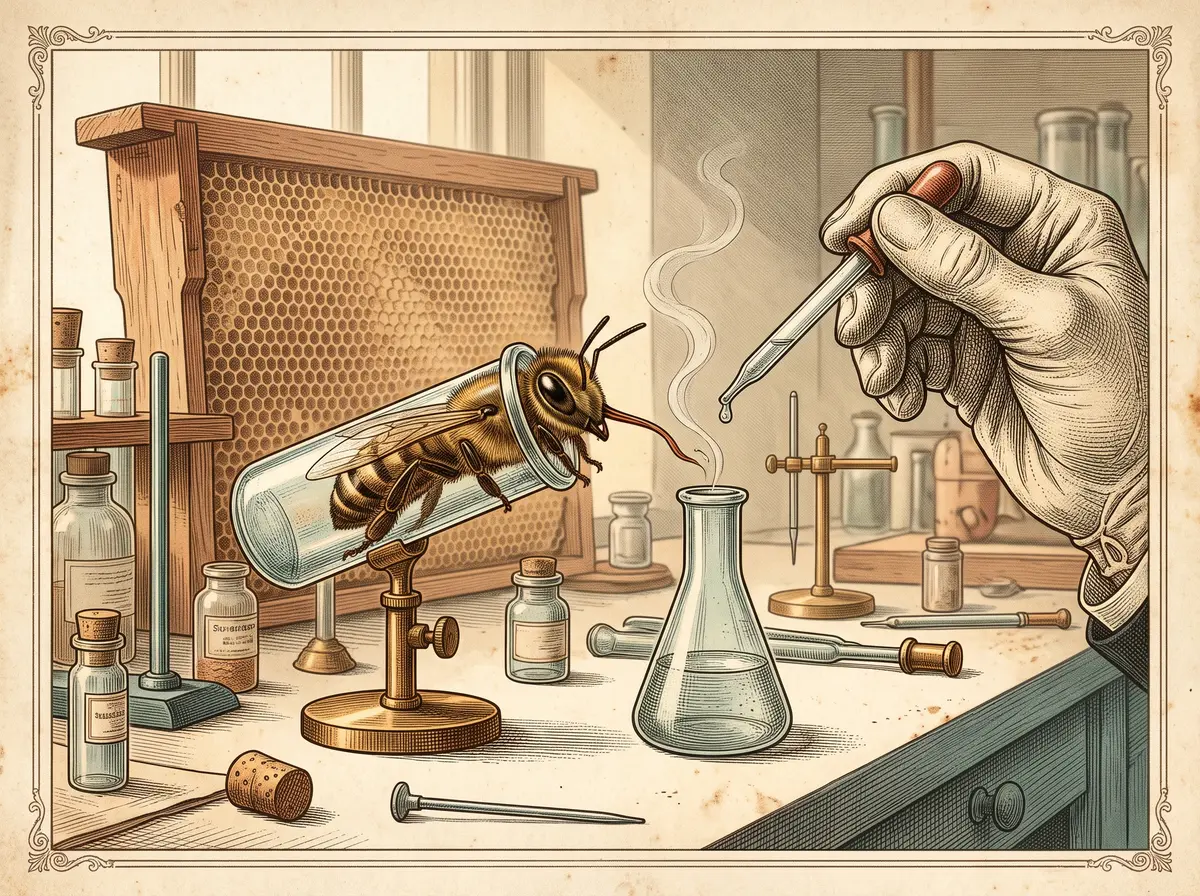
In 2006, at the laboratory that built the first atomic bomb, a honeybee sat snugly in a small tube with only its head poking out. A researcher wafted a faint trace of explosive vapor past its antennae. The bee did what it had been trained to do: it unrolled its tongue. That tiny flick, a bee hoping for a sip of sugar water, was the entire alarm system of a bomb detector.
By the Curiosities Desk · · 5 min read · Filed under Biology · Today’s round
Part of The Animals Hired for a Job
What happened: The Bomb Detector That Worked by Watching Bees Stick Out Their Tongues
In November 2006, Los Alamos National Laboratory in New Mexico announced results from something called the Stealthy Insect Sensor Project. Funded by the Defense Advanced Research Projects Agency (DARPA), the Pentagon’s research arm, and led by principal investigator Tim Haarmann with colleagues Kirsten McCabe and Robert Wingo, the project set out to turn the ordinary honeybee into a sensor for explosives, especially the improvised explosive devices, or IEDs, that had become a major threat to troops in Iraq.
The trick relied on a reflex every beekeeper knows. When a hungry bee’s antennae touch something sweet, it automatically sticks out its proboscis, the straw-like mouthpart it uses to drink nectar. Scientists call this the proboscis extension reflex. Since the early 1960s, when Japanese researcher Kimihisa Takeda introduced the method, biologists have used it to study how insects learn: pair a smell with a reward, and the bee soon sticks out its tongue for the smell alone.
That is Pavlovian conditioning, the same kind of learning that famously made Ivan Pavlov’s dogs drool at a signal that meant food was coming. The Los Alamos team simply swapped the flower scent for explosives. Each bee was placed in a holder that kept its body still but left its head and mouthparts free. The researchers puffed the vapor of a target chemical at it, then touched its antennae with sugar water. After a few rounds, the bee started extending its proboscis as soon as the scent arrived, before any sugar appeared.
It worked on a long list of targets. The bees learned to respond to TNT, the plastic explosive C-4, propellants, and TATP, a homemade explosive. According to MIT Technology Review, the team could train 50 bees in two to three hours. The bees still picked out the target when it was mixed with lotion, deodorant, tobacco, or motor oil, the kinds of everyday smells a smuggler might use as cover. Wingo said the bees could detect TATP at levels the instruments in his lab could not.
The plan was a hand-held box, roughly the size of a shoebox, holding a row of trained bees. A guard at a checkpoint, or a robot rolling up to a suspicious car, would draw air across them. If the bees stuck out their tongues, something nearby smelled like a bomb. Haarmann told Technology Review that after field trials, a working detector might be about a year away.
The bees were not the only ones put to work. Wingo, a chemist who had never worked with bees before, estimated he was stung “hundreds” of times over the 18 months of research.
Why it was strange: The Bomb Detector That Worked by Watching Bees Stick Out Their Tongues
Bomb detection usually means expensive machines or dogs that take months of training. Here, a weapons laboratory was pinning its hopes on an insect that weighs about a tenth of a gram and learns its job in an afternoon.
The “readout” was strange too. There was no beep or flashing light at first, just a twitch of a mouthpart smaller than an eyelash. The whole invention depended on a bee’s hope of dessert.
The limits were very much biological. Confinement is hard on a bee. Haarmann noted that the strapped-in insects died at a high rate after about 48 hours, so a detector would need a constant supply of freshly trained bees. Some bees also learned better than others, which is a problem when the sensor is alive. Haarmann, a beekeeper himself, admitted that losing them bothered him.
Bees were not the first animals the military tried to recruit: The Bomb Three Pigeons Were Trained to Steer is another chapter of The Animals Hired for a Job.
What scientists learned: The Bomb Detector That Worked by Watching Bees Stick Out Their Tongues
The project confirmed what bee researchers had suspected for decades: a honeybee’s sense of smell is remarkably sharp. “Scientists have long marveled at the honey bee’s phenomenal sense of smell, which rivals that of dogs,” Haarmann said in the lab’s announcement. Bees do their smelling with their antennae, which catch odor molecules drifting past.
The Los Alamos team also used the project to study why some bees are better sniffers than others, comparing proteins and genetic traits of good and poor learners, and to look at the structures inside the antenna that make detection possible.
Other researchers tried a different approach. Entomologist Jerry Bromenshenk of the University of Montana let bees fly free. Working with Sandia National Laboratories in the late 1990s, his team trained whole colonies to forage wherever they smelled explosives, then tracked where the bees lingered to map buried landmines. “Bees are like flying dust mops,” Bromenshenk said. He later admitted that free-flying bees “don’t work well in airports,” which is where the strapped-in version came in.
How it reaches us today: The Bomb Detector That Worked by Watching Bees Stick Out Their Tongues
The bee bomb detector never became standard equipment. Dogs and machines still do almost all of the world’s explosives screening. Keeping live sensors fed, healthy, and freshly trained turned out to be the hard part.
The idea did not disappear, though. A British company called Inscentinel built a hand-held device named the Vasor136 that used the same tongue-flick response, read automatically by an infrared sensor. The company said an automatic trainer could prepare 500 bees in five hours, and pitched the device for screening cargo.
The bigger legacy is in the lab. The proboscis extension reflex remains one of the main tools biologists use to study learning and memory in a brain far smaller than a grain of rice. And engineers designing artificial “noses” still look to insect antennae as a model.
Another unlikely creature that ended up in a medical lab: The Pigeons Trained to Spot Breast Cancer — and the Flock That Got It Right 99% of the Time.
Fun fact: The Bomb Detector That Worked by Watching Bees Stick Out Their Tongues
The chemist who helped train the bomb-sniffing bees had never worked with bees before the project began, and by his own estimate he was stung hundreds of times along the way.
Sources: The Bomb Detector That Worked by Watching Bees Stick Out Their Tongues
- Los Alamos National Laboratory, “Bees Trained to Detect Explosives” (via ScienceDaily, November 29, 2006): https://www.sciencedaily.com/releases/2006/11/061128140820.htm
- Stephen Ornes, “Using Bees to Detect Bombs,” MIT Technology Review, December 7, 2006: https://www.technologyreview.com/2006/12/07/227361/using-bees-to-detect-bombs/
- Associated Press, “Scientists train bees to sniff out bombs,” NBC News, November 2006: https://www.nbcnews.com/id/wbna15938954
- Sandia National Laboratories, “Sandia, University of Montana researchers try training bees to find buried landmines,” April 27, 1999: https://newsreleases.sandia.gov/sandia-university-of-montana-researchers-try-training-bees-to-find-buried-landmines/
- Giurfa, M. & Sandoz, J.-C., “Invertebrate learning and memory: Fifty years of olfactory conditioning of the proboscis extension response in honeybees,” Learning & Memory 19 (2012): https://doi.org/10.1101/lm.024711.111