The Snail Hired to Eat Another Snail — That Ate the Wrong Ones Instead
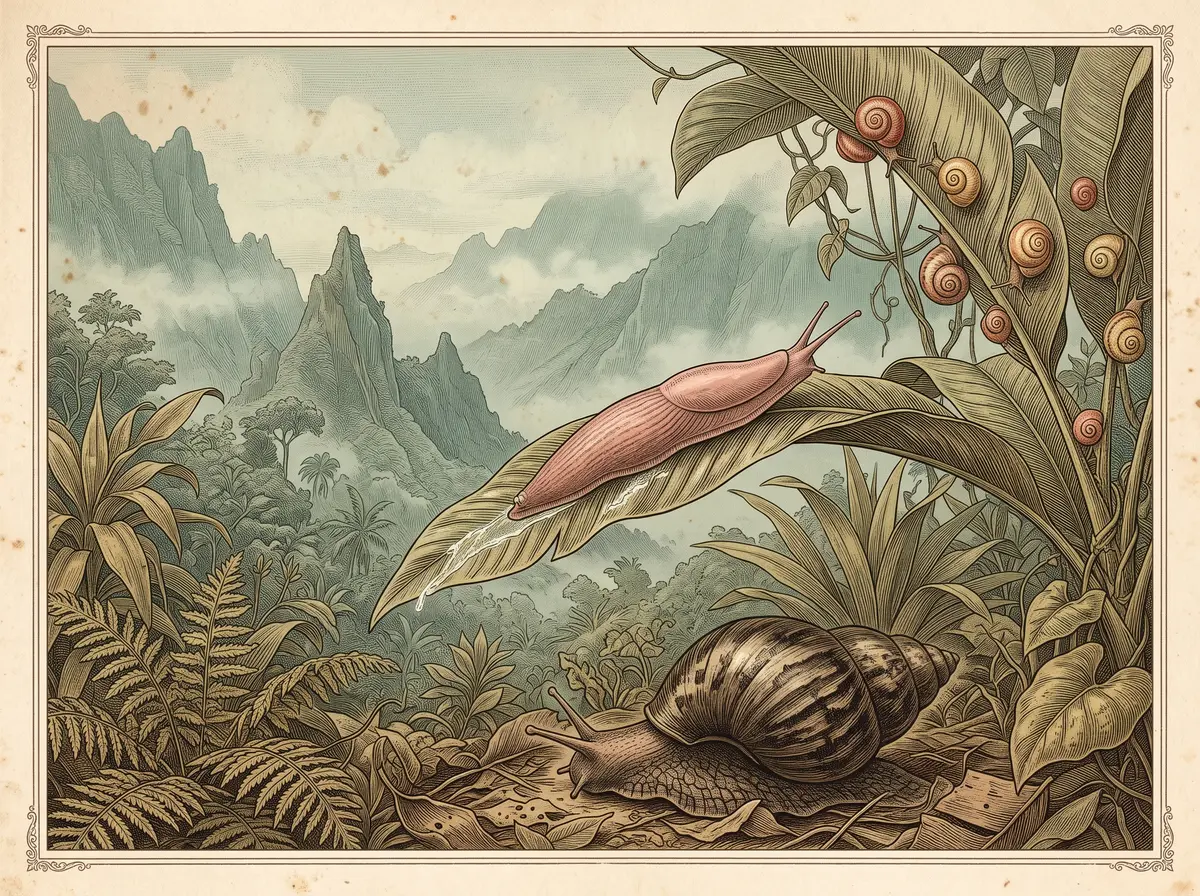
In 1977, a pinkish, torpedo-shaped snail from the southeastern United States was released on the island of Moorea, in French Polynesia, with a simple job: eat the giant African snails chewing through local crops. The rosy wolf snail is a hunter. It finds dinner by following other snails' slime trails. It just didn't follow the slime trails anyone expected. Within a decade, the tree snails that biologists had spent seventy years studying there were gone from the wild.
By the Curiosities Desk · · 5 min read · Filed under Biology · Today’s round
Part of The Animals Hired for a Job
What happened: The Rosy Wolf Snail
The trouble started in 1967, when the giant African land snail (Achatina fulica, now usually called Lissachatina fulica) was brought to Tahiti as food. It escaped, spread to neighboring islands, and became a serious agricultural pest. It is a big animal, with a shell that can grow longer than a person’s palm, and it eats a wide range of plants.
Agricultural officials across the tropics already had a candidate solution. The rosy wolf snail (Euglandina rosea) is a carnivore native to Florida and the southeastern United States. It eats other snails, sometimes whole, sometimes by reaching into the shell. In 1955, Hawaiʻi had released several hundred on Oʻahu. Within three years, about 12,000 had been collected and shipped to other islands. Over the next four decades, the wolf snail was moved to at least 27 island groups and countries.
French Polynesia joined in. The wolf snail was released on Tahiti in 1974 and on Moorea in 1977. That put it next door to one of the most famous snails in biology.
Partula tree snails are small, about 1 to 2 centimeters long. They live on leaves in the damp valleys of the Society Islands. They come in swirls of cream, brown, yellow, and purple, and different valleys often hold different species and color forms. From 1906 onward, the American biologist Henry Crampton walked valley after valley collecting them, building a record that would fill several monographs over the following decades. Later researchers, including Bryan Clarke and James Murray, used Moorea’s Partula to study how new species arise. These snails were, in effect, a natural laboratory for evolution.
The rosy wolf snail found them. It moved through Moorea’s valleys like a slow front line. The last wild Moorean Partula were seen in Haapiti Valley in November 1986. In June and July of 1987, a team led by Murray searched 16 valleys and found no live Partula at all. Their 1988 paper in Pacific Science listed seven Moorean species as extinct in the wild. One of them, Partula exigua, survived nowhere, not even in a lab.
Tahiti and the other islands followed. Of the 61 known tree snail species in the Society Islands, more than 50 were wiped out. Meanwhile, a large 2021 review in Biological Invasions found no evidence that the wolf snail ever achieved real, lasting control of the giant African snail anywhere it was released.
Why it was strange: The Rosy Wolf Snail
The plan made a kind of sense on paper: a snail problem, solved by a snail that eats snails. But “eats snails” turned out to be exactly the problem. Nobody had shown that the wolf snail preferred giant African snails over smaller, easier prey. It turned out to prefer the smaller ones. A tiny tree snail with no history of facing such a predator was a much simpler meal than a giant with a thick shell.
Islands made it worse. Partula had evolved without anything like a slime-trail-following hunter. They also reproduce slowly, giving birth to live young one at a time. They had no defenses and no way to outbreed the losses.
There’s an irony, too. The animals erased were among the best-documented snails on Earth. Scientists had decades of records about where every color form lived, and then they got to watch, with that same precision, as the forms disappeared.
It shares a shelf with The Mongooses Hired to Hunt Rats — Who Worked the Day Shift, in The Animals Hired for a Job.
What scientists learned: The Rosy Wolf Snail
The wolf snail became a standard warning about biological control, or biocontrol: using a pest’s natural enemy to keep it in check. Done properly, biocontrol starts with host-specificity testing. That means proving, before release, that the new predator or parasite will attack only the target pest. The wolf snail introductions skipped that step. One researcher who surveyed the survivors on Tahiti called the episode “a salutary lesson in hasty biological control.”
The rescue also taught something. As Partula vanished, Clarke, Murray, and colleagues brought the last individuals into labs. In the early 1990s, London Zoo and Edinburgh Zoo started an international breeding programme. It now spans more than a dozen zoos.
A few wild species held on, and in 2021 scientists figured out how one of them did it. A team from the University of Michigan glued sensors measuring 2 by 5 by 2 millimeters to snails on Tahiti. The sensors showed that the surviving Partula hyalina lives on sunny forest edges that get about 10 times more light at noon than the shady places where wolf snails hunt. The researchers suspect the predator can’t risk the heat out there. P. hyalina’s white shell may reflect the light that keeps the wolf snail away.
The same thread continues in The Toad Australia Released to Fight a Pest — and Turned Into a Bigger One.
How it reaches us today: The Rosy Wolf Snail
The zoo-bred snails are going home. Over nearly ten years, more than 30,000 have been released back into French Polynesia, including over 6,000 in 2024 alone. That year, conservationists found unmarked adult Partula tohiveana on Moorea, which meant they had been born in the wild. It was the first time in about 40 years. The species is being moved off the “Extinct in the Wild” list to “Critically Endangered.”
The wolf snail hasn’t gone anywhere, though. It’s still on the islands, and releases depend on keeping it out of the protected patches. Today’s biocontrol programs worldwide now demand the careful testing that was skipped in the 1950s through the 1970s.
Also in The Animals Hired for a Job: The 23 Cats the RAF Parachuted Into Borneo to Fight a Rat Plague.
Fun fact: The Rosy Wolf Snail
Before each release, zoo staff paint a tiny dot of UV-reflective paint on every snail’s shell. It glows under an ultraviolet flashlight, so researchers can find the nocturnal snails in the dark forest at night. Any adult without a glowing dot was born in the wild.
Sources: The Rosy Wolf Snail
- Murray, J., Murray, E., Johnson, M. S., & Clarke, B. (1988). “The Extinction of Partula on Moorea.” Pacific Science, 42(3–4), 150–153. https://scholarspace.manoa.hawaii.edu/items/c30d7c26-088b-4a67-be11-78a852724ea0/full
- Coote, T. (2007). “Partulids on Tahiti: Differential persistence of a minority of endemic taxa among relict populations.” American Malacological Bulletin, 22, 83–87. https://archive.org/details/biostor-143339
- Gerlach, J., et al. (2021). “Negative impacts of invasive predators used as biological control agents against the pest snail Lissachatina fulica: the snail Euglandina ‘rosea’ and the flatworm Platydemus manokwari.” Biological Invasions. https://doi.org/10.1007/s10530-020-02436-w
- University of Michigan News (2021). “Snails carrying the world’s smallest computer help solve mass extinction survivor mystery.” https://news.umich.edu/?p=71657
- ZSL London Zoo (2024). “Over 6,000 ‘extinct’ snails return to the wild as re-established wild species now confirmed.” https://londonzoo.org/zoo-stories/news/over-6000-extinct-snails-return-wild-re-established-wild-species-now-confirmed
Related stories: The Rosy Wolf Snail
- Part of The Animals Hired for a Job