The Rat-Tail Bounty That Turned Hanoi Into a Rat Farm
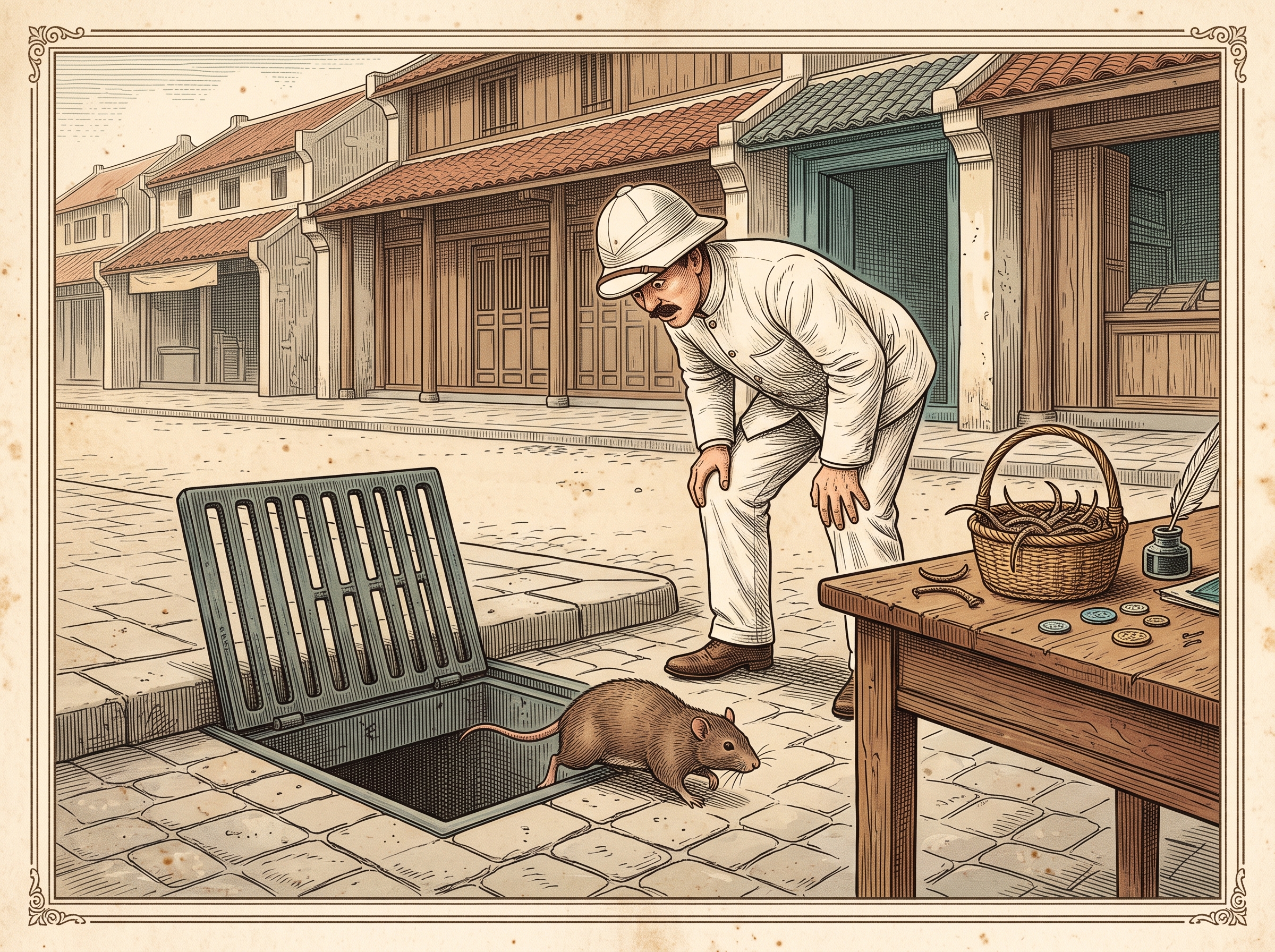
In July 1902, a French official in Hanoi reported seeing something that should not have existed: a perfectly healthy rat scampering around with no tail. The city was paying a bounty for every rat tail handed in, and tails had been pouring in by the thousands. The rats they came from, it turned out, were still alive — and still breeding.
By the Curiosities Desk · · 5 read · Filed under Medicine · Today’s round
Part of The Animals Hired for a Job
What happened?
In 1897 Paul Doumer arrived in Hanoi as Governor-General of French Indochina, the colonial federation that included what is now Vietnam. He set about rebuilding the city as a showcase of French modernity: wide tree-lined avenues, grand administrative buildings, and villas for the colonists — with running water and flush toilets. Beneath the French Quarter, the colonial government laid roughly nine miles of modern sewer pipe.
The infrastructure was not shared equally. Historian Michael G. Vann, who has spent more than two decades on this story, describes a “dual city”: roughly 90 percent of Hanoi’s population was packed into the Old Quarter, where most Vietnamese and Chinese residents fetched water from public fountains and relied on night-soil collectors rather than proper sewers.
The new pipes also turned out to be excellent rat habitat — cool, dark, protected from predators, and connected directly to the kitchens and bathrooms of the city’s wealthiest homes. Brown rats, which Vann believes arrived on ships and trains from China, moved in and multiplied. There were reports of rats climbing up outflow pipes and emerging from French toilets.
That was unpleasant. What made it alarming was the plague. A bubonic plague pandemic that began in Yunnan, China, had reached Hong Kong in 1894 and spread along shipping routes around the world. And in 1898, the French researcher Paul-Louis Simond had shown that rat fleas carried the plague bacterium from rats to people. A city full of rats was now, in the eyes of its public health officials, a city full of loaded weapons.
So in the spring of 1902 the authorities declared war. They hired Vietnamese workers to go down into the sewers and kill rats, paid per animal. The archival tallies, which Vann found almost by accident in a French colonial archive in Aix-en-Provence, climb fast: 7,985 rats in the last week of April; 15,041 on May 30 alone; and on June 21, a peak of 20,112 in a single day. How exactly the rats were killed isn’t recorded.
The work was miserable and dangerous — crawling through waste in cramped tunnels after animals that might carry plague fleas — and the sewer crews soon balked. The rats kept coming.
So officials tried Plan B: let anyone join the hunt. The city offered a bounty of one cent per rat. To spare the municipal offices from drowning in carcasses, you didn’t need to bring in the whole rat. Just the tail.
For a while, it looked like a triumph. Tails flooded in. Then came the tailless rats. Some hunters had worked out that a rat with its tail snipped off and released would keep breeding — and every baby rat came with a fresh, bounty-eligible tail. Investigators also turned up a region-wide network smuggling rats into the city from the surrounding countryside of Tonkin — and farms raising rats for their tails.
The bounty was scrapped. The rats stayed.
Why was it strange?
Because everyone involved behaved rationally — just not in the direction the policy intended.
The French wanted fewer rats. But what they actually paid for was tails, and a tail is only a stand-in for a dead rat. The moment the measurement and the goal came apart, people followed the money. From the perspective of a poor Hanoi resident, a rat that could produce more tails was worth more alive than dead.
There’s another layer of strangeness. The same modern engineering meant to make Hanoi cleaner and safer — the sewers — created the rat problem in the first place. The cure built the disease a highway.
Vann is careful about what the story does not mean. It’s often told as a fable about clever locals outwitting clumsy officials, or as an argument against any government action at all. He sees it instead as a warning about programs designed “where the arrogance is so strong and the power differential is so intense that evidence can be ignored.”
It shares a shelf with The Mongooses Hired to Hunt Rats — Who Worked the Day Shift, in The Animals Hired for a Job.
What did scientists learn?
The biology was right. Simond’s rat-flea discovery was real, and rats in Hanoi did carry plague. Plague struck the city in the years that followed, including a serious outbreak around 1906; French officials recorded at least 263 deaths, most of them Vietnamese. What ultimately worked, according to Vann, were intense and often invasive measures once cases appeared: isolating the sick, seizing bodies, and burning belongings and sometimes homes. They helped contain the disease — and deeply angered the people they were imposed on.
The bigger lesson was about incentives. Economists now call this pattern a perverse incentive: a reward that ends up encouraging the very thing it was meant to stop. It’s closely related to Goodhart’s law, often paraphrased as “when a measure becomes a target, it ceases to be a good measure.”
Also in The Animals Hired for a Job: The Toad Australia Released to Fight a Pest — and Turned Into a Bigger One.
How does it affect us today?
The Hanoi rat hunt is now a standard teaching example of the “cobra effect” — named for a possibly apocryphal story about a cobra bounty in colonial Delhi that supposedly led people to breed cobras. Unlike that tale, the Hanoi episode is backed by archival paperwork, which is why it turns up in economics lectures, business books, and a 2012 Freakonomics episode that brought Vann’s research to a wide audience.
Public health programs still wrestle with the same design problem: paying for a proxy — tests run, forms filed, tails collected — instead of the outcome you care about. Vann’s book The Great Hanoi Rat Hunt, a graphic history drawn by Liz Clarke for Oxford University Press, also uses the episode to show how disease campaigns can be bent by racism and unequal power.
Another from The Animals Hired for a Job: The Bomb Full of Sleeping Bats That Burned Down Its Own Air Base.
Fun fact
In 1997, while doing research in a Hanoi archive, Vann reached into a card-catalogue drawer of pre-1954 French colonial files — and felt a rat scurry across his hand.
Plague still exists in a few parts of the world, including the western United States, but it is rare and treatable with antibiotics when caught early. If you develop a sudden fever after contact with rodents or their fleas, see a doctor promptly.
Sources
- Michael G. Vann, “Of Rats, Rice, and Race: The Great Hanoi Rat Massacre, an Episode in French Colonial History,” French Colonial History 4 (2003): 191–203.
- Ivan Franceschini and Michael G. Vann, “The Great Hanoi Rat Hunt: A Conversation with Michael G. Vann,” Made in China Journal, 2020.
- Michael G. Vann, “Confessions of a Rogue Historian: Why I Wrote a Graphic History of Colonial Hanoi,” H-France.
- Shay Maunz, “The Great Hanoi Rat Massacre of 1902 Did Not Go as Planned,” Atlas Obscura, 2017.
- Centers for Disease Control and Prevention, “Plague” (current facts on transmission and treatment).
Related stories
- Part of The Animals Hired for a Job