The Toad Australia Released to Fight a Pest — and Turned Into a Bigger One
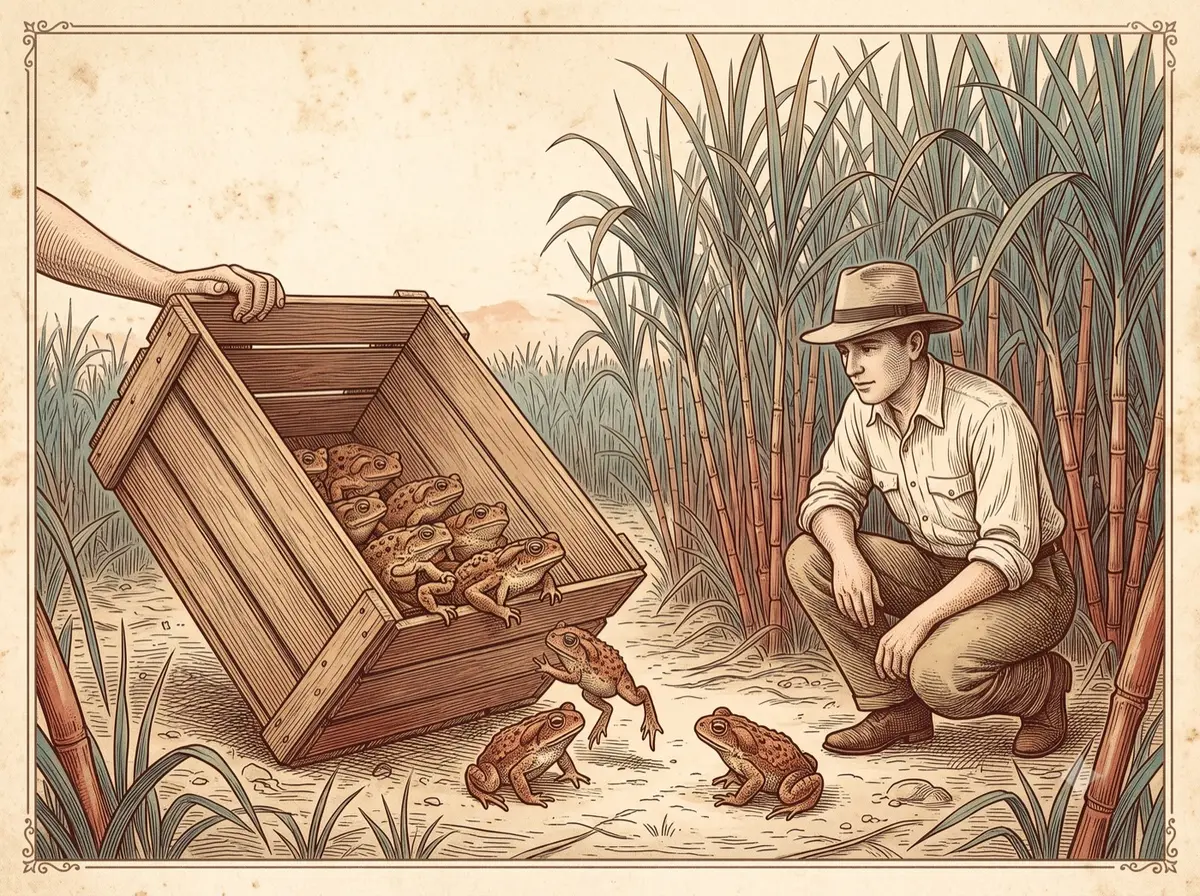
In August 1935, a crate of toads sat in a purpose-built enclosure near Cairns, Australia, freshly bred from a handful captured in Hawaii. Nobody had tested whether the toads would actually eat the beetle they were being released to kill. Nobody had studied what else they might eat, or what might try to eat them, or what would happen once 2,400 of them were let loose into the Queensland bush. Ninety years later, their descendants number in the tens of millions and cover more than a million square kilometers of the continent.
By the Curiosities Desk · · 5 min read · Filed under Biology · Today’s round
Part of The Animals Hired for a Job
What happened: The Toad Australia Released to Fight a Pest — and Turned Into a Bigger One
The trouble started with a beetle. From the 1880s on, sugar cane growers in Queensland were losing crops to the larvae of native scarab beetles — commonly called cane beetles — which fed on the roots of the cane underground. Growers lobbied for help, and in 1900 the government set up the Bureau of Sugar Experiment Stations, staffing it with entomologists who spent decades testing chemical treatments against the beetles with limited success.
In 1932, Bureau plant pathologist Arthur Bell attended a conference in Puerto Rico, where he learned that the cane toad (Bufo marinus, now more often classified as Rhinella marina) had reportedly helped control beetle populations threatening sugar crops there. The toad is a large, warty, and extremely adaptable amphibian native to Central and South America, one that had already been carried to Puerto Rico and then Hawaii for the same purpose. In June 1935, Bureau entomologist Reginald Mungomery traveled to Hawaii, collected a breeding sample, and brought them back to a specially prepared enclosure in Gordonvale, near Cairns. By August, the toads had bred successfully in captivity, and 2,400 of them were released into the surrounding cane fields.
The plan had a basic flaw that nobody had checked for: cane beetle grubs live underground and the adult beetles that do venture into the open mostly cluster high on the cane stalks, well above where a toad — a squat, ground-bound animal — can reach. No one at the Bureau had confirmed the toads would even eat cane beetles in the wild, let alone studied what else was in their diet or what would happen to the ecosystem they were entering.
Not everyone was on board. Walter Froggatt, a prominent entomologist, warned in 1936 that the toad was “immune from enemies, omnivorous in its habits, and breeding all the year round,” and predicted it “may become as great a pest as the rabbit or cactus” — both of which were already infamous Australian invasive-species disasters. Froggatt persuaded the federal Health Department to ban further releases. The ban didn’t last: later that year, under pressure from the Queensland government, cane growers, and the press, Prime Minister Joseph Lyons rescinded it, and the toads kept spreading.
Why it was strange: The Toad Australia Released to Fight a Pest — and Turned Into a Bigger One
The toad went on to do essentially nothing about the beetles it was imported to control — cane beetle populations are managed today with pesticides, the same tool the toad was supposed to replace. But it thrived anyway. Female cane toads can lay 8,000 to 30,000 eggs at a time, several times a year, and adults can live over a decade with almost nothing in Australia equipped to stop them. A species brought in to solve one problem solved nothing and created an entirely different one, on a much larger scale, and the country’s own leading expert had named the exact failure mode a year before the toads were even freed from Froggatt’s temporary ban.
It shares a shelf with The Mongooses Hired to Hunt Rats — Who Worked the Day Shift, in The Animals Hired for a Job.
What scientists learned: The Toad Australia Released to Fight a Pest — and Turned Into a Bigger One
The toad’s real weapon turned out to be chemical, not competitive. Glands behind its eyes secrete a milky toxin containing compounds called bufadienolides, which disrupt the sodium-potassium pump animal cells use to regulate electrical signaling — the same broad class of toxin found in some heart medications, at a dose no animal’s heart can handle. Australian predators like quolls, goannas, and snakes had no evolutionary history with toxic toads and no instinct to avoid them; many died within minutes of biting one. The northern quoll, a cat-sized marsupial predator, has been pushed toward extinction across large parts of its range largely because of toad poisoning, and is now listed as endangered.
The invasion also turned into an unplanned experiment in rapid evolution. Researchers studying the toads’ leading edge found that toads there had evolved longer legs and traveled farther per season than toads in longer-established populations, a phenomenon called “spatial sorting.” Some native predators are adapting too: certain quoll and snake populations show growing tolerance to the toxin, or have simply learned to leave toads alone — a live case study in how an ecosystem adjusts, slowly and unevenly, to a new threat.
Also in The Animals Hired for a Job: The Rat-Tail Bounty That Turned Hanoi Into a Rat Farm.
How it reaches us today: The Toad Australia Released to Fight a Pest — and Turned Into a Bigger One
Cane toads have now spread from Queensland through coastal New South Wales and across the Northern Territory and into Western Australia’s Kimberley region, advancing an estimated 40 to 60 kilometers a year at the invasion front. In 2010, the Australian government concluded there was “unlikely to ever be a broadscale method available to control cane toads across Australia.” Current efforts focus on protecting the most vulnerable native species directly, including trials that condition quolls to associate cane toads with nausea rather than food, and genetic approaches such as a 2025 CSIRO-linked project engineering toads that never mature into breeding adults and instead prey on their own tadpoles, aiming to suppress local populations without another blanket release.
The episode is now a standard case study in conservation biology classes on the dangers of introducing a species for biological control without first testing what it will actually do to the ecosystem it’s entering — a caution echoed decades later in debates over introducing other predators, pathogens, or genetically modified organisms to fight invasive pests.
Another from The Animals Hired for a Job: The Bomb Three Pigeons Were Trained to Steer.
Fun fact: The Toad Australia Released to Fight a Pest — and Turned Into a Bigger One
Not every native species is losing to the toad. Australian water rats have learned to flip cane toads onto their backs and eat them with surgical precision, carefully avoiding the poison glands behind the eyes and the liver, and leaving the toxic parts untouched — a workaround no one taught them and evolution alone provided.
Sources: The Toad Australia Released to Fight a Pest — and Turned Into a Bigger One
- Griggs, P. / National Museum of Australia, “Introduction of cane toads” (Defining Moments in Australian History), citing Walter Froggatt, “The introduction of the great Mexican toad Bufo marinus into Australia,” The Australian Naturalist, vol. 9, 1936 (primary source quote). https://www.nma.gov.au/defining-moments/resources/introduction-of-cane-toads
- “Cane toads in Australia.” Wikipedia, citing peer-reviewed ecological literature. https://en.wikipedia.org/wiki/Cane_toads_in_Australia
- Australian Government Department of Climate Change, Energy, the Environment and Water, “The cane toad (Bufo marinus) — fact sheet.” https://www.dcceew.gov.au/environment/invasive-species/publications/factsheet-cane-toad-bufo-marinus
- Phillips, B. L. et al., “Invasion and the evolution of speed in toads.” Nature 439, 803 (2006). https://www.nature.com/articles/439803a
- de Kruijff, R. “Gene-edited ‘Peter Pan’ cane toad that never grows up created to eat its siblings, control invasive species.” ABC News, 8 April 2025. https://www.abc.net.au/news/science/2025-04-08/cane-toad-created-that-never-grows-up-and-eats-its-siblings/105100286
Related stories: The Toad Australia Released to Fight a Pest — and Turned Into a Bigger One
- Part of The Animals Hired for a Job
- The Time Australia Sent Machine Guns After 20,000 Emus — Australia deployed machine guns against emus, and lost
- The 23 Cats the RAF Parachuted Into Borneo to Fight a Rat Plague — The RAF airdropped cats into Borneo after a pesticide backfired
- Biosphere 2: The Sealed World Where the Oxygen Mysteriously Vanished — A sealed glass world where the oxygen quietly disappeared